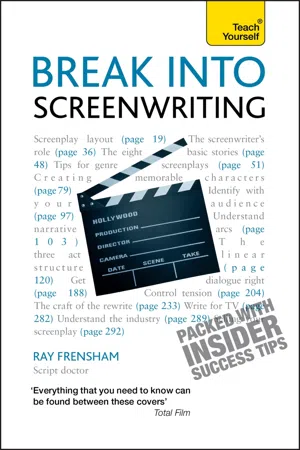
This is a comprehensive, jargon-free guide for all budding screenwriters. Its aim is not just to guide you through the techniques and skills you need to write for the screen (film and television), but also to give you guidance on how to approach the industry as a whole. Focusing on every aspect of screenwriting, from how to set about the writing process to how to develop your characters, plot and structure, this book will give you all the guidance you need to break into this highly competitive industry and make a career for yourself as a screenwriter.
eBook - ePub
Break Into Screenwriting
Your complete guide to writing for stage, screen or radio
- 368 pages
- English
- ePUB (mobile friendly)
- Available on iOS & Android
eBook - ePub
Break Into Screenwriting
Your complete guide to writing for stage, screen or radio
About this book
Information
1

Introduction
In this chapter you will learn:
- what makes writing for the screen unique from other writing forms
- the different types of screenplays that exist
- how to get some discipline into your writing day
- about the gatekeeper you have to impress to get your talents and script through to the right people – the Script Reader.

To make a great movie, you need just three things: a great script, a great script, and a great script.
Alfred Hitchcock, Director
The quality of a movie is, nine times out of ten, due to the quality of the script.
David Puttnam, Producer: Bugsy Malone, Chariots Of Fire, Local Hero, The Killing Fields, etc.

Why read this book?
This book is written for the starting-out Screenwriter. The aim is not just to guide you through the intricacies and craft of writing for the screen (film, television and DVD), but also to give you guidance on how to approach the industry. Of all the different forms of writing, screenwriting is where creativity interfaces with business the most and you need to feel comfortable and confident when dealing with both. The media like to create a mystique about themselves and their working methods; I prefer to demystify the process.
You may already have a story you want to tell but don’t know how to structure it into a screenplay. Or you may only have the enthusiasm to write, but little idea what to say. However, before you write scene one, there is still a tremendous amount of work to be done.
This book covers the techniques and specialist skills used in writing for the visual medium. It covers the practical questions I and many members of The Screenwriters’ Workshop have been asked over and over again through the years: How do you get your ideas? What questions should I ask about my script or characters? How do I get an agent? How can I protect my copyright? As well as many more.
Many books on screenwriting approach the subject by laying down rigid rules that must be followed, particularly in regard to screenplay structure. This one is different. Here, when any guidelines are set out, I am not declaring “This is the way it must be done.” What I am saying is twofold:
- As a starting-out writer submitting your work to a Producer, Director or Commissioning Editor (i.e. those with the power to make decisions), your script will not be read by them. It will go to one of their Readers for assessment. It is their job, at the lower end of the production hierarchy, to sort through the ‘slush pile’ of unsolicited manuscripts (those not submitted by an agent). These professional Readers are the people you and your script have to get past and impress. And any ‘rules’ this book outlines are the sort of points Readers have been taught and trained to look for in script submissions. And…
- You, the writer, need to know the rules of the game before you can begin to bend and stretch them to your own design.
Writing a script is so much like writing a sonnet: you have very specific boundaries in which to shape a story.
Caroline Thompson, Screenwriter: Edward Scissorhands, The Night Before Christmas, The Secret Garden
Basically, 90 per cent of all scripts submitted are rubbish (for reasons you will discover in this book) and rejected outright. Approximately 10 per cent are worth reading to the end. Of those, perhaps 2 per cent are worth following up and calling the writer in for ‘a chat’, and only 1 per cent are worth further serious consideration. (In Hollywood they claim it’s one script in every 100–130, but it’s nearer one in 200, and rising.) Your script needs to get into that top 2 per cent. This book will help you get there.
It is a distillation of accumulated knowledge and experience gained in the Workshop since it began in 1983, and from my own experiences in the industry as writer, Script Reader, teacher, Script Doctor, film finance broker and Producer, and as chairman of the London Screenwriters’ Workshop. Most of what I teach is based on good films or television I’ve seen and bad scripts I’ve read. You will find this book regularly illustrated with comments and experiences from writers who have made it or are now breaking through into the world of film and television.
Insight
“I am going to destroy your appreciation of movies for life” – I have often started my courses with these words – and it’s true. Because I am going to show you how it’s done. I just urge you, by the end of it, to try to hold on to that childlike sense of wonder you had when you went to see a film for the first time, however tough that may be.
There has never been a greater time for the industry. Audiences for film and broadcast entertainment are growing, demanding more, new and different experiences. The development of digital technology has meant a potentially limitless expansion of television, cable and satellite channels with the consequent air-time that needs to be filled. There’s also the Internet and the computer games industry now, as well as super-compact video cameras, Web TV, various ‘on demand’ TV portals and a multitude of mobile/cellphone/iPhone/iPad technologies and applications. Indeed, there already exist screenwriting apps for your iPhone (see Chapter 22). The opportunities are there to be grasped.
Finally, this book also supplies checklists (many gained from industry sources) and regular exercises you can use to analyse and assess your own efforts – ‘interactive’ in the truest sense of the word. What it is not is a substitute for your actually writing something – that’s up to you.
Never cross the road without a good script.
Stephen Frears, Director: High Fidelity, The Grifters, Dangerous Liaisons, Dirty Pretty Things, My Beautiful Laundrette
Original vs. adapted
There are two types of screenplay: original and adapted.
An original screenplay is one written specifically for the screen and not based on any previously produced or published work (e.g. The Sopranos, Amélie, Monsters, Inc., The Sixth Sense, Up, Avatar, Ocean’s Eleven, Pleasantville, CSI, Mad Men, Anchorman, The Wire, Waking Ned, American Pie, Notting Hill, The Usual Suspects, L.A. Confidential, La Haine, American Beauty, Toy Story, Memento, Shakespeare In Love, Gosford Park).
An adapted screenplay is one based on source material. For example:
- a book: e.g. Angela’s Ashes, The Lord Of The Rings, Babe, The Social Network, The Wizard Of Oz, True Grit, The Bourne Ult...
Table of contents
- Cover
- Title
- Copyright
- Contents
- Acknowledgements
- Meet the Author
- In One Minute
- Foreword
- 1 Introduction
- 2 Screenplay Layout: Your Visual Language
- 3 Originating your Ideas
- 4 Developing your Ideas: From Idea to Framework
- 5 Creating your Characters
- 6 Character Goals, Growth, Motivation and Conflict
- 7 Structure
- 8 Structural Variations
- 9 ‘Deep Structure’
- 10 Enhancing Emotion
- 11 The Next Step
- 12 The Actual Writing
- 13 The Craft of The Rewrite
- 14 The ‘Finished’ item
- 15 Assembling Your Portfolio
- 16 Copyright
- 17 Agents - What They Do and How to Get One
- 18 Adaptations, Shorts, Soaps, Series, Sitcoms and Collaboration
- 19 The Industry: How It Works and Your Place In It
- 20 Your Career as A Writer
- 21 Final Comments
- 22 Screenwriting and The Internet
- 23 Taking It Further
- Answers
Trusted by 375,005 students
Access to over 1.5 million titles for a fair monthly price.
Study more efficiently using our study tools.
Frequently asked questions
Yes, you can cancel anytime from the Subscription tab in your account settings on the Perlego website. Your subscription will stay active until the end of your current billing period. Learn how to cancel your subscription
No, books cannot be downloaded as external files, such as PDFs, for use outside of Perlego. However, you can download books within the Perlego app for offline reading on mobile or tablet. Learn how to download books offline
Perlego offers two plans: Essential and Complete
- Essential is ideal for learners and professionals who enjoy exploring a wide range of subjects. Access the Essential Library with 800,000+ trusted titles and best-sellers across business, personal growth, and the humanities. Includes unlimited reading time and Standard Read Aloud voice.
- Complete: Perfect for advanced learners and researchers needing full, unrestricted access. Unlock 1.5M+ books across hundreds of subjects, including academic and specialized titles. The Complete Plan also includes advanced features like Premium Read Aloud and Research Assistant.
We are an online textbook subscription service, where you can get access to an entire online library for less than the price of a single book per month. With over 1.5 million books across 990+ topics, we’ve got you covered! Learn about our mission
Look out for the read-aloud symbol on your next book to see if you can listen to it. The read-aloud tool reads text aloud for you, highlighting the text as it is being read. You can pause it, speed it up and slow it down. Learn more about Read Aloud
Yes! You can use the Perlego app on both iOS and Android devices to read anytime, anywhere — even offline. Perfect for commutes or when you’re on the go.
Please note we cannot support devices running on iOS 13 and Android 7 or earlier. Learn more about using the app
Please note we cannot support devices running on iOS 13 and Android 7 or earlier. Learn more about using the app
Yes, you can access Break Into Screenwriting by Ray Frensham,Ray Frensham in PDF and/or ePUB format, as well as other popular books in Languages & Linguistics & Creative Writing. We have over 1.5 million books available in our catalogue for you to explore.