"Cognitive Behavioural Therapy is now hugely popular, and as a self-help technique that has helped millions of people in the UK alone, and as an NHS-funded treatment for illnesses like depression. Teach Yourself: Cognitive Behavioural Therapy was one of the first and most successful books on CBT. This new edition shows how CBT techniques, which focus on using altered patterns of thinking to achieve goals and overcome problems, can make a major difference to your mentality.
The first half of the book explains the background to CBT, what it is, and how to use it. The second half of the book gives examples of how you can use CBT to deal with specific issues, such as helping to overcome depression and anxiety, and boosting your mindfulness, resilience, assertiveness and self-esteem."
eBook - ePub
Cognitive Behavioural Therapy
CBT self-help techniques to improve your life
- 240 pages
- English
- ePUB (mobile friendly)
- Available on iOS & Android
eBook - ePub
About this book
Information
1
A general understanding of CBT

Before we start working on the particular skills and techniques of CBT, it would be helpful for you to have some idea of the concepts underlying the therapy and why it is currently regarded as the treatment of choice for achieving good mental health and well-being. You may think that CBT sounds a very simple and straightforward therapy – just ‘common sense’. Up to a point this is true, but the purpose of CBT is to discover why, if solutions seem clear and obvious, our emotional difficulties don’t go away. Why, despite all our best efforts, are we still stuck in the mud of depression, anxiety, stress and/or a variety of other frustrating ‘feel bad’ problems? This chapter will give you an answer.

1 What do the initials CBT stand for?
2 What three aspects of our personalities does it make links between?
3 Is the past or the present more important in CBT?
4 Can you think of any particular reason why CBT has become so popular now?
5 Can you think of any disadvantages to using CBT as a therapy?
Make a note to look for the answers to these questions as you read on. For this test, it really doesn’t matter if you don’t know any of the answers at the moment (although it’s a good start if you do), as you will find all the answers as you read through this chapter. So refer back to these questions when you’ve finished the chapter and ensure you have some responses. This will give you a good basic understanding of CBT before you move on to its practical skills.

The basic premise of CBT
Here’s a thought:
‘I’ve spent some hard-earned cash on this book but I’m really not sure that a book can help me with my problems.’
And what this thought might mean to you:
‘Like so many things, I will probably start off enthusiastically and then lose motivation.’
Which could make you feel:
Rather downhearted and depressed.
So what will you do?
‘Well, give it a go but if I don’t see quick results I’ll ditch it.’
And what might the outcome be?
‘Yet another book at the back of the bookshelf and the same old worries and problems whirling around in my head unresolved.’
This example demonstrates the premise of CBT – that what you think (and the personal meaning of those thoughts to you) will affect how you feel and what you do. I have made the first example a negative one since, if you are reading this book, you probably suffer from pessimistic thinking and are interested in learning how to do something about it.
Let’s start again but with a different way of thinking:
‘I’ve spent some hard-earned cash on this book but I’m really not sure that a book can help me with my problems.’
And what this thought might mean to you:
‘I haven’t spent a lot and, looking through it, it seems like easy reading with possibilities, so I’ll take the positive view that it will help me rather than dismiss it without giving it a shot.’
Which could make you feel:
At least a little energized and motivated.
So what will you do?
‘Rather than bite off more than I can chew and then give up on the book, I’ll try a “little and often”’ approach – just a few minutes a day or a chapter a week – and make sure I tackle the exercises rather than skipping over them.’
And what might the outcome be?
‘While that is an unknown quantity there is a good chance that I will pick up a few ideas for generating more positivity in my life and if I really enjoy the concepts I am practising, it could be quite life-changing.’
AN ALTERNATIVE VIEW
Well, that’s better! Nothing much has changed – the same book has been purchased for the same reasons – but the thinking and behaviour in the second example is more likely to give a positive, constructive outcome.
In essence, this is the basic premise of CBT:
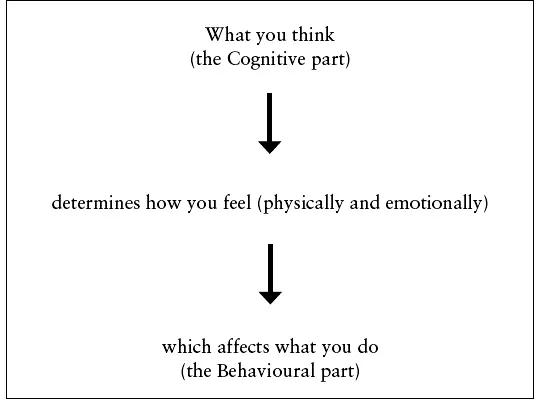
Cognitions are your thoughts and the emotional effects they have on you; so ‘cognitive’ describes something relating to ‘the mental action or process of acquiring knowledge and understanding through thought, experience, and the senses’.
The meaning of ‘behavioural’ is self-evident; ‘behaviour’ is the way in which an animal or person behaves in response to a particular situation or stimulus.
Let’s try something that will help to give you a better idea of the effect of cognitions.

Remember that you will need to have a notepad and pen, or your laptop, iPad or other electronic device, beside you when doing any exercises in this book. You won’t have the same depth of recall and understanding if you try to do the exercises in your head; there will be too many other things going on in your brain so these thoughts and ideas won’t stand out and ‘stick’.

Think of a situation recently where things didn’t go so well for you. Perhaps you made a mistake at work, had a disagreement with someone, burnt the dinner? Write down what you can recall of the thoughts you had about this at the time. These might have been along the lines of ‘I’m hopeless at my job’, ‘No one ever sees my side of things’ or ‘I can’t cook for toffee’.
How did these thoughts make you feel? Happy and confident or frustrated, upset or depressed? What about the physiology – did you feel energized by these thoughts or drained and lethargic?
And what did you do as a result? Write down your reactions to your thoughts about these events.
Now move on to thinking of a situation that was a happy one. Perhaps you achieved something you had been working towards, received an unexpected compliment or simply enjoyed a social event. Again, write down your thoughts about this situation as well as you can recall them. Perhaps you decided that you were quite smart to have achieved your goal, or a more amusing person than you had thought you were? Perhaps you simply thought how good life was generally when you were surrounded by friends?
How did these thoughts make you feel? Depressed and unhappy or elated and cheerful? Again, how did you feel physically – tired or energized? Write down any resulting behaviour(s) you can recall.
What connection can you make here between thoughts, feelings and actions?
Understanding the connections
When you take a close look at your thinking it becomes easier to see that if your thoughts are negative, how you feel will also be negative. You might also notice unpleasant physical symptoms (shortness of breath or panicky feelings or tiredness) and you may have reacted negatively as well.
However, if you had positive, upbeat thoughts about an event, it would be almost impossible to imagine that you felt anything other than cheerful, happy and physically energized, and exhibited positive behaviours (which might simply be laughing and smiling rather than scowling and grouching).
In other words, how you felt about the event depended on your view of the...
Table of contents
- Cover
- Half Title
- Title
- Contents
- Introduction to Cognitive Behavioural Therapy
- 1 A general understanding of CBT
- 2 Setting Your Goals
- 3 Identifying Your Problems
- 4 Linking Thoughts to Emotions
- 5 Dealing with Negative Thoughts
- 6 Strengthening Your Balanced Thinking
- 7 Managing Your Emotions
- 8 What are you doing?
- 9 What Drives our Thinking?
- 10 Adding to Your Toolbox
- 11 Symptom Relief
- 12 Mindfulness
- 13 Overcoming Depression with CBT
- 14 Defeating Anxiety
- 15 Dealing with Anxiety Disorders
- Useful Resources
- Copyright
Trusted by 375,005 students
Access to over 1.5 million titles for a fair monthly price.
Study more efficiently using our study tools.
Frequently asked questions
Yes, you can cancel anytime from the Subscription tab in your account settings on the Perlego website. Your subscription will stay active until the end of your current billing period. Learn how to cancel your subscription
No, books cannot be downloaded as external files, such as PDFs, for use outside of Perlego. However, you can download books within the Perlego app for offline reading on mobile or tablet. Learn how to download books offline
We are an online textbook subscription service, where you can get access to an entire online library for less than the price of a single book per month. With over 1.5 million books across 990+ topics, we’ve got you covered! Learn about our mission
Look out for the read-aloud symbol on your next book to see if you can listen to it. The read-aloud tool reads text aloud for you, highlighting the text as it is being read. You can pause it, speed it up and slow it down. Learn more about Read Aloud
Yes! You can use the Perlego app on both iOS and Android devices to read anytime, anywhere — even offline. Perfect for commutes or when you’re on the go.
Please note we cannot support devices running on iOS 13 and Android 7 or earlier. Learn more about using the app
Please note we cannot support devices running on iOS 13 and Android 7 or earlier. Learn more about using the app
Yes, you can access Cognitive Behavioural Therapy by Christine Wilding in PDF and/or ePUB format, as well as other popular books in Psychology & Cognitive Psychology & Cognition. We have over 1.5 million books available in our catalogue for you to explore.