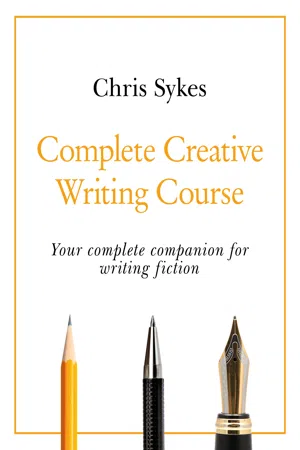
LEARN HOW TO WRITE CREATIVELY WITH THIS COMPREHENSIVE AND PRACTICAL COURSE. The only comprehensive Creative Writing title on the market that goes beyond introducing the basic genres to offering a complete journey along the writing path, including material on editing, redrafting and polishing a piece of work. Featuring the unique Workshop exercises to encourage readers to hone their work rather than just progressing through a number of exercises.Takes the reader from complete beginner or committed amateur to the point you've completed, edited and redrafted your work and are ready for publication. ABOUT THE SERIES The Teach Yourself Creative Writing series helps aspiring authors tell their story. Covering a range of genres from science fiction and romantic novels, to illustrated children's books and comedy, this series is packed with advice, exercises and tips for unlocking creativity and improving your writing. And because we know how daunting the blank page can be, we set up the Just Write online community at tyjustwrite, for budding authors and successful writers to connect and share.
In this chapter you will learn some of the tools of a writer’s trade. You will start to keep a notebook as well as a commonplace book; establish a writing routine, and consider other books and tools you will need.
Keeping a notebook
Starting out you will obviously need something to write with and something to write on. This might be paper, pens, pencil or a computer. One essential, as we have already said, is a notebook, your notebook, your ‘writer’s notebook’.
Key idea
Many writers use notebooks; whether electronic or paper. Get yourself one.
There are some famous written notebooks that writers have kept which are well worth both aspiring and experienced writers looking at. Virginia Woolf and Katherine Mansfield kept diaries and journals that have been published and can therefore be studied by aspiring writers anxious to learn what the daily life of a writer is like. Samuel Butler’s notebooks can be studied as can the notebooks of novelist Somerset Maugham. He kept a notebook all his working life and published excerpts from 1892 to 1949 in A Writer’s Notebook.
W. Somerset Maugham
‘I never made a note of anything that I did not think would be useful to me at one time or another in my work.’
Maugham goes on to refer to the notebooks as a ‘storehouse of materials for future use’. This idea of a storehouse is a key concept for creative writing. The idea of harvesting and storing material to get you over lean months fits well the needs of the writer when the creative seasons are not always abundant.
BUILDING A STOREHOUSE
A storehouse is something to build up over time, to keep and to use to feed off through the lean months. And there are plenty of lean months in writing; plenty of times when you need to go to something for nourishment, sustenance and energy. Note also that Maugham does not say everything was used and was useful: only that he thought it might be useful. This itself is a useful attitude to adopt. To gather potential material you need to buy yourself a notebook.
Jack London, from ‘Getting into Print’
‘Keep a notebook. Travel with it, eat with it, sleep with it. Slap into it every stray thought that flutters up into your brain. Cheap paper is less perishable than gray matter, and lead pencil markings endure longer than memory.’
Snapshot: my notebook
Answer these questions:
• What sort of notebook should I get?
• What sort of things should I record in my notebook?
• How do I use my notebook?
• What should I write in my notebook?
Take some time to consider these questions and write your responses to each question, before reading on.
WHAT SORT OF NOTEBOOK SHOULD I GET?
Get one you like. Make it nice but not so nice that you are afraid to sully it. Some writers swear by old school type notebooks; others use hard-backed notebooks that are robust enough to withstand lots of opening and closing and thrusting into and out of jacket pockets or bags. These books can be kept and looked back on over the months and years to find phrases, half ideas jotted down, lines for a poem, or half ideas for a character or plot that might be developed now. They are also an interesting record of where you have been. They are places to record ideas that have caught your interest; scraps of dialogue you might overhear; images that come to you; snatches of songs. They are places to put down anything that grabs your interest. You should write without worrying about what anyone else will make of it, because no one else is going to see it. This is your notebook for your ideas and for your eyes only.
You might also want to try some kind of recording device to get down your immediate thoughts. The drawback of using, say, a digital voice recorder as a notebook is that you will then have to transcribe what you have recorded into a readable form, which could take endless hours of listening and typing, although these days you can get digital recorders which, with the aid of the right software, will do the transcribing for you. Recorders, digital or otherwise, do have their uses and you should make use of them, but choose what you want to use them for. They are no substitute for a good notebook and a favourite pen.
You could use an iPad; laptops and palmtops can also be a notebook. If you are skilled and proficient in using a laptop or some other portable computer device, then use it. Take your notes, record your visuals or your aural snippets. For ease here, we shall assume notebook means an old-fashioned written notebook. But please translate this into an electronic form if that suits you better.
WHAT SORT OF THINGS SHOULD I RECORD?
That is up to you. It would be easy to say record anything unusual that you see, read or hear, but each of us sees, reads and hears differently. The best advice is to gather what you think you may be able to use in your writing: what strikes you, what intrigues, what amuses you, what captures your interest. It might be something you overhear, or something you see someone doing or something you imagine. It could be something someone is wearing; a description of a room or building; a recording of the weather. It could be a strange sight. It could literally be anything; anything that somehow pricks your interest and which might generate work or that you might use in a piece of writing later. You don’t always know how you are going to use it, that might only become clear days, months, years later, but that is not the issue here. Put it down because, then, you have it or at least you have a key to the memory of it.
It is amazing, too, how often we find what we are interested in. For instance, if you are working on a particular project or piece of writing about, for example, elephants, the mind and eye will quite likely pick out all sorts of sayings, images and references to elephants from the mass of confusing details and references that fill the world.
When taking notes, among the sorts of things you might note are:
• People: the way people look, act, dress and talk. People from real life will find their way into your writing, this is natural. Practise looking at people and listening to them as a writer would. Note details about them, colouring of skin and hair, colour of eyes, mannerisms they have, the way they dress and move.
Key idea
People-watching is an essential habit to develop for a writer.
• Dialogue: Listen to the way people speak, what they say and how they say it. People interrupt themselves and each other; they trip over words, use the wrong words, repeat themselves, pronounce or mispronounce certain words interestingly. You should be listening wherever you are. If you hear something interesting, write it down. If you are not near your book, then remember it for a few moments, if you have to, but otherwise write it down, or you will lose that particular, individual flavour that attracted you in the first place. Sometimes the very phrase or word order is key and a paraphrase of it will not do.
• Lists: Making lists can be a way of trawling both experience and memory and the things that interest you. Writers often make lists of favourite books, favourite authors, favourite places, favourite foods, favourite films, and favourite music. Keep a section in your notebook for favourite words for favourite images.
• Memories: These are a great storehouse for writers. Memories are written indelibly in us. We draw on them when searching for situations, characters, emotions and they can often give us the basic idea of a character or a situation or a story. Often without realizing it we dig down deep into this storehouse and pull out experiences that provide the energy, the living sap for our writing. It can be productive to write down some of your memories; some of the earliest memories are rich with the power that we need in our writing. Learn to tap into this energy. Writing down, or writing out your memories in a creative way, putting them into a fictional form, can also be a way of healing yourself of traumas. This is often not just a side effect but a motivating factor for a lot of writers in their work.
• Other writing: When you come across a piece of writing that you like, make a note of it, write it down. L...
Table of contents
Cover
Title
Dedication
About the author
Acknowledgements
Contents
Introduction: how to use this book
1 Organizing yourself as a writer
2 Starting to write
3 The components of language – nouns and verbs
4 The components of language – adjectives and adverbs
5 Writing poetry using similes and metaphors
6 The five senses (1)
7 The five senses (2)
8 The missing senses
9 Making the senses work together
10 Showing, telling and ignoring
11 Description
12 Character from outside in
13 Inside-out characters
14 Character and viewpoint
15 Story and plot
16 Conflict and genre
17 Writing dialogue
18 Writing for radio
19 Writing for the stage
20 Screenwriting – the visual language of film
21 How to stop writing and start selling
Useful contacts
Further reading
References
Copyright
Trusted by 375,005 students
Access to over 1.5 million titles for a fair monthly price.
Study more efficiently using our study tools.
Frequently asked questions
Yes, you can cancel anytime from the Subscription tab in your account settings on the Perlego website. Your subscription will stay active until the end of your current billing period. Learn how to cancel your subscription
No, books cannot be downloaded as external files, such as PDFs, for use outside of Perlego. However, you can download books within the Perlego app for offline reading on mobile or tablet. Learn how to download books offline
Perlego offers two plans: Essential and Complete
Essential is ideal for learners and professionals who enjoy exploring a wide range of subjects. Access the Essential Library with 800,000+ trusted titles and best-sellers across business, personal growth, and the humanities. Includes unlimited reading time and Standard Read Aloud voice.
Complete: Perfect for advanced learners and researchers needing full, unrestricted access. Unlock 1.5M+ books across hundreds of subjects, including academic and specialized titles. The Complete Plan also includes advanced features like Premium Read Aloud and Research Assistant.
Both plans are available with monthly, semester, or annual billing cycles.
We are an online textbook subscription service, where you can get access to an entire online library for less than the price of a single book per month. With over 1.5 million books across 990+ topics, we’ve got you covered! Learn about our mission
Look out for the read-aloud symbol on your next book to see if you can listen to it. The read-aloud tool reads text aloud for you, highlighting the text as it is being read. You can pause it, speed it up and slow it down. Learn more about Read Aloud
Yes! You can use the Perlego app on both iOS and Android devices to read anytime, anywhere — even offline. Perfect for commutes or when you’re on the go. Please note we cannot support devices running on iOS 13 and Android 7 or earlier. Learn more about using the app
Yes, you can access Complete Creative Writing Course by Chris Sykes in PDF and/or ePUB format, as well as other popular books in Languages & Linguistics & Creative Writing. We have over 1.5 million books available in our catalogue for you to explore.