This product is most effective when used in conjunction with the corresponding audio support.
- You can purchase the book and audio support as a pack (ISBN: 9781444106916)
- The audio support is also sold separately (ISBN: 9781444107012)
(copy and paste the ISBN number into the search bar to find these products)
Are you looking for a complete course in Czech which takes you effortlessly from beginner to confident speaker? Whether you are starting from scratch, or are just out of practice, Complete Czech will guarantee success!Now fully updated to make your language learning experience fun and interactive. You can still rely on the benefits of a top language teacher and our years of teaching experience, but now with added learning features within the course and online.
The course is structured in thematic units and the emphasis is placed on communication, so that you effortlessly progress from introducing yourself and dealing with everyday situations, to using the phone and talking about work. By the end of this course, you will be at Level B2 of the Common European Framework for Languages: Can interact with a degree of fluency and spontaneity that makes regular interaction with native speakers quite possible without strain for either party.Learn effortlessly with a new easy-to-read page design and interactive features: NOT GOT MUCH TIME?
One, five and ten-minute introductions to key principles to get you started.AUTHOR INSIGHTS
Lots of instant help with common problems and quick tips for success, based on the author's many years of experience.GRAMMAR TIPS
Easy-to-follow building blocks to give you a clear understanding.USEFUL VOCABULARY
Easy to find and learn, to build a solid foundation for speaking.DIALOGUES
Read and listen to everyday dialogues to help you speak and understand fast.PRONUNCIATION
Don't sound like a tourist! Perfect your pronunciation before you go.TEST YOURSELF
Tests in the book and online to keep track of your progress.EXTEND YOUR KNOWLEDGE
Extra online articles at: www.teachyourself.com to give you a richer understanding of the culture and history of the Czech Republic.TRY THIS
Innovative exercises illustrate what you've learnt and how to use it.The course is also available as a print book (9781444106015), as a pack comprising the book and double CD (9781444106916) and as a double CD (9781444107012).
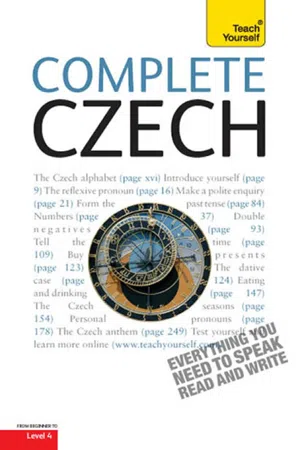
eBook - ePub
Complete Czech Beginner to Intermediate Course
Learn to read, write, speak and understand a new language with Teach Yourself
- 384 pages
- English
- ePUB (mobile friendly)
- Available on iOS & Android
eBook - ePub
Complete Czech Beginner to Intermediate Course
Learn to read, write, speak and understand a new language with Teach Yourself
About this book
Information
1

Dobrý den. Jak se máte? Good morning. How are you?
In this unit you will learn
• How to handle first encounters with greetings and responses
• How to spot some words that are common to Czech and English
• How to say I (first person singular)
Dialogue 1
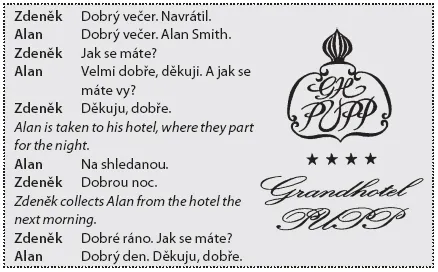
Alan Smith has just arrived in Prague to be met by Zdeněk Navrátil. It is evening.

QUICK VOCAB
dobrý večer good evening
jak se máte? how are you?
velmi dobře, děkuji very well, thank you
velmi very
a and
vy you
na shledanou goodbye (pron. naschledanou)
dobrou noc goodnight
dobré ráno good morning
dobrý den good morning, good day, good afternoon
1 Dobré ráno and other greetings
This is only used to greet someone first thing in the morning, say up to 8 a.m.; an alternative is dobré jitro. After 8 a.m. and through the day use dobrý den (Lit. good day). Dobrý večer is used to greet someone in the evening; dobrou noc on parting for the night or before bedtime. Na shledanou (Lit. ‘au revoir’) can be used at any parting.
2 dobrý, dobré, dobrou – ‘good’
These are all forms of the same adjective good, which is in dictionaries in the form of dobrý. Note that the various forms of such an adjective end in a long vowel or the two-vowel sound ou. Contrast this with the related adverb dobře (well), which ends in a short vowel. You may remember meeting, in the section on pronunciation, a similar pair rychlé (quick), rychle (quickly).
3 Velmi – ‘very’
As in English, velmi (very) is an adverb that qualifies adjectives or other adverbs.
4 Děkuju – ‘Thank you’
You may also hear a more formal version of this: děkuji.
5 Jak se máte? – ‘How are you?’
This expression is an idiom which has to be learned as a piece; the word you does not actually occur, though in the return question it does, as vy. You will understand the whole structure better in later units.
Exercises
1 Respond in kind to the following greetings:
a Dobré ráno.
b Dobrý den.
c Dobrý večer.
2 a You have just met someone; it is 11 a.m. How would you greet him/her? Supply the missing information. D…. d.. J.. .. m…?
b You are asked how you are: Jak se máte? and you respond positively: V…. d…., d…..
c You are asked how you are and you have replied: (Jak se máte? Dobře, děkuju.) It is now your turn to ask: A … .. …. v.?
d On parting, you say goodnight to your host and say you hope to meet again: D….. n.. a n. s……..
Dialogue 2
Zdeněk is meeting Alan on his second visit to Prague.
| Zdeněk | Dobré jitro. Vítám vás znova v Praze. |
| Alan | Děkuju. Jak se máte? |
| Zdeněk | Jde to. A jak se máte vy? |
| Alan | Dnes špatně, bolí mě v krku, ale jsem rád, že jsem tady v Praze. |
| At the hotel. | |
| Zdeněk | Dobrou noc. |
| Alan | Na shledanou zítra. |
QUICK VOCAB
vítám vás welcome (Lit. I welcome you)
znova again
jde to so, so (Lit. goes it)
dnes today
špatně badly
krk throat
Praha Prague
v Praze in Prague (pron. fpraze)
ale but
že that
tady here
zítra tomorrow
bolí mě v krku I’ve got a sore throat (Lit. it hurts me in the throat) (pron. fkrku)
jsem rád, že jsem tady I’m glad that I’m here (ráda for female speaker)
6 More on spelling and pronunciation
Most Czech words are stressed (given more forceful pronunciation) on the first syllable, irrespective of the length of the vowels in the word. This means that, among the words that you now know, dobrý is stressed on the first half of the word, though with the short vowel o, and the second syllable is unstressed but has a long ý. This is a stress pattern matched by such English words as ‘’blackbird’ (as opposed to ‘black ’bird’), or some people’s pronunciation of ‘’garage’, as opposed to the American pronunciation ‘ga’rage’. Try to imitate some of the contrasting patterns using the following words:
| mile | kindly |
| milé | kind |
| míle | mile |
| nakládat | to load |
| náklady | lo... |
Table of contents
- Cover
- Title Page
- Contents
- Meet the author
- Only got a minute?
- Only got ten minutes?
- Introduction
- 1 Dobrý den. Jak se máte? Good morning. How are you?
- 2 Jak se jmenujete? What’s your name?
- 3 Kde pracujete? Where do you work?
- 4 Jak bydlíte? What is your house like?
- 5 Je tu někde knihkupectví? Is there a bookshop near here?
- 6 Na celnici At customs
- 7 Kde jste vlastně studoval? Where exactly did you study?
- 8 Nemůžu najít klíč I can’t find the key
- 9 Kolik je hodin? What’s the time?
- 10 Co mám koupit rodině? What should I buy the family?
- 11 Ve čtvrtek k nám přijde návštěva We’ve got visitors coming on Thursday
- 12 Děti do školy vodí manželka It’s my wife who takes the children to school
- 13 Prší! It’s raining!
- 14 Nehádejte se! Stop arguing!
- 15 Kdybych věděla, že přijdete … If I knew you were coming …
- 16 Tak to bude rychlejší It’ll be quicker that way
- 17 Kvůli politice se nerozčiluj! Don’t get worked up over politics!
- 18 Nejdřív uděláme pořádek v Líbině skříni First we’ll tidy Líba’s wardrobe
- 19 Dejte si něco na ochutnání Have something to taste
- Supplement: selected features of high- and low-style Czech
- Taking it further
- Key to the exercises
- Glossary of grammatical terms
- Appendices: reference tables and voicing and devoicing
- Czech–English vocabulary
- English–Czech vocabulary
- Credits
- Copyright
Trusted by 375,005 students
Access to over 1.5 million titles for a fair monthly price.
Study more efficiently using our study tools.
Frequently asked questions
Yes, you can cancel anytime from the Subscription tab in your account settings on the Perlego website. Your subscription will stay active until the end of your current billing period. Learn how to cancel your subscription
No, books cannot be downloaded as external files, such as PDFs, for use outside of Perlego. However, you can download books within the Perlego app for offline reading on mobile or tablet. Learn how to download books offline
Perlego offers two plans: Essential and Complete
- Essential is ideal for learners and professionals who enjoy exploring a wide range of subjects. Access the Essential Library with 800,000+ trusted titles and best-sellers across business, personal growth, and the humanities. Includes unlimited reading time and Standard Read Aloud voice.
- Complete: Perfect for advanced learners and researchers needing full, unrestricted access. Unlock 1.5M+ books across hundreds of subjects, including academic and specialized titles. The Complete Plan also includes advanced features like Premium Read Aloud and Research Assistant.
We are an online textbook subscription service, where you can get access to an entire online library for less than the price of a single book per month. With over 1.5 million books across 990+ topics, we’ve got you covered! Learn about our mission
Look out for the read-aloud symbol on your next book to see if you can listen to it. The read-aloud tool reads text aloud for you, highlighting the text as it is being read. You can pause it, speed it up and slow it down. Learn more about Read Aloud
Yes! You can use the Perlego app on both iOS and Android devices to read anytime, anywhere — even offline. Perfect for commutes or when you’re on the go.
Please note we cannot support devices running on iOS 13 and Android 7 or earlier. Learn more about using the app
Please note we cannot support devices running on iOS 13 and Android 7 or earlier. Learn more about using the app
Yes, you can access Complete Czech Beginner to Intermediate Course by David Short in PDF and/or ePUB format, as well as other popular books in Languages & Linguistics & Languages. We have over 1.5 million books available in our catalogue for you to explore.