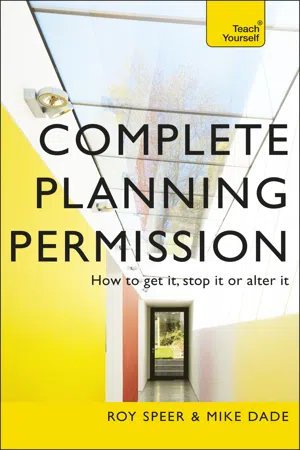
The UK Planning Regulations are a minefield for anyone looking to build a new home - and for those who are worried about the impact of a new planning application near their home. Avoid being one of the thousands whose application is turned down - and whose dreams are crushed - by using this book to familiaries yourself with the system and beat it. With a step-by-step guide to every part of the application process and ehaustive coverage of the do's and don'ts this is an essential guide to securing that first step on the path to building your dream home. And if you're worried about a nearby development there are easily implimented strategies for preventing planning permission from being granted. From one of the UK's leading planning consultancies with the very latest on all the new and recent changes to planning law this is the most comprehensive guide avaliable to manipulating the intricacies of this difficult and controversial area.
- 256 pages
- English
- ePUB (mobile friendly)
- Available on iOS & Android
eBook - ePub
About this book
Information
Topic
ArchitectureSubtopic
Urban Planning & LandscapingPART 1
THE PLANNING SYSTEM
1
The nature of planning

In this chapter you will learn:
• What the planning system does and why it was introduced
• How planning policy underpins the planning system
• About the different types of applications and consents
• About appeals against decisions
• How local authorities can deal with breaches of planning regulations
What the system does
In 1948 the right to carry out property development was nationalized. In other words, landowners’ right to build and alter buildings, or to use land or buildings for a different purpose, was taken away by the government. Since that date, anyone wishing to carry out development needs permission to do so. Permission is given mainly by the local planning authority for the area, which in most cases is the district, borough or city council (collectively referred to as ‘district’ councils). In addition, local government was charged with preparing plans for their areas showing where various kinds of buildings could and could not be built. Thus, the modern comprehensive planning system was born.
The system is now overseen by Department of Communities and Local Government in England; the Scottish Government; the Welsh Assembly Government and the Department of the Environment in Northern Ireland.
 | Key idea |
Most new buildings and changes of use need planning permission.

The planning system was introduced so that property development could be controlled in the public interest. Previously, buildings could be built anywhere, or they could be demolished, and land and buildings could be used for any purpose the owner chose. This was thought to be inefficient and sometimes had harmful consequences. The idea behind the planning system is that new buildings and uses are controlled to ensure:
• that incompatible uses are not sited together;
• the preservation of important buildings and areas;
• the conservation of the countryside and natural environment;
• the prevention of urban sprawl;
• that the appearance and layout of new development is compatible with existing development;
• that resources are not wasted;
• that infrastructure can be provided efficiently;
• that people’s enjoyment of their properties is protected;
• highway safety;
• co-ordinated provision of new housing and employment facilities.
However, the planning system is not coercive. It relies on landowners wanting to undertake development. An owner does not have to use land in a particular way just because it is allocated for that use or development. Similarly, even when permission is given, the owner is not compelled to act on it.
The system is only concerned with what can be built. It does not deal with how it is built. Structural stability, health and safety, sanitation and so on are dealt with under separate legislation and regulations.
Role of planning policy
Fundamental to the planning system is planning policy. As well as allocating sites and areas for certain types of development, council development plans contain guidance and standards for buildings and uses, relating to matters such as design, layout, density, garden space, privacy, noise, highway safety, size and mix of buildings, parking and many other issues. This guidance, and standards, is known as planning policy and can be set out in a range of development plan documents. There is a preparation process that development plans must go through and public consultation and opportunities for public comment are built into the procedures.
| | Key idea |
Planning decisions are based primarily on planning policies.
In addition to local policies, the governments of the UK publish national planning policy documents. Inevitably, these are more broad-brush in nature. Their function is not only to guide decisions on individual development proposals but also to give direction to the development plans drawn up by local authorities. The government indicates what should be taken into account when preparing local plans and, in some areas, the thrust of what they should say.
When seeking permission for development, planning law requires the body responsible for making the decision to do so in accordance with formally drawn up local planning policy, unless there are sound reasons for coming to a different conclusion (see Chapter 3). Therefore, planning policies are the prime consideration in whether planning permission will be given.
 | Remember this |
Check planning policies early on to see how a project measures up.
Planning applications
Permission is needed for development; consequently there is an application process for seeking that permission. Two types of planning application can be made. First, there are ‘full’ or ‘detailed’ applications. These show all aspects of the proposal and are specific about precisely what would be built, what alterations would be made or what use would be made of land or buildings. Second, there are outline applications. These are made to establish, in principle, whether a building can be built, leaving some or all details of the scheme to be determined subsequently. Outline applications can only be made for buildings not for changes of use, including conversions. The details of the building and site layout are called ‘reserved matters’, because they are reserved from the outline application. Another type of application is then made for the approval of reserved matters within the scope of the original outline permission. Once they have been approved, the outline and reserved matters together are the equivalent of a full planning permission.
Although planning permission is supposed to be obtained for development before it takes place, inevitably building work and changes of use happen without the necessary consent. In these circumstances, an application can be made for permission after the event. This is generally referred to as ‘retrospective’ planning permission.
There are various other applications which can be made after planning permission has been granted. Conditions are attached to permissions (see Chapter 4) and there is a procedure for applying to remove or vary conditions. In certain circumstances, this type of application can be used to make changes to the design or layout of an approved scheme (see Chapter 8). There is a separate procedure for making very minor changes to a planning permission, called a non-material amendment. One condition attached to a planning permission is a time limit within which to begin the development permitted; this is usually three years for full planning permission (five years in Northern Ireland and Wales). Applications to extend the duration of planning permission are often referred to as ‘renewals’ although they are, technically, new applications.
| | Remember this |
If it is not clear, ask the council which type of application is appropriate.
Other consents
Sometimes special applications have to be made either in conjunction with planning applications or separately. Buildings and structures with exceptional historical or architectural value are given special protection. They are included on a list of such buildings and, hence, are called ‘listed’ buildings. Most work to listed buildings needs listed building consent (see ...
Table of contents
- Cover
- About the Author
- Acknowledgements
- Title
- Contents
- Disclaimer
- How to use this book
- Introduction
- Part 1 The Planning System
- Part 2 Making Planning Applications
- Part 3 Protecting Your Property
- Taking it further
- Copyright
Trusted by 375,005 students
Access to over 1.5 million titles for a fair monthly price.
Study more efficiently using our study tools.
Frequently asked questions
Yes, you can cancel anytime from the Subscription tab in your account settings on the Perlego website. Your subscription will stay active until the end of your current billing period. Learn how to cancel your subscription
No, books cannot be downloaded as external files, such as PDFs, for use outside of Perlego. However, you can download books within the Perlego app for offline reading on mobile or tablet. Learn how to download books offline
Perlego offers two plans: Essential and Complete
- Essential is ideal for learners and professionals who enjoy exploring a wide range of subjects. Access the Essential Library with 800,000+ trusted titles and best-sellers across business, personal growth, and the humanities. Includes unlimited reading time and Standard Read Aloud voice.
- Complete: Perfect for advanced learners and researchers needing full, unrestricted access. Unlock 1.5M+ books across hundreds of subjects, including academic and specialized titles. The Complete Plan also includes advanced features like Premium Read Aloud and Research Assistant.
We are an online textbook subscription service, where you can get access to an entire online library for less than the price of a single book per month. With over 1.5 million books across 990+ topics, we’ve got you covered! Learn about our mission
Look out for the read-aloud symbol on your next book to see if you can listen to it. The read-aloud tool reads text aloud for you, highlighting the text as it is being read. You can pause it, speed it up and slow it down. Learn more about Read Aloud
Yes! You can use the Perlego app on both iOS and Android devices to read anytime, anywhere — even offline. Perfect for commutes or when you’re on the go.
Please note we cannot support devices running on iOS 13 and Android 7 or earlier. Learn more about using the app
Please note we cannot support devices running on iOS 13 and Android 7 or earlier. Learn more about using the app
Yes, you can access Complete Planning Permission by Roy Speer,Mike Dade in PDF and/or ePUB format, as well as other popular books in Architecture & Urban Planning & Landscaping. We have over 1.5 million books available in our catalogue for you to explore.