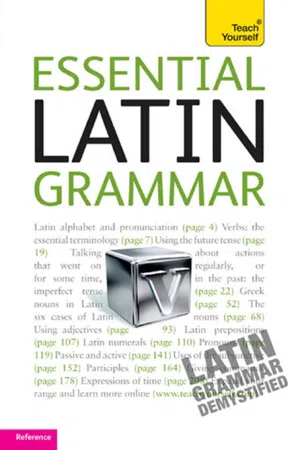
Essential Latin Grammar will help you get more out of your study of Latin. Essential Latin Grammar is an up-to-date introduction to Latin grammar. You don't need to know a lot about grammar before you start. Everything is explained simply and there are lots of examples to illustrate each point. Unlike more traditional grammars, Essential Latin Grammar is structured so that you can look up language forms according to their meaning, even if you don't know the grammatical term for them. Essential Latin Grammar will help you to understand and manipulate Latin grammar with confidence because:
- you need no prior knowledge of grammatical terminology to use it;
- the approach is accessible and supportive;
- the examples are clear and in context;
- exercises help you practise every point.Now in a brand new edition with new, easy-to-follow page design and interactive on-line features: NOT GOT MUCH TIME?
One, five and ten-minute introductions to key principles to get you started.AUTHOR INSIGHTS
Lots of instant help with common problems and quick tips for success, based on the author's many years of experience.USEFUL VOCABULARY
Easy to find and learn, to build a solid foundation for speaking.EXTEND YOUR KNOWLEDGE
Extra online articles at: www.teachyourself.com to give you a richer understanding of the culture of Ancient Rome.
- 208 pages
- English
- ePUB (mobile friendly)
- Available on iOS & Android
eBook - ePub
Essential Latin Grammar: Teach Yourself
About this book
Information
Subtopic
Ancient Languages1
Alphabet, pronunciation and terminology
Alphabet and pronunciation
There are 24 letters in the Latin alphabet. The Romans had no j or w. In writing, capitals are used for proper nouns, adjectives and numerals, not to start sentences.
A Pronunciation
There are no silent letters in Latin and long vowels take about twice as long to say as short ones.
| A | a as in father when long, but as in act when short |
| B | b as in but |
| C | c as in cut, not as in church, cider or loch |
| D | d as in dog |
| E | e as in prey when long, but as in jet when short. |
| F | f as in father |
| G | g as in goat, not as in genius |
| H | h as in have |
| I | i as in machine when long, as in pit when short and as y in yet when used as a consonant |
| K | k as in king (this Greek letter [kappa] was used only in words of Greek origin) |
| L | l as in long |
| M | m as in mother |
| N | n as in newt, but, before c, g and quit is pronounced ng, as in sing |
| O | o as in tone (although the French o in chose is closer) when long, as in hot when short |
| P | p as in pat |
| Q | q as in queen and always followed by u, as in English |
| R | r is always rolled, as in Italian |
| S | s as in sun, not as in was, treasure or sugar |
| T | t as in top, not as in motion |
| U | u as in food when long but as in put when short |
| V | w as in wine, although the Hindi pronunciation of v is closer |
| X | x as in axe, not as in exact |
| Y | y as in the French vu (this Greek letter [upsilon] was used only in words of Greek origin) |
| Z | z as in zoo (this Greek letter [zeta] was used only in words of Greek origin) |
B Diphthongs are combinations of vowels making one sound. In Latin they are all long:
ae pronounced ai as in aisle, e.g. praeda → booty
au pronounced ou as in house, e.g. aurum → gold
oe pronounced oi as in boil, e.g. poena → penalty
ei pronounced ei as in reign. Only found in the exclamations ei! eia! heia! → oh! aha!
eu pronounced ew as in pew, e.g. seu → whether
ui pronounced wea as in weak, e.g. huic → to this
The diphthongs ei, eu and ui are rare. Mostly when these vowel combinations are found they are pronounced separately, as in tui → yours (pronounced two-ee), fluit → it flows (flew-it), mei → mine (meyee) and deus → god (de-yus). When the u follows the letter q it is pronounced w, as in English.
C Consonantal i and u
• In some Latin words the letter i is pronounced as the consonant y at the beginning or even in the middle of words, e.g. coniungo (I join together: pronounced con-yungo) and iam (already: pronounced yam). In the English derivatives of many of these words the consonantal i becomes the letter j, e.g. juvenile comes from iuvenis (young man), judicial comes from iudicium (judgement), joke comes from iocus (joke) and the name Julius from Iulius.
• The Romans made no distinction between v and u when writing so, for example, in an inscription you might find EQVVS for equus → horse. Some published texts still make no distinction so you may find uinum for vinum → wine.
D When t, c or p are followed by an h, they are called aspirated consonants th, ch and ph. They come from the Greek letters theta, chi and phi and exist in Latin words which come from Greek. They should be pronounced as an emphasized version of the letters without the h but in practice th and ph are often pronounced as in the English thin and photo and ch as in the Scottish loch.
E Length of vowels and syllables
• In English the stressed vowel of a word is usually lengthened while unstressed ones are not, e.g. cider, boredom. In a Latin word, however, any of the vowels may be either long or short. In dictionaries and textbooks the long vowels are usually marked out by a line over the top of the vowel called a macron (ē). In some cases, it is important to know whether a vowel is long or short, especially in verse, but when you come to read Latin documents you will not find any distinguishing marks over long vowels. In this book there are no marks used over vowels for the exercises and readers do not need to include them. In the explanatory matter, long syllables are marked when they are of importance.
• The length of a syllable, as opposed to a vowel, is important to know for verse. A syllable is long if it has a long vowel or a diphthong, or ends in two consonants, the letter x or a single consonant if the next word also begins with a consonant. All other syllables are short.
F Stress accent
• In Latin the stress accent (ictus) falls on the first syllable of two syllabled words, e.g. pater → father. It falls only rarely on the last syllable, e.g. illic → to th...
Table of contents
- Cover
- Title Page
- Contents
- Meet the author
- Only got a minute?
- Only got ten minutes?
- Introduction
- 1: Alphabet, pronunciation and terminology
- 2: Tenses (indicative active)
- 3: Nouns
- 4: Cases
- 5: Adjectives and adverbs
- 6: Prepositions, conjunctions and numerals
- 7: Pronouns and questions
- 8: Passive and deponent verbs
- 9: Subjunctive verbs
- 10: Verbal nouns and adjectives (participles, gerunds, supines and gerundives)
- 11: Infinitives and imperatives
- 12: Impersonal, defective and irregular verbs
- 13: Relative and temporal clauses, ablative absolute
- 14: Final, consecutive and conditional clauses
- 15: Indirect speech
- 16: Other subordinate clauses (clauses of concession, cause, proviso, comparison, fear, doubt and prevention, and the use of quin)
- 17: Miscellaneous (dates, money and measures, names, places, inscriptions, timeline, Latin today)
- Key to the exercises
- Copyright
Trusted by 375,005 students
Access to over 1.5 million titles for a fair monthly price.
Study more efficiently using our study tools.
Frequently asked questions
Yes, you can cancel anytime from the Subscription tab in your account settings on the Perlego website. Your subscription will stay active until the end of your current billing period. Learn how to cancel your subscription
No, books cannot be downloaded as external files, such as PDFs, for use outside of Perlego. However, you can download books within the Perlego app for offline reading on mobile or tablet. Learn how to download books offline
Perlego offers two plans: Essential and Complete
- Essential is ideal for learners and professionals who enjoy exploring a wide range of subjects. Access the Essential Library with 800,000+ trusted titles and best-sellers across business, personal growth, and the humanities. Includes unlimited reading time and Standard Read Aloud voice.
- Complete: Perfect for advanced learners and researchers needing full, unrestricted access. Unlock 1.5M+ books across hundreds of subjects, including academic and specialized titles. The Complete Plan also includes advanced features like Premium Read Aloud and Research Assistant.
We are an online textbook subscription service, where you can get access to an entire online library for less than the price of a single book per month. With over 1.5 million books across 990+ topics, we’ve got you covered! Learn about our mission
Look out for the read-aloud symbol on your next book to see if you can listen to it. The read-aloud tool reads text aloud for you, highlighting the text as it is being read. You can pause it, speed it up and slow it down. Learn more about Read Aloud
Yes! You can use the Perlego app on both iOS and Android devices to read anytime, anywhere — even offline. Perfect for commutes or when you’re on the go.
Please note we cannot support devices running on iOS 13 and Android 7 or earlier. Learn more about using the app
Please note we cannot support devices running on iOS 13 and Android 7 or earlier. Learn more about using the app
Yes, you can access Essential Latin Grammar: Teach Yourself by Gregory Klyve in PDF and/or ePUB format, as well as other popular books in Languages & Linguistics & Ancient Languages. We have over 1.5 million books available in our catalogue for you to explore.