Is this the right book for me? Gain a working vocabulary in Pitman 2000 in clear and easy stages
Shorthand is a valuable asset to everyone, young or old, in private or business life and Pitman 2000 is a system designed for easy learning, with a speed potential to meet the demands of a modern fast-moving world. Get Started in Shorthand Pitman 2000 is a beginner's guide to the basic theory and will give you a working vocabulary in Pitman 2000 in clear and easy stages.Each of the main sections contains a new set of sounds and rules, short forms, phrases and exercises. Review exercises give you the opportunity to consolidate material already covered, and a key to the exercises enable you to measure your rate of progress throughout the book. Written to make self-tuition both simple and stimulating and based on original Pitman Publishing material, this authoritative book is indispensable to anyone seeking a first or refresher course in Pitman 2000. Get Started in Shorthand Pitman includes: Chapter 1: Basic strokes
Consonants
Vowels
Position of outlines
Circle S
SES circle
The suffix -ING
Tick THE
Punctuation Chapter 2: Consonants and vowels
Seven more consonants
Stroke S
Past tense of regular verbs
The consonant R
Unstressed vowels Chapter 3: Halving strokes
Halving to add T
Halving to add D
When not to halve Chapter 4: Common combinations
The L hook
The final syllables -TL or -DL
L hook with circle S
Plural -INGS Chapter 5: Third-place vowels
Dots
Dashes Chapter 6: Complex vowel sounds
Dipthongs
Triphones
SES circle Chapter 7: S and T in combinations
The ST loop
The -STER loop
M and N with a following T or D
S and Z
Diphones
ZH
H
Chapter 8: The R hook
R hook on straight strokes
Stress rules Chapter 9: Hook N
Final hook N to curved strokes
Final N hook to straight strokes Chapter 10: Suffixes and compounds
Suffixes
Compound consonants Chapter 11: L and R hooks with curves
Initial hooks to curved strokes
Stress rules with R and L hooks
Reverse forms of initially hooked curves Chapter 12: More hooks
-SHUN hook
F/V hook Chapter 13: Speed strokes
Doubling
CON- or COM- Chapter 14: Last words
Figures
Negative words
Suffix -SHIP
Disjoining
Omission of a consonant
Vowel insertion
.
.
.
.
.
.
.
.
.
.
.
.
.
Learn effortlessly with a new easy-to-read page design and interactive features: Not got much time?
One, five and ten-minute introductions to key principles to get you started. Author insights
Lots of instant help with common problems and quick tips for success, based on the author's many years of experience. Test yourself
Tests in the book and online to keep track of your progress. Extend your knowledge
Extra online articles to give you a richer understanding of the subject. Five things to remember
Quick refreshers to help you remember the key facts. Try this
Innovative exercises illustrate what you've learnt and how to use it.
eBook - ePub
Get Started In Shorthand: Pitman 2000
Master the basics of shorthand: a beginner's introduction to Pitman 2000
- 256 pages
- English
- ePUB (mobile friendly)
- Available on iOS & Android
eBook - ePub
Get Started In Shorthand: Pitman 2000
Master the basics of shorthand: a beginner's introduction to Pitman 2000
About this book
Information
1
Basic strokes
In this unit you will learn:
- 13 consonant strokes
- how to show vowels
- about circle S and SES
- about short forms
Consonants
There are twenty-four consonant sounds in the English language. Here are thirteen of them.
The first six are all written downwards:

The next five are all horizontals written from left to right. Three of these – M, N, NG (as in bank or song) – are shallow curves.

The next two are written upwards, at an angle. L is a full-bodied quarter circle; W is a line, beginning with a small round hook.
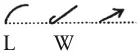
Note that:
- The first eight go in pairs: P-B, T-D, CH-J, K-G. Each pair has the same sound except that the more firmly written of the pair is voiced, and the very light one of the pair unvoiced. That is to say, the vocal cords are used for voiced consonants, but not for the unvoiced ones.
- All the consonants are the same length.
CONSONANTS JOINED
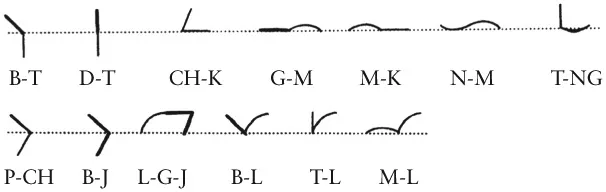
Two or more of these consonants can be written one after another without taking the pen from the paper, forming an outline for a word.
Writing notes
When two or more consonants are written together there should be no appreciable pause between ending one stroke and beginning the next. Write very lightly even when making the distinction between such stroke as T and D. Write the outline first, and insert the vowels afterwards.
EXERCISE 1
Practise writing the thirteen consonants several times, then practise the consonants joined to form outlines, as shown here.
Vowels
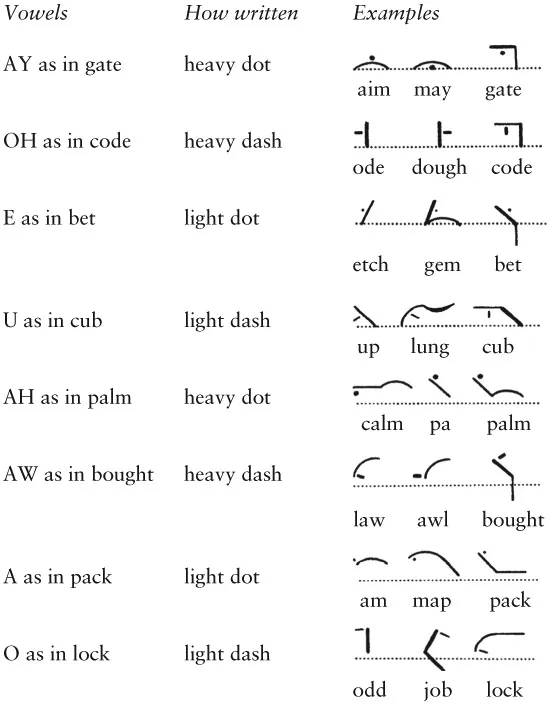
English has twenty vowels and diphthongs. In this section, we are dealing with eight vowels. Vowels are written with either dots or short dashes, and at set places on the lines – we will come back to the places in a moment.
VOWEL PLACES
The first four vowels are all second-place vowels. Any consonant has three places for vowels to be written, according to the direction in which the consonant stroke is written:

The first rule is simple: if the vowel comes before the consonant, it is written before it, and if it comes after the consonant, it is written after it. The examples will make this clear:

Dash angles
Notice that dash vowels are at right angles to the stroke at the point where they are written.
Position of outlines
These two rules run all the way through shorthand:
- The first vowel in a word decides where the outline for that word will be written – above, on, or through the line.
- With first place vowels, the outlines go above the line
- With second place vowels, the outlines go on the line
- With third place vowels, the outlines go through the line.
- Is it the first upward or downward stroke that goes above, on or through the line. If the outline consists only of horizontal strokes, they are written above, on or through the line.
In the table of eight vowels shown above, the first four (AY, OH, E and U) are all second-place vowels. Their outlines all sit on the line.
The second group of four vowels (AH, AW, A and O) are first-place vowels. Therefore they were written above the line.
Here are the outlines for six more words illustrating these two rules:
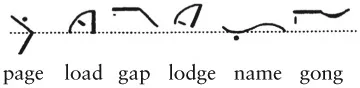
EXERCISE 2
Read then copy the following words:
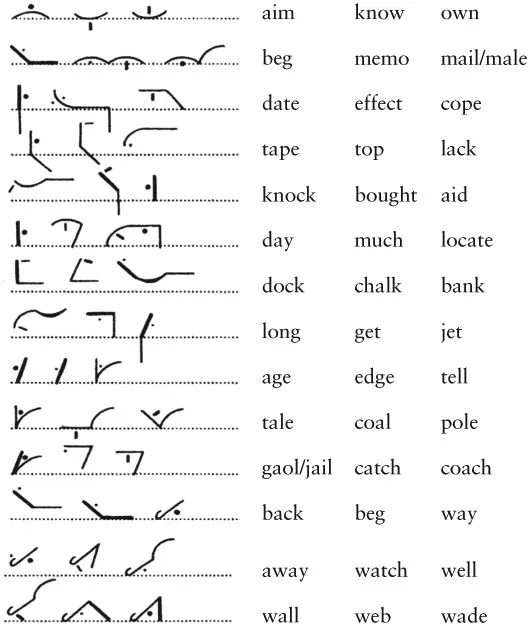
EXERCISE 3
Write the following words in shorthand then check against the key at the end of the book:

Circle S
A small circle may be written at the beginning or at the end of any consonant. Initially it represents the sound of S, Finally it may represent the sound of S or Z. An initial S is read first. A final circle S is read last....
Table of contents
- Cover
- Title
- Copyright
- Contents
- Personal introduction
- Only got one minute?
- Only got ten minutes?
- 1 Basic strokes
- 2 Consonants and vowels
- 3 Halving strokes
- 4 Common combinations
- 5 Third-place vowels
- 6 Complex vowel sounds
- 7 S and T in combinations
- 8 The R hook
- 9 Hook N
- 10 Suffixes and compounds
- 11 L and R hooks with curves
- 12 More hooks
- 13 Speed strokes
- 14 Last words
- Keys to the exercises
Trusted by 375,005 students
Access to over 1.5 million titles for a fair monthly price.
Study more efficiently using our study tools.
Frequently asked questions
Yes, you can cancel anytime from the Subscription tab in your account settings on the Perlego website. Your subscription will stay active until the end of your current billing period. Learn how to cancel your subscription
No, books cannot be downloaded as external files, such as PDFs, for use outside of Perlego. However, you can download books within the Perlego app for offline reading on mobile or tablet. Learn how to download books offline
Perlego offers two plans: Essential and Complete
- Essential is ideal for learners and professionals who enjoy exploring a wide range of subjects. Access the Essential Library with 800,000+ trusted titles and best-sellers across business, personal growth, and the humanities. Includes unlimited reading time and Standard Read Aloud voice.
- Complete: Perfect for advanced learners and researchers needing full, unrestricted access. Unlock 1.5M+ books across hundreds of subjects, including academic and specialized titles. The Complete Plan also includes advanced features like Premium Read Aloud and Research Assistant.
We are an online textbook subscription service, where you can get access to an entire online library for less than the price of a single book per month. With over 1.5 million books across 990+ topics, we’ve got you covered! Learn about our mission
Look out for the read-aloud symbol on your next book to see if you can listen to it. The read-aloud tool reads text aloud for you, highlighting the text as it is being read. You can pause it, speed it up and slow it down. Learn more about Read Aloud
Yes! You can use the Perlego app on both iOS and Android devices to read anytime, anywhere — even offline. Perfect for commutes or when you’re on the go.
Please note we cannot support devices running on iOS 13 and Android 7 or earlier. Learn more about using the app
Please note we cannot support devices running on iOS 13 and Android 7 or earlier. Learn more about using the app
Yes, you can access Get Started In Shorthand: Pitman 2000 by Pitman Publishing in PDF and/or ePUB format, as well as other popular books in Business & Human Resource Management. We have over 1.5 million books available in our catalogue for you to explore.