LEARN HOW TO WRITE COMPELLING STORIES FOR CHILDREN. Get Started in Writing for Children will help you at the very beginning of the creative journey to gain confidence and find inspiration, and then support you in the completion of your first piece of children's literature, whether it's a picture book, a middle-grade story or a young adult novel. Each chapter includes a central writing exercise and four shorter ones, while key quotes, key ideas and focus points will be clearly signposted and will summarise important concepts and advice. At the heart of each chapter is the 'Workshop', a key exercise in which you will gain a deeper insight into the craft of writing for children. In addition to coverage of the key categories and their conventions, this book includes substantial information on getting established in the writing community, gathering a fan base and pitching your work to publishers.What are you waiting for? This book has all you need to get started.
eBook - ePub
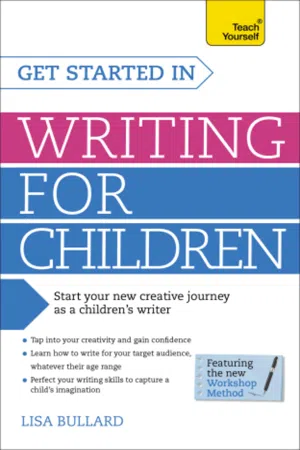
Get Started in Writing for Children: Teach Yourself
How to write entertaining, colourful and compelling books for children
- 224 pages
- English
- ePUB (mobile friendly)
- Available on iOS & Android
eBook - ePub
Get Started in Writing for Children: Teach Yourself
How to write entertaining, colourful and compelling books for children
About this book
Information
1

Reflect on your readers
The books we read as children can leave a potent imprint on us. Even decades later, we often remember details about the stories that mattered most to us as young people. And as those who write for children discover, it’s thrilling to have that kind of impact on a child by creating a book that they love!
 | Children’s author Heather Vogel Frederick |
‘There’s something special about the books we fall in love with when we’re young. We carry them with us in our hearts for the rest of our lives.’
 | A remembered read |
Think back to your childhood and try to remember a favourite book. Write a paragraph describing the book and your experience with it. You might consider the following questions as you write:
• Did someone else read it to you, or did you read it alone?
• What did you love so much about that particular book?
• Can you remember any sensory details such as the feeling or the look of the book?
• For what span of ages did you think of that book as your favourite?
• Have you treasured that book for many years – maybe even shared it with your own children – or had you forgotten about it until this question?
What a difference a year or two makes
Don’t be fooled – just because children’s books are for young readers, they are no simpler to write than books for adults. But writing for children IS different from writing for adults. Not only will you shape young people with your writing, but young people will help shape your writing in return! Your audience will likely have an impact on some stage of your writing process, and they’ll definitely influence the way the book is published. Fiction writers for adults don’t have to stop and ask, ‘Will a 34-year-old woman be able to grasp this concept?’ But when you’re writing for children, at some point you need to consider, ‘Will a three-year-old understand this story?’ Or, ‘Will a six-year-old who has just learned to read be able to decipher this word?’ Or, ‘How will an eleven-year-old deal with this level of violence?’ The way you answer questions like those may very well have a big impact on how you write your story.
It’s almost as if your readers are peeking over your shoulder as you tap away at your keyboard. Sure, there are stages in the writing process when you’ll write without an active awareness of those future fans. But the age, reading ability and developmental stage of your audience will have a significant impact on your finished book. Even a year or two can make a substantial difference in a child’s ability to process certain words and concepts. So, in this chapter, we’ll dig deeper into the world of children’s books by looking at the way publishers divide readers into age categories.
| | Time machine |
Imagine you have stepped into a time machine, and it has transported you back to the age of five. Everything you’ve learned or experienced since that age has been wiped clear from your memory. All you know and understand is what you knew and understood as a five-year-old. Close your eyes and let yourself sink into remembering what it felt like to be ‘waist-high’ in the adult world.
Once your eyes are open again, briefly answer the following questions the way you believe your five-year-old self would have answered them. Go with your gut impulse; don’t overthink your answers!
• What scares you most?
• What do you keep secret?
• Whom do you most want to spend time with?
Once you’ve answered, step back into the time machine. Jump ahead to the age of ten. Some things will have changed since you were five. Answer those same three questions the way your ten-year-old self might have answered.
When your ten-year-old self has finished answering, jump ahead to age 15. Answer the three questions once again.
Look over all of your answers. What do you notice about the difference a few years can make in childhood?
The right book at the right time
Children are constantly changing, and the books that intrigue them change with their age. Those who connect children and books sometimes talk about it as the right book at the right time. When the match is a good one, it can lead to that powerful connection between a child and a favourite book. A mismatch – a book that’s too hard to read, or covers content the child considers confusing or disturbing, boring or babyish – is a missed opportunity to grow a reader. So book publishers separate children’s books into categories based on general age groups and reading ability. The categories work as a starting point to help make the matches between books and readers more successful. That way, when Grandma arrives at the bookshop to buy a birthday present for her nine-year-old grandson, the bookseller can quickly help her narrow down her search.
It’s key to remember that many children’s book purchase decisions are made by adults. The younger the reader, the less likely it is that he chooses what to read without adult supervision of some sort. But the best book match is when the child is also excited about the book choice. All the partners in the matchmaking process – publishers, parents and teachers included – have a vested interest in finding easy ways to pair books with young readers who will love them.
That’s where book categories enter in. The categories are a short-cut language designed to help pair the right book with the right reader. Publishers expect writers to understand the categories, and for the most part, to shape their books to fit them. Doing so makes it easier for the publisher to sell books, and without book sales, the whole system collapses. Remember the grandma looking for a good book for a nine-year-old? Just how long would she have shopped if the books for children, babies and teens were all randomly mixed into the books for adults?
But putting books into pre-established categories often make...
Table of contents
- Cover
- Title
- Dedication
- Acknowledgements
- Contents
- About the author
- Introduction: How to use this book
- 1 Reflect on your readers
- 2 Explore for ideas
- 3 Structure a story
- 4 Breathe life into characters
- 5 Build a world
- 6 Develop writing habits
- 7 Find the right words
- 8 Revise your work
- 9 Join the community
- 10 Investigate other opportunities
- Glossary of literary terms
- Further reading and useful resources
- References
- Copyright
Trusted by 375,005 students
Access to over 1.5 million titles for a fair monthly price.
Study more efficiently using our study tools.
Frequently asked questions
Yes, you can cancel anytime from the Subscription tab in your account settings on the Perlego website. Your subscription will stay active until the end of your current billing period. Learn how to cancel your subscription
No, books cannot be downloaded as external files, such as PDFs, for use outside of Perlego. However, you can download books within the Perlego app for offline reading on mobile or tablet. Learn how to download books offline
Perlego offers two plans: Essential and Complete
- Essential is ideal for learners and professionals who enjoy exploring a wide range of subjects. Access the Essential Library with 800,000+ trusted titles and best-sellers across business, personal growth, and the humanities. Includes unlimited reading time and Standard Read Aloud voice.
- Complete: Perfect for advanced learners and researchers needing full, unrestricted access. Unlock 1.5M+ books across hundreds of subjects, including academic and specialized titles. The Complete Plan also includes advanced features like Premium Read Aloud and Research Assistant.
We are an online textbook subscription service, where you can get access to an entire online library for less than the price of a single book per month. With over 1.5 million books across 990+ topics, we’ve got you covered! Learn about our mission
Look out for the read-aloud symbol on your next book to see if you can listen to it. The read-aloud tool reads text aloud for you, highlighting the text as it is being read. You can pause it, speed it up and slow it down. Learn more about Read Aloud
Yes! You can use the Perlego app on both iOS and Android devices to read anytime, anywhere — even offline. Perfect for commutes or when you’re on the go.
Please note we cannot support devices running on iOS 13 and Android 7 or earlier. Learn more about using the app
Please note we cannot support devices running on iOS 13 and Android 7 or earlier. Learn more about using the app
Yes, you can access Get Started in Writing for Children: Teach Yourself by Lisa Bullard in PDF and/or ePUB format, as well as other popular books in Languages & Linguistics & Creative Writing. We have over 1.5 million books available in our catalogue for you to explore.