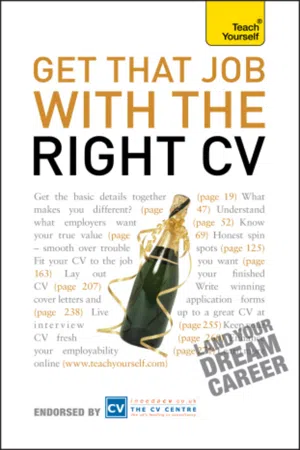
Get that Job with the Right CV will teach you how to write the best possible CV to land that perfect job. It covers everything from layout and format, through to perfecting a jargon-free writing style, avoiding common pitfalls and tailoring your CV to different jobs. Julie Gray's in-depth professional advice and friendly style will guide you through every step of the CV writing process with humour and practicality and give you real confidence to effectively showcase your skills to employers.
NOT GOT MUCH TIME?One, five and ten-minute introductions to key principles to get you started.
AUTHOR INSIGHTSLots of instant help with common problems and quick tips for success, based on the author's many years of experience.
TEST YOURSELFTests in the book and online to keep track of your progress.
EXTEND YOUR KNOWLEDGEExtra online articles at www.teachyourself.com to give you a richer understanding of how to get your CV right.
FIVE THINGS TO REMEMBERQuick refreshers to help you remember the key facts.
TRY THISInnovative exercises illustrate what you've learnt and how to use it.
- 256 pages
- English
- ePUB (mobile friendly)
- Available on iOS & Android
eBook - ePub
Get That Job With The Right CV
About this book
Information
Subtopic
Carrières1
How this book can help you
In this chapter you will:
- understand the benefits of writing your own CV
- get started straight away
- decide where in the book to begin
There are few guarantees in life, and employment is certainly not one of them. Despite hard work and careful choices, jobs can come and go quite unexpectedly.
The perfect opportunity that slipped by because you weren’t quite ready for it; the too-good-to-be-true job offer that lived up to its name; that brilliant role ruined by a domineering manager with whom you simply couldn’t get along; the seemingly secure job for life that disappeared just when you needed it most; the small gap in your employment that quickly expanded into a chasm.
Whether you welcome it or fear it, job searching is a part of almost everyone’s life – now more than ever.
Competition for jobs
There is one thing you can guarantee when it comes to a job search: competition.
Most of us have had to fight to get the jobs we need and want; this was happening even before the catastrophic impact of the 2008 events on the global economy. If the company you work for goes under, it’s not just you being left without a job. Tens or even hundreds of your co-workers will be in the same position. That raises the stakes: you’re all chasing the same job opportunities at the same time.
Once the economy has started to stabilize, competition for jobs will probably keep rising because companies will remain very cautious about whom they take on.
Before the crash it wasn’t uncommon to have 100 or more applicants chasing one vacancy – and that’s not just the high flyers. However much or little experience you have, it’s getting harder for anyone to reach interview stage.
Repeatedly being refused interviews, often with little or no explanation, can undermine anyone’s self-confidence. If you were feeling a little shaky to start with, this can quickly become a problem. Before long you find yourself sending out applications that you don’t really believe are going to get you anywhere. Once this happens, it’s often clear to the person reading your application that you’ve given up. Unless you work for an anti-smoking charity, quitting is not a desirable quality in an employee.
What is a CV?
The one tool that everyone needs in a job search is a great CV, or Curriculum Vitae, which literally means ‘the course of one’s life’. Ignore the Latin roots: a CV is simply a brief written summary about you. It tells prospective employers three things:
- what you can do for their business
- why they should interview you for this job
- how to get in touch with you to arrange it.
You may hear it said that CVs are just for managers and professionals; this simply isn’t true. From administrators to accountants, truck drivers to telesales reps, school leavers to shift workers, having a confident CV can only improve your chances of getting an interview for the job you want.
How can I write a CV?
Even if you don’t feel your writing skill is anything to shout about yet, it will improve as this book takes you through every step of writing and refining your CV.
You’re not alone if you find this daunting at first: many people find writing about themselves the hardest subject of all, one over which even the most confident communicator can stumble. It’s easy to:
- believe your writing is not very good
- know what you want to say but struggle to find the right words
- think of so many ‘good words’ that the really important bits get overlooked
- just feel uncomfortable writing anything about yourself
- be unsure how to balance modesty with self-promotion
- have low confidence after being rejected for interviews
- not know what should be on your CV, or what it should look like
- wonder if you even need a CV anyway.
All these concerns will be addressed in this book.
The benefits of writing your own CV
Writing your own CV can take quite a bit of effort. But the rewards are worth it. Going through the process of preparing, writing and refining your own CV – and keeping it up to date – generates benefits at every stage of your job search.
This book can help you learn to:
- identify your skills and abilities
- deflect attention from your less positive aspects
- become comfortable writing – and talking – about yourself
- build your self-confidence
- see yourself from a prospective employer’s viewpoint
- create a positive CV that you can still relate to
- write covering letters or fill out application forms
- refresh your memory before an interview
- highlight weaknesses you may wish to act upon
- ensure you are ready to act whenever an opportunity comes along.
A few of these benefits are discussed in more detail below.
Hard evidence
One great advantage of teaching yourself to write your own CV is that it becomes solid proof of your writing/communication skills.
Everyone needs to communicate at work. Most jobs involve some degree of writing, speaking, or both. Waiters pass orders to chefs, teachers write school reports, hauliers negotiate delivery slots with warehouses. Call centre operators soothe angry customers, senior managers justify a budget of millions and charity workers send out letters to potential donors. Every employer needs good communicators.
There’s little point sending a badly written CV to try to convince an employer what a great communicator you are. They will just wonder what other skills you say you have, but actually don’t. A clear, concise, well-written CV supports your claim to be a good communicator, because it provides proof. It is your proof.
CVs as personal trainers
Employers aren’t the only ones who will benefit from your CV. You can too. Try treating your CV as something you are doing just for yourself.
You don’t have to run marathons just because you start running a mile every Wednesday. Improving your fitness is a good enough reason to do it. Likewise, even if you don’t have to send a CV when applying for a job you can gain a lot by preparing one anyway.
With the help of this book, going through the process of writing and refining your CV will help to develop the way you see yourself. As you think more about what you can offer an employer, your strengths will become clearer. The way you talk about yourself to others will also become clearer.
That’s the perfect state of mind to be in when searching for a job, whether you are sending your first application or trying to impress someone at final interview.
A personal CV
Employers don’t receive piles of CVs that all look more or less the same because employees all are more or less the same. They receive stacks of them because most people don’t spend enough time preparing their CV, or don’t know how.
Perhaps you sit or stand next to someone at work, in the classroom or in the lecture theatre, who appears to do the same things you do, with similar results. Your ‘double’. Outwardly, they might seem just as employable as you. If you both wanted the same job and sent a CV, surely both of you (or neither of you) would get interviewed?
Not necessarily. Despite obvious overlaps, you will each have skills that the other does not. Outside of work or study, other aspects of your lives won’t be the same. How you write your CVs will also differ.
Like fingerprints, no two CVs should ever be identical. Whatever the surface similarities, every mix of skills, traits and experiences is individual. This uniqueness gradually becomes clear as you prepare, write and refine your own CV. Used well, it makes a good case for why you can do this job for this employer in a way that no one else can. This type of CV sees you invited for interview when your ‘double’ is not. In times of mass redundancy and layoffs, when you can find yourself on the market with dozens of similarly skilled people, this is crucial.
Cost-cutting CVs
Job searches often coincide with times when there isn’t much money around. When you’re on a budget, you can’t get any cheaper than do-it-yourself.
Granted, there’s the cost of this book. But how many reputable CV companies can offer a professionally written and tailored CV for the same price?
Of course, you could negotiate with the cheapest possible CV-writing company and save some cash that way. But beware, your name could end up at the top of a CV that – plus or minus a few tweaks – hundreds of other customers have already put their names to. There’s no way of knowing whether an employer has already seen three other versions of the same CV when you add yours to the pile.
Writing a CV tailored for a client, for the job they want and for the employer they want to work for, takes considerable time to do properly. Time, unless it is your own, costs money. You’ll only get as much of someone els...
Table of contents
- Cover
- Title
- Copyright
- Contents
- Meet the author
- Foreword
- Only got a minute?
- Only got five minutes?
- Only got ten minutes?
- 1 How this book can help you
- Part one: Preparing the details
- Part two: Writing the basics
- Part three: Refining your language
- Part four: Targeting it carefully
- Part five: Presenting it perfectly
- Part six: Using it properly
- Part seven: Further help
- Index
Trusted by 375,005 students
Access to over 1.5 million titles for a fair monthly price.
Study more efficiently using our study tools.
Frequently asked questions
Yes, you can cancel anytime from the Subscription tab in your account settings on the Perlego website. Your subscription will stay active until the end of your current billing period. Learn how to cancel your subscription
No, books cannot be downloaded as external files, such as PDFs, for use outside of Perlego. However, you can download books within the Perlego app for offline reading on mobile or tablet. Learn how to download books offline
Perlego offers two plans: Essential and Complete
- Essential is ideal for learners and professionals who enjoy exploring a wide range of subjects. Access the Essential Library with 800,000+ trusted titles and best-sellers across business, personal growth, and the humanities. Includes unlimited reading time and Standard Read Aloud voice.
- Complete: Perfect for advanced learners and researchers needing full, unrestricted access. Unlock 1.5M+ books across hundreds of subjects, including academic and specialized titles. The Complete Plan also includes advanced features like Premium Read Aloud and Research Assistant.
We are an online textbook subscription service, where you can get access to an entire online library for less than the price of a single book per month. With over 1.5 million books across 990+ topics, we’ve got you covered! Learn about our mission
Look out for the read-aloud symbol on your next book to see if you can listen to it. The read-aloud tool reads text aloud for you, highlighting the text as it is being read. You can pause it, speed it up and slow it down. Learn more about Read Aloud
Yes! You can use the Perlego app on both iOS and Android devices to read anytime, anywhere — even offline. Perfect for commutes or when you’re on the go.
Please note we cannot support devices running on iOS 13 and Android 7 or earlier. Learn more about using the app
Please note we cannot support devices running on iOS 13 and Android 7 or earlier. Learn more about using the app
Yes, you can access Get That Job With The Right CV by Julie Gray in PDF and/or ePUB format, as well as other popular books in Développement personnel & Carrières. We have over 1.5 million books available in our catalogue for you to explore.