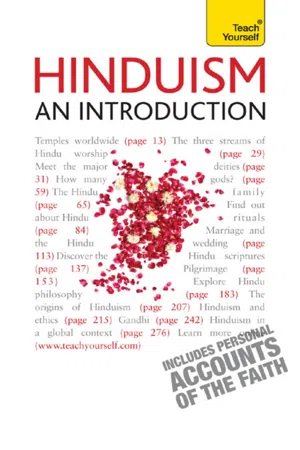
Hinduism, with its rich variety of religious traditions, can often be hard to define. This book is an informative guide to those traditions, and their underlying unity. Covering all important aspects of Hinduism, from deities and temples to mythology and philosophy, and exploring what it means to lead a Hindu life, this book will let you discover this fascinating religion and understand its relevance today.
NOT GOT MUCH TIME?One, five and ten-minute introductions to key principles to get you started.
AUTHOR INSIGHTSLots of instant help with common problems and quick tips for success, based on the authors' many years of experience.
TEST YOURSELFTests in the book and online to keep track of your progress.
EXTEND YOUR KNOWLEDGEExtra online articles at www.teachyourself.com to give you a richer understanding of psychology.
FIVE THINGS TO REMEMBERQuick refreshers to help you remember the key facts.
TRY THISInnovative exercises illustrate what you've learnt and how to use it.
- 254 pages
- English
- ePUB (mobile friendly)
- Available on iOS & Android
eBook - ePub
Hinduism - An Introduction
About this book
Information
Topic
Theology & ReligionSubtopic
Hinduism1
Diversity and unity
In this chapter you will learn:
- about a British Hindu boy’s sacred thread ceremony
- about the Gayatri verse used in morning prayers
- about the importance of pilgrimage
- about priests
- about bathing in the Ganges.
‘My name is Raj Mohan Joshi and my father’s name is Mohan Ganesh Joshi. So my second name is my father’s first name, and his second name is my grandfather’s first name. Our family name is Joshi, which suggests that one of my ancestors probably worked as a priest in the village in western India from which our family comes.
Insight – Hindus in different parts of India follow varied systems of naming individuals
In northern India, a person’s name very often has two parts: the first is his/her personal name, the second is the family name. For example, Ramesh Chatterji, Hemchandra Goswami, Savitri Yadav, Uma Sharma.
In western India a person has three names. The first one identifies the individual, the second one is the father’s name and the third is the family name. For example, Saguna Baburao Patil, Ratan Maganlal Shah.
In the south a person has four names. The first initial denotes the village of origin, the second is the father’s name, the third is the person’s given name and the fourth signifies caste. A famous southern Indian was Sir C. P. Ramaswami Aiyar, Chief Minister of Travancore.
‘I was born in north London. My sister Meena was born when I was about four. My sister and I went to the local primary and secondary schools, wore European clothes and spoke English. At home my parents spoke Marathi and I picked up a few sentences, but because of the school work and constant contact with other pupils, we never learned to read and write Marathi. I am now studying for my A levels and hope to do computer science later on. My sister wants to be a doctor if she can get the necessary A levels in science and get admission to a medical college. I was born in Britain and my first language is English, but my skin is brown. When I was seven years old I became the target of name-calling in my school. Many pink-skinned boys and girls used to call me ‘you bloody Paki’ and say, ‘you Paki go home’. When I said, ‘I was born here’, they used to call me ‘a curry-smelling liar’. That experience put me off ‘spiced food’, so mum prepared sausages and beans for Meena and me, while Mum and Dad ate rice, chapattis and vegetable curry. Sometimes mum prepared chicken curry for dad, sausages or omelette for Meena and me, but she always ate only vegetable dishes.
‘Since I was about five or six I have seen Mum doing a puja after bathing in the morning. She used to stand before a little shrine which is on a shelf in our kitchen. She would wash little metal statues and dry them, then offer a couple of flowers to the statues. She would light a small lamp and wave it about along with an agarbatti (Westeners often call it a joss stick), which had a strong smell. While she was doing puja she said prayers in Marathi that I could not understand. She used to ask me to stand before the statues, joining my hands in front of me, and say, ‘Devaa viddya day’ (God grant me learning). Then she would give me a sugar crystal from the metal bowl in front of the statues. I didn’t really understand how the little statues would give me learning. I was in my primary school where the teacher was helping me to learn to read, write and do sums.
‘The name-calling I had suffered at school made me want to find out more about my Indian family and what they believed in. All of us used to visit a temple every Saturday afternoon. My parents used to take some fruit to place before the statue there, put some coins in the gift box and say prayers in Marathi, a language spoken in western India. Meena and I always did our namaskar by joining our palms together in front of us and bowing low before the statue.
‘Sometimes we visited another temple where there were many statues that looked like men and women, but two statues particularly amused me. One looked like a powerful monkey holding a club and the other was half-man, half-elephant, sitting on a chair and wearing a golden crown. Dad told me the names of the different statues, but it took me many visits to the temple before I remembered them all. He told me that these statues showed how different people imagined God to be.
‘Once we visited a third temple where people said their prayers in a language that Mum and Dad did not understand. Dad said that the language was called Tamil, which was spoken in southern India. (When we got back home I looked at the map of India in the atlas and found the words Tamil Nadu towards the pointed end of the map.) The priest in that temple applied a little ash to my forehead in blessing, but when we visited the temple with many statues (I later learned that they were called murtis) the Pandit there applied a little red powder to my forehead. Dad assured me that God’s blessing was the same; only the colour of the powder was different.
‘In our school there were boys and girls whose parents had come from India or east Africa. Their parents spoke Gujarati and regularly visited a temple which had a different murti. They said they were also Hindus but went to a temple where the grown-ups spoke Gujarati and the prayers were in Gujarati. There were two boys whose parents spoke Punjabi, but one was a Hindu and the other was a Sikh. At that age I found it all very confusing but I accepted my father’s assurance that I was a Hindu like all those people who spoke Punjabi, Gujarati or Tamil and went to different temples.
A sacred thread ceremony
‘A few months before my eighth birthday dad received a letter from my grandfather who had retired from his teaching job and lived in Pune. The letter said:
Raj will soon be eight years old; his sacred thread ceremony has to be performed during his eighth year. It would be a good idea if you all came to India for a short break so that our family priest can do the ceremony in our family house, where your younger brother Prakash now lives with his wife and children. Write and tell me in detail what you think of this idea and whether you four can make the journey when the time comes.
‘Mum and Dad talked about the letter and the thread ceremony for weeks. Dad spoke to the Pandit in the temple about it.
“Does the ceremony have to be performed only during the eighth year?” he asked the Pandit.
“Strictly speaking, yes, Mr Joshi, but if the circumstances are not favourable, the sacred thread can be performed up to the age of twelve. In any case it should be done before marriage. You see, Mr Joshi”, the Pandit went on, “the upanayana, which is the ceremony’s correct name, is an educational sacrament, and it should be celebrated when the boy reaches an age of understanding. He should be able to learn the Sanskrit mantras when he has reached his eighth year. That is about the time he is beginning to find his school work interesting. If you leave it too late, Raj will have considerable difficulty in learning and reciting the Sanskrit mantras.”
“But Panditji,” argued my dad, “Raj was born in this country and his first language is English. He is going to be trained in the English educational system. He doesn’t need to learn Sanskrit mantras.”
“That is true, Mr Joshi,” said the Pandit, “but by experiencing the upanayana, Raj will be initiated into the duties and responsibilities of an adult Hindu. Without the sacred thread ceremony, he will be a Hindu in name only, since he was born of Hindu parents.”
Insight
Upanayana – leading a boy to his Guru’s ashrama, where he is initiated into the vedic education. A Guru is a spiritual teacher.
‘Mum and Dad talked some more and decided that my sacred thread would have to wait until I had finished my primary school education. I would still be younger than 12 and my Dad would have time to save money for our trip to India. Then Dad wrote and explained everything to grandfather.
Insight
In ancient times, boys as well as girls, aged eight, from the three upper varnas experienced this thread ceremony. Hindu society has four varnas: Brahmin, Kshatriya, Vaishya and Shudra.
‘Three years passed. My last term in primary school came to an end. I was to start secondary school six weeks later. During the summer holidays all four of us had arranged to visit India for my thread ceremony. Dad had booked our flight to Mumbai, and because we had British Passports our visas were also arranged in good time. Meena and I were looking forward to our first air journey. We would meet grandfather and grandma for the first time. We were asked to address them as Ajoba and Aji when we met them. We also looked forward to meeting Uncle Prakash – Prakash-kaka, Auntie Leela – Leela-kaku, our cousins Vasant and Gauri, Dad’s sister Asha-attya, her husband and their son, Arun. Mum and Dad bought saris, shirts, dresses, earrings, two watches and perfume sprays, so that everyone in our family in India would get a present.
‘When all the passengers were in their seats the captain announced that we would take off in ten minutes. Mum and Dad said a prayer to the god Ganesha for a safe journey to Mumbai.
‘There were many Indian families on the plane, but I could not tell whether they were all Hindus.
‘Our plane landed in Mumbai at midday. It had rained that morning but as we got off the plane the air was hot and humid. Passport check, security and customs formalities took nearly an hour. Prakash-kaka and Leela-kaku met us outside the airport. Dad and Prakash hugged each other. We went by taxi to Leela-kaku’s brother’s place at Dadar, a little suburb of Mumbai, where we all freshened up. Leela-kaku then lighted a little ghee lamp, put a dab of red powder on our foreheads and waved the lamp in front of us to welcome us and ward off evil spirits. We all made our namaskars to Ganesha and other gods in the shrine in the kitchen before having a late lunch.
‘The next day we travelled by train to Pune. It was very sultry in Mumbai and the noise of car horns never seemed to stop. As the train left Dadar station and travelled towards Pune, the noise and the crowds of Mumbai vanished. I enjoyed the journey through the mountains; it was less dusty and we passed through 22 tunnels. Soon we reached Pune and met Ajoba and Aji. My grandparents cried as they hugged Meena and me. Dad and Mum bowed low before them and touched their feet. Prakash-kaka and my auntie did the same.
‘Ajoba and Aji lived in a flat with two large rooms, a kitchen with a dining table and folding metal chairs, a toilet with white tiles and a pan sunk in the floor and a bathing room. At night, all the men slept in one room and all the women in the other room. During the day, the bedding was rolled up and the rooms became sitting-rooms. We stayed in Pune for three weeks. Ajoba took Meena and me to see various temples. I liked the Ganesha temple, which was about 30 years old and the Devi temple on the hill, which was over 200 years old. At the Ganesha temple I saw two holy men, which was a new experience for me. Outside the Rama temple there was a cow standing in the middle of the road, quietly eating some grass. No one tried to move the animal and many people respectfully touched its back as they passed it. Ajoba said that different Hindus see the One God in different murtis, and believe that trees and animals also have the spirit of God in them. A cow is considered holy.
‘A few days after our arrival in Pune, our family priest – whom we always called Guruji – came and discussed the arrangements for my sacred thread ceremony. It was decided to hold the ceremony in Ajoba’s flat. All our relations and some very close friends of Ajoba and Prakash-kaka attended the ceremony. I will always remember the important rituals.
Insight
The boy is invested with the sacred thread which is a loop of strong cotton thread with three strands. It is worn re...
Table of contents
- Cover
- Title
- Copyright
- Acknowledgements
- Contents
- Meet the authors
- Only got a minute?
- Introduction
- 1 Diversity and unity
- 2 The temple
- 3 Murtis and mythology
- 4 Gods and priests
- 5 The family
- 6 Religion in the home
- 7 Family rituals and ceremonies
- 8 Scriptures
- 9 Pilgrimage
- 10 Liberation; enlightenment; the place of the Guru
- 11 Hindu philosophy
- 12 The path of loving devotion
- 13 The beginnings of Hinduism
- 14 Ethics
- 15 Hinduism since 1757
- 16 Mohandas Karamchand Gandhi
- 17 Some aspects of Hinduism today
- 18 Global Hinduism
- Taking it further
- Glossary
- Index
Trusted by 375,005 students
Access to over 1.5 million titles for a fair monthly price.
Study more efficiently using our study tools.
Frequently asked questions
Yes, you can cancel anytime from the Subscription tab in your account settings on the Perlego website. Your subscription will stay active until the end of your current billing period. Learn how to cancel your subscription
No, books cannot be downloaded as external files, such as PDFs, for use outside of Perlego. However, you can download books within the Perlego app for offline reading on mobile or tablet. Learn how to download books offline
Perlego offers two plans: Essential and Complete
- Essential is ideal for learners and professionals who enjoy exploring a wide range of subjects. Access the Essential Library with 800,000+ trusted titles and best-sellers across business, personal growth, and the humanities. Includes unlimited reading time and Standard Read Aloud voice.
- Complete: Perfect for advanced learners and researchers needing full, unrestricted access. Unlock 1.5M+ books across hundreds of subjects, including academic and specialized titles. The Complete Plan also includes advanced features like Premium Read Aloud and Research Assistant.
We are an online textbook subscription service, where you can get access to an entire online library for less than the price of a single book per month. With over 1.5 million books across 990+ topics, we’ve got you covered! Learn about our mission
Look out for the read-aloud symbol on your next book to see if you can listen to it. The read-aloud tool reads text aloud for you, highlighting the text as it is being read. You can pause it, speed it up and slow it down. Learn more about Read Aloud
Yes! You can use the Perlego app on both iOS and Android devices to read anytime, anywhere — even offline. Perfect for commutes or when you’re on the go.
Please note we cannot support devices running on iOS 13 and Android 7 or earlier. Learn more about using the app
Please note we cannot support devices running on iOS 13 and Android 7 or earlier. Learn more about using the app
Yes, you can access Hinduism - An Introduction by Owen Cole,V P Hermant Kanit in PDF and/or ePUB format, as well as other popular books in Theology & Religion & Hinduism. We have over 1.5 million books available in our catalogue for you to explore.