There are many brilliant books out there, which have not been published because their
author has not been able to successfully navigate the minefield that is finding a publisher. In many cases, authors make basic mistakes in their submissions, which ensure that they do not even get read by the correct person. Even if they do reach someone with decision-making power, they often fail to clearly explain the proposition of their book, or the target market.
Claire Gilman is the perfect person to help you find a publisher for your manuscript. She
has done it successfully, having had twenty of her own books published. She has spoken
to many commissioning editors and agents about what they look for (and look to avoid) in a submission. And she has worked as a literary consultant, helping all sorts of authors to improve their proposals. Now, she combines all this wisdom into one book, explaining clearly 50 common mistakes which authors make, and how you can avoid them and ensure that your work receives the attention and the publisher that it deserves.
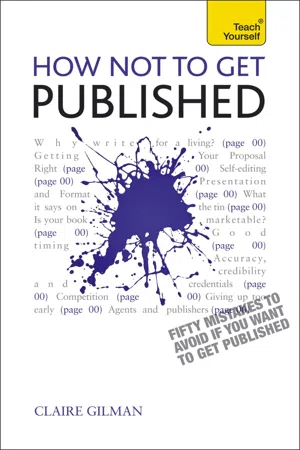
eBook - ePub
How NOT to Get Published
Fifty mistakes to avoid if you want to publish your creative writing
- 192 pages
- English
- ePUB (mobile friendly)
- Available on iOS & Android
eBook - ePub
How NOT to Get Published
Fifty mistakes to avoid if you want to publish your creative writing
About this book
Information
Topic
Personal DevelopmentSubtopic
Writing & Presentation Skills1
Why write?

In this chapter you will learn:
• That there are common traps that can trip up the unwary writer
• How writing can be an integral and rewarding part of your life
• How this book can help you
• What’s in it for you, the writer.
The very fact that you are reading the opening pages of this book suggests that you have a passion for writing, a message that you wish to share with a wider audience and/or a desire to see a writing project in print. And I am delighted to hear it because I love writing. Yes, it can be fun and fulfilling, yet frustrating and challenging in equal measure, but it is always interesting.
What draws us to write is different for each individual and yet there are also common bonds that bind writers. Often, there is a love of language – just playing with words and how they fit together can be a joy in itself. For many, it is simply the best form of self-expression, and writing down thoughts and feelings can bring meaning and clarity to your ideas or to a situation. For those of you who have specialist knowledge or who have undergone remarkable experiences, what better way to share your gifts with a wider audience than through the written word?
The desire to write, then, is shared, and, irrespective of the genre of book you have chosen, it behoves us all to produce the very best writing for our readers that we can. And herein lies the problem. The enthusiasm and intention of novice writers is undeniable, but there are many common pitfalls and mistakes that can befall the inexperienced writer and, sadly, these often result in a manuscript being rejected by prospective publishers. The aim of this book is to identify these pitfalls and to point out how they can easily be avoided once you know about them, so increasing the chances that your submission for publication will be successful.
In case you are wondering how I am equipped to help you with your quest, let me share a little bit about myself. I have been writing professionally for nearly 30 years and I love what I do and the fact that I am still learning. In that time, I have interviewed some amazing people and I have written about subjects that I have found fascinating – and I hope the resulting features/books have inspired a similar response in my readers.
As a staff journalist, I have edited consumer magazines specializing in health, parenting, travel and spiritual living – all of which are subjects close to my heart – and I am currently the co-editor of Kindred Spirit magazine. As a freelancer, I have contributed to women’s magazines and national newspapers. I have written over a dozen non-fiction books for adults and a series of creative non-fiction titles for children under the pen name Rory Storm.
I am also a workshop leader and an editor for the writing consultancy The Writers’ Workshop, specializing in non-fiction and life writing. It is hugely rewarding to be able to help new writers to get their ideas and writing into shape for possible publication. Over the years, I have seen many of the same writing blunders cropping up time and time again in the manuscripts I receive, and I share them here with you in the pages of this book so that you are forewarned and forearmed, and thus able to avoid making the same mistakes.
By seeking some help at the early stages of your writing project, you are ahead of the game and, if you follow the advice contained in these pages, you should be able to polish and finesse your writing and its presentation, so that you can get it to a much better standard before submission.
 | Remember this: Increase your chances from the outset |
Inexperienced writers often make the same mistakes that curtail any chance of their manuscript being accepted for publication. Once these errors are ironed out, or avoided from the outset, the odds of acceptance are increased tenfold.

‘Writers are born, not made’
Like most axioms, there is a modicum of truth in the above statement, but it is not wholly accurate. The desire to write despite all the obstacles that will be put in your way – the pressures of daily living and the inevitable rejections that are a part of every writer’s life – is something that cannot be manufactured, admittedly. You have to want to write quite badly, have a passion for it even, because it can be hard work and getting your book published will not be easy. However, How Not to Get Published is designed to give you some insider knowledge of the publishing world that will help you through the submission process and signpost some of the wrong turnings that you should avoid when writing. It offers short cuts that you might miss if you were travelling the writer’s path alone.
The very fact that you have a desire to improve and are willing to seek help suggests that you are already on the way to becoming a better writer. You could probably find out a great deal of the information contained within these pages for yourself through trial and error but that would be time-consuming and discouraging. This book will save you time and help you to circumvent the more common pitfalls, so that you can concentrate on perfecting your style and honing your skills.
How this book can help
Throughout these pages I draw on my own experiences and my conversations (formal and informal) with my students and those I mentor in their writing careers to find inspiration for what to include. There are some practical exercises (labelled ‘Try it now’) that you can try which are designed to engender greater confidence in your abilities and to get you on the first rung of the publishing ladder. Some you will tackle happily and willingly, I am sure; others, however, will pose more of a challenge and take you outside your comfort zone. None is compulsory but all will be beneficial if attempted.
There are tactics, strategies and useful information (‘Writers’ top tips’) plus aide-memoire boxes (labelled ‘Remember this’) in every chapter that will nudge you in the right direction and help you to remember the most salient points. And in the ‘Case study’ boxes there is also advice from professionals and experts in their field of publishing, which I hope you will find interesting and insightful.
The key points of each chapter are summed up in ‘Focus points’ at the end of the chapter, so that you have the information in a nutshell if you are pressed for time.
Whether you choose to cherry-pick the sections that resonate with you, go straight to the chapter that is most pertinent to the current stage of your writing project, or read this book from start to finish, all are fine. Simply find the path that is best for you and your writing.
What about you?
As you have decided to enlist some help from this book, I am guessing that you probably have your heart set on a writing project that you would like to see through to fruition, but you perhaps doubt your abilities or that you have the talent to finish a book. This self-doubt is common to nearly every writer I know, even the most successful. You are far from alone in your insecurity. Even so, it is probably one of the reasons that you have put off writing your book until now. But, despite your misgivings, if you have the desire to write, then you have to take the plunge and get started. (There are tips for beating procrastination in Chapter 2.)
Whether you want to write a novel, a non-fiction guide, a play or a screenplay, you must devote time and effort to the process if you are going to produce something that an agent or publisher will consider for publication. You may decide that you want to keep your writing as a pleasurable but serious hobby and that getting something into print would be the icing on the cake. Perhaps you want to write as a sideline – a second income stream to your main career. Or possibly writing for a living has been a lifelong ambition and this attempt at getting published is your first toe in the water. Whichever applies to you, you must set aside some time for writing.
Undoubtedly, we all lead busy lives, and this probably means sacrificing something else (surfing the Web, a favourite television show, drinks after work, or keeping up with Facebook friends), but the truth is that, if you want to be published, you have to be disciplined in devoting part of your day or week to your writing project. It does not have to be a long stretch of time, but regularity is what counts when it comes to getting the best out of your writing.
| Remember this: Writing is totally non-discriminatory |
You can write at any age, and in any language. You can be fit or unhealthy, fat or slim, attractive or pug-ugly, supremely well qualified or ill educated… None of this matters – to be a writer, all you have to have is something to say.
As with many things, regular practice is the best way to improve, and, in the case...
Table of contents
- Cover
- Title
- Acknowledgements
- Contents
- 1 Why write?
- 2 Getting Started
- 3 Self-Editing
- 4 Presentation and Format
- 5 Fit for Function?
- 6 Staying Focused
- 7 Characters and Dialogue
- 8 Is Your Book Marketable?
- 9 Good Timing
- 10 Getting Your Proposal Right
- 11 Agents and Publishers
- 12 Giving up Too Early
- 13 New Media and Self-Publishing
- Further Sources of Information
- Copyright
Trusted by 375,005 students
Access to over 1.5 million titles for a fair monthly price.
Study more efficiently using our study tools.
Frequently asked questions
Yes, you can cancel anytime from the Subscription tab in your account settings on the Perlego website. Your subscription will stay active until the end of your current billing period. Learn how to cancel your subscription
No, books cannot be downloaded as external files, such as PDFs, for use outside of Perlego. However, you can download books within the Perlego app for offline reading on mobile or tablet. Learn how to download books offline
Perlego offers two plans: Essential and Complete
- Essential is ideal for learners and professionals who enjoy exploring a wide range of subjects. Access the Essential Library with 800,000+ trusted titles and best-sellers across business, personal growth, and the humanities. Includes unlimited reading time and Standard Read Aloud voice.
- Complete: Perfect for advanced learners and researchers needing full, unrestricted access. Unlock 1.5M+ books across hundreds of subjects, including academic and specialized titles. The Complete Plan also includes advanced features like Premium Read Aloud and Research Assistant.
We are an online textbook subscription service, where you can get access to an entire online library for less than the price of a single book per month. With over 1.5 million books across 990+ topics, we’ve got you covered! Learn about our mission
Look out for the read-aloud symbol on your next book to see if you can listen to it. The read-aloud tool reads text aloud for you, highlighting the text as it is being read. You can pause it, speed it up and slow it down. Learn more about Read Aloud
Yes! You can use the Perlego app on both iOS and Android devices to read anytime, anywhere — even offline. Perfect for commutes or when you’re on the go.
Please note we cannot support devices running on iOS 13 and Android 7 or earlier. Learn more about using the app
Please note we cannot support devices running on iOS 13 and Android 7 or earlier. Learn more about using the app
Yes, you can access How NOT to Get Published by Claire Gillman in PDF and/or ePUB format, as well as other popular books in Personal Development & Writing & Presentation Skills. We have over 1.5 million books available in our catalogue for you to explore.