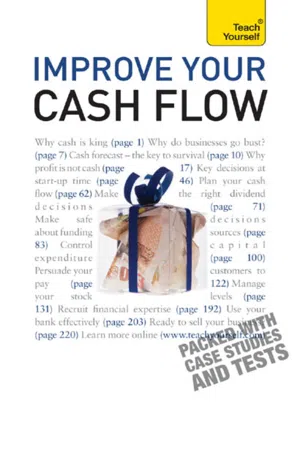
Do you have responsibility for managing cash flow in a small to medium enterprise or as a manager in a larger organisation, but have limited financial experience? Do you worry that lack of attention to this crucial aspect of financial management could lead to disaster for your business? Improve your Cash Flow, written by two leading financial experts, will help employers, managers and consultants to understand more about how to manage cash flow and how it can impact on your business. Whether you are working at home, a growing business or a non-financial manager this book will guide you easily through all the issues, providing practical advice on why cash is king, including why businesses go bust; why profit is not cash, how to deal with creditors and debtors; using supplier credit as a source of finance; debtors and cash collection; financial planning and sources of funding; the pros and cons of debt finance, using your bank effectively and much more.
NOT GOT MUCH TIME?One, five and ten-minute introductions to key principles to get you started.
AUTHOR INSIGHTSLots of instant help with common problems and quick tips for success, based on the authors' many years of experience.
TEST YOURSELFTests in the book and online to keep track of your progress.
EXTEND YOUR KNOWLEDGEExtra online articles at www.teachyourself.com to give you a richer understanding of setting up your own small business.
FIVE THINGS TO REMEMBERQuick refreshers to help you remember the key facts.
TRY THISInnovative exercises illustrate what you've learnt and how to use it.
- 304 pages
- English
- ePUB (mobile friendly)
- Available on iOS & Android
eBook - ePub
Improve Your Cash Flow: Teach Yourself
About this book
Information
1
Why ‘cash is king’
In this chapter:
- the nature of cash flow
- the development of cash flow reporting
- the implications for the smaller business
- cash flow for a business start-up
- the drivers of cash flow
- cash forecasting – the key to survival
The nature of cash flow
Cash flow is the simplest financial concept of all. It is often understood best by those who know very little about accounting. If you have never been distracted by the complexities of the Profit and Loss Account (P&L) and Balance Sheet, you can more easily understand what cash flow is; it is the real money coming in and out of a business during a particular period of time. Cash flow movements are represented by the difference between the cash balance at the beginning of the period and the cash balance at the end. And because most businesses keep their cash in the bank rather than under the bed, this means that cash flow represents the change in the bank account during a particular period, be it a week, month, quarter or year.
We all understand cash flow at the personal level, or at least those of us who avoid personal bankruptcy do so! Though we may not always be effective at managing our cash flow, we understand what it means when we see that bank statement with more outs than ins and the dreaded red ink at the bottom line. We may not be able to do anything about it, but we do not agonize about what each line means, as many of us do when we first try to understand the meaning of the P&L and Balance Sheet.
So why, you may ask, is such a fuss made about cash flow and why is a ‘Teach Yourself’ book necessary? The answer is twofold. Firstly, because it is not enough to understand what cash flow is. Survival in the modern business world is about understanding and managing the drivers of cash flow. Secondly, it is vital also to understand the relationship between cash flow and the other two financial statements, the P&L and Balance Sheet, because financial success is about managing all aspects of finance in a balanced and logical way. Therefore the links between the financial statements – particularly between the P&L and Cash Flow – must be understood if the business is to survive and thrive over the long term.
The development of cash flow reporting
One major change in business thinking over the last half century has been an increase in the emphasis on cash flow reporting. Fifty years ago, external financial reports were based mainly on the P&L and Balance Sheet. There was little if any reference to cash flow, apart from the balance at the end of the period in the list of assets in the Balance Sheet.
Perhaps the assumption was that the Balance Sheet and P&L were all that those managing the business needed to see, that the cash position would be managed by the company Accountant’s team, without the need for any external reporting processes. This belief was reinforced by the correct view that, in any case, cash flow in a particular period is highly volatile and does not reflect the short-term performance of the business, which is revealed through the P&L.
Several things happened to change this view during the early 1970s. The initial trigger was the high-profile insolvency of Rolls-Royce which led to it being put into receivership, and the widespread amazement that such a thing could happen to a large company that was reporting healthy profits. It led to a realization among many analysts, who should have known it already, that the numbers in the P&L and Balance Sheet require judgement and that cash is the only indisputable reality in financial reporting; that is, Cash is King. Wherever judgement is required, mis-statement – either unintentional or fraudulent – is always possible.
This began a period during the last quarter of the twentieth century when distrust in financial reporting became widespread and the concern was heightened by the impact of a period of high inflation. The impact of inflation was that profit calculations became even more judgemental and companies found that apparent profits were not reflected in cash and were therefore not available to pay dividends to shareholders.
Insight
As the latter half of the twentieth century developed, business analysts realized more and more that you must look at cash flow as well as profit if you are to understand the health of a business. But the different views about how this information should be presented made this difficult to achieve.
Just after the turn of the century, the ‘dash to cash’ became even more marked as Enron and several other major companies collapsed at a time when they appeared to be highly profitable. The causes were many and complex but one consequence was the generally accepted view that if analysts had been monitoring Enron’s cash flow more carefully rather than focusing on its profit position, they would have seen it coming.
The implications for the smaller business
During this period, the position of the small to medium sized business was quite different. Those who survived during the periods of high inflation must have known, whether from instinct, advice or common sense, that they could not run their businesses on the basis of a P&L and Balance Sheet alone. These documents, though important and interesting, are by definition produced by accountants well after the key decisions have been made. The information that is important to run the business for short-term survival is the cash available now and the forecast of what will happen to the cash flow if intended plans are carried out.
Of course there were many businesses that did not work this out and these were the ones that went under. There is a classic syndrome of the man or woman who buys a village shop and who borrows the money to set it up and fill it with stock. There is an initial euphoria as the cash flow comes in from the early sales, and the owner decides to take some cash out of the business for an expensive holiday to reward the family for all the hours they have put in. ‘At last there are some profits to pay us back for all the hard work!’
After the holiday, there is a return to reality. The shelves are getting empty and need to be replenished, probably at higher prices. The temporary employees who have been filling in during the holiday need to have their wages paid. Cash is still coming in from sales but it is declining because the range of stock is less than it used to be. The only way of finding the cash to bring the stock back to previous levels is to ask the bank manager for more money but he wants to see a cash forecast and P&L first. Soon the windows will be boarded up and the ‘for sale’ notice outside.
This story reminds us of two points which we will be building on during these first few chapters. Firstly, it is the cash flow forecast that is the vital document for running a business. A retrospective cash flow report may be interesting and informative, but it is then too late to do anything to change it. Secondly, despite the earlier reservations about the P&L, it is an important document. It tells you how much money you are making and thus, among other things, provides guidance about how much it is prudent to take out as owners’ salary or dividend.
Insight
You must look at both the Profit & Loss Account and the Cash Flow Statement to fully understand the health of a business; it is not ‘either/or’. You must also be able to forecast them both in advance with maximum possible accuracy.
Cash flow for a business start-up
Let’s illustrate the simplicity of cash, compared to the other financial statements, by a short exercise, based on what happens to the cash position of a new start-up. It is simplified to make things easier at this stage, but its principles apply to any and every business...
Table of contents
- Cover
- Title
- Copyright
- Contents
- Welcome to Improve Your Cash Flow
- Only got a minute?
- Only got five minutes?
- Only got ten minutes?
- Acknowledgements
- 1 Why ‘cash is king’
- 2 Profit and cash flow
- 3 The impact of the business model
- 4 Key decisions at start-up time
- 5 Cash flow planning
- 6 Sources of funding
- 7 Controlling capital expenditure
- 8 Debtors and cash collection
- 9 Managing stock levels
- 10 Using supplier credit as a source of finance
- 11 Alternative routes to financing
- 12 Formats for cash flow reporting
- 13 Recruiting financial expertise
- 14 Using your bank effectively
- 15 ‘Cash is king!’
- Answers to Testing Yourself
- Appendix
- Taking it further
- Glossary
- Index
Trusted by 375,005 students
Access to over 1.5 million titles for a fair monthly price.
Study more efficiently using our study tools.
Frequently asked questions
Yes, you can cancel anytime from the Subscription tab in your account settings on the Perlego website. Your subscription will stay active until the end of your current billing period. Learn how to cancel your subscription
No, books cannot be downloaded as external files, such as PDFs, for use outside of Perlego. However, you can download books within the Perlego app for offline reading on mobile or tablet. Learn how to download books offline
Perlego offers two plans: Essential and Complete
- Essential is ideal for learners and professionals who enjoy exploring a wide range of subjects. Access the Essential Library with 800,000+ trusted titles and best-sellers across business, personal growth, and the humanities. Includes unlimited reading time and Standard Read Aloud voice.
- Complete: Perfect for advanced learners and researchers needing full, unrestricted access. Unlock 1.5M+ books across hundreds of subjects, including academic and specialized titles. The Complete Plan also includes advanced features like Premium Read Aloud and Research Assistant.
We are an online textbook subscription service, where you can get access to an entire online library for less than the price of a single book per month. With over 1.5 million books across 990+ topics, we’ve got you covered! Learn about our mission
Look out for the read-aloud symbol on your next book to see if you can listen to it. The read-aloud tool reads text aloud for you, highlighting the text as it is being read. You can pause it, speed it up and slow it down. Learn more about Read Aloud
Yes! You can use the Perlego app on both iOS and Android devices to read anytime, anywhere — even offline. Perfect for commutes or when you’re on the go.
Please note we cannot support devices running on iOS 13 and Android 7 or earlier. Learn more about using the app
Please note we cannot support devices running on iOS 13 and Android 7 or earlier. Learn more about using the app
Yes, you can access Improve Your Cash Flow: Teach Yourself by Robert McCallion,Alan Warner in PDF and/or ePUB format, as well as other popular books in Business & Finance. We have over 1.5 million books available in our catalogue for you to explore.