The ability to manage projects in an effective and efficient manner - on schedule and on budget - is a vital skill to have and a real asset for any business and even any home project. Improve Your Project Management helps you to gain this important skill - using a progressive, step-by-step approach. Covering everything from building the right team chemistry to micro-managing finances and dealing with unexpected problems, this book will arm you with all you need to become a great project manager.
NOT GOT MUCH TIME?One and five-minute introductions to key principles to get you started.
AUTHOR INSIGHTSLots of instant help with common problems and quick tips for success, based on the author's many years of experience.
TEST YOURSELFTests in the book and online to keep track of your progress.
EXTEND YOUR KNOWLEDGEExtra online articles at www.teachyourself.com to give you a richer understanding of project management.
FIVE THINGS TO REMEMBERQuick refreshers to help you remember the key facts.
TRY THISInnovative exercises illustrate what you've learnt and how to use it.
- 224 pages
- English
- ePUB (mobile friendly)
- Available on iOS & Android
eBook - ePub
Improve Your Project Management: Teach Yourself
About this book
Information
1
Projects, projects and projects
In this chapter you will learn:
- About the what, why, where, when and how of projects
- What the Five Fundamentals of a project are
- How the Three Dimensions define its boundaries
- How the patterns of its life cycle vary
Projects old and new
When the Egyptian Pharaoh Cheops died, in 2612 BCE, he was buried in what we now call the Great Pyramid of Giza. Ranked for over 43 centuries as the tallest structure on Earth, this huge edifice is said to have taken over twenty years and almost seven million person-weeks of effort to complete. The finished structure contained over two million blocks of stone, each with an average weight of 2.5 tons. In its original form it rose some 146 metres above a square base whose sides are exactly aligned to the four points of the compass and measured almost 230 metres. A massive project – even by modern day standards – but not the only one in our history.
The ‘top one hundred’ list of humankind’s projects includes many other ancient structures such as the Colossus of Rhodes, the Coliseum of Rome, the Great Wall of China, the Mayan temples of Central America, the Pharos of Alexandria and the megalithic stone circle at Stonehenge, England. But the projects that led to these huge structures were rare, once in a generation, events.
Now, things are different. The project has become an everyday event. It’s a regular feature of all our lives and, for many of us, it’s a common-place experience to be involved in a project, either at work or at home. So why has this happened?
Projects now
Projects are about change. Without exception, they alter, modify, even transform the world in which we live. To do that they act in ways that are creative, energetic and active. The attraction of the project as a change-creating mechanism is both considerable and obvious. But this only goes part way to telling us why our use of the project has changed – why it has become a part of our everyday lives.
Insight
It’s worth asking yourself, at least once a week, a question that goes something like this: ‘Which of my current tasks would be completed more efficiently if I treated it as a project?’ Write the answer down, keep it safe and – if the same task comes up again next week – convert it into a project.
The other part of the answer lies in the fact that we have all become more aware of the power of the project. For not only does the project create things, it also enables us to use our resources more efficiently and effectively. Today’s business professional uses it to plan, direct and execute the ways in which organizational resources are used. In our homes we can use the project to enhance the quality of our lives. As a result, the project has become a major contributor to survival and growth in all organizations, whatever their aims, products or services might be, and a tool for us all to use to shape our lives.
But this isn’t the only reason. For the world has also changed. It is, for better or for worse, different from the one that our grandfathers and fathers lived and worked in. Our projects are larger, more ambitious and far more complex. Boston, USA’s Big Dig project which replaced 12 kilometres of city centre highway, China’s ambitious 40-year project to connect the Yangtze, Hai, Huai and Yellow Rivers, Greece’s 670-kilometre Egnatia Highway, the joint American and Japanese Hayabusa probe to the asteroid Itikawa, the world’s biggest hydroelectric river dam, the Three Gorges Dam in China and the worlds tallest hotel, the 321-metre high Burj Al-Arab hotel in Dubai are all examples. Our projects also have shorter life spans. In our market places the tides of change are now global, rather than local or national. What happens in Tokyo on Monday is with us on Tuesday – if not before! This means that customer-led organizations, who need to respond to the desires of their customers, need a mechanism, a process, to enable them to do just that – and quickly.
The project is, without doubt, the answer to that need. It’s more efficient than the programme, that sequence of activities with a specific purpose of generating incremental change that is so common in our organizations. The project acts as a lens through which an organization or an individual can focus resources and abilities towards a desired outcome. In short, the project enables the organization to delight its customers and us, as individuals, to achieve our goals.
How and why
At the core of the project lies the act of doing. Projects are about work, actions, building, re-building, achievements, deliverables and outcomes. But to be successful they must be managed with care and forethought – in ways that ensure that all of this ‘doing’ is carried out efficiently and effectively and focused towards a common endpoint. If we fail to do this then our projects will finish late, generate outcomes that are incomplete or inadequate and do so at costs that exceed our planned expenditure. These sorts of project – the failures of the project world – have ill-defined tasks and deliverables, and inappropriate organizations. They are, as you’ll see in Chapter 12, poorly led, with ineffective communication systems and isolated project teams. Their plans are inflexible and inadequate. Successful projects plan and track measurable tasks and goals. They build on success in short-term deliverables to generate further successes in complex long-term outcomes. They look for results now, rather than later. Their problems are detected early; the creativity, commitment and energy of their teams drive their projects to success.
Insight
Project success comes when you achieve measurable goals. Failure happens when you don’t have clear-cut identified goals.
To make those things happen in our projects we need a map to help us steer our way, a framework from within which we can view the detail of the following chapters of this book, an image that tells us about the project process. Figure 1.1 answers all these needs.
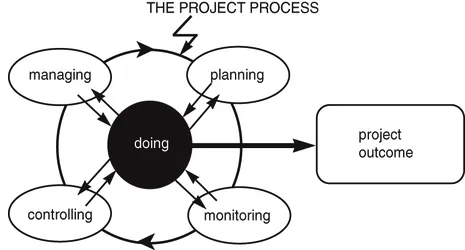
Figure 1.1 The project process.
This not only confirms that the act of doing is core to the project process – it also tells us that it doesn’t stand alone. For doing needs to be supported and reinforced by the acts of managing, planning, monitoring and controlling. But all of these need, if they are to be effective, to be carried out within an arena that is built on the foundations of good project management – which is where you come in.
But your involvement has its entry conditions.
There are three criteria that you have to meet if you are going to become an effective, creative, change-generating project manager:
First: | You have to need and want to be a project manager. |
Second: | You must have the opportunity – either at work or at home – to be able to explore being a project manager. |
Third: | You must have enough knowledge of the what, how, why and when of being a project manager. |
The first two of these are down to you. The third one – the knowledge of the what, how, why and when of project management – is what this book is about. But first, before we reach out for that knowledge, what we need to do is to take a good hard look at the project itself.
Big or small
Most people will have heard about at least one big project. The ones that catch the public eye are usually about creating or doing things that are significant, large, expensive and well publicized, like NASA’s Mars project, Beijing’s 2008 Olympics or Fédération Internationale de Football Association’s (FIFA) World Cup.
But not all of our projects are as ambitious or as massive or as costly as these. For every day, all over the world, millions of projects take place. They are launched, planned, monitored and completed with smaller outcomes, much more modest costs and even shorter time scales.
Insight
The total world spend on small projects is estimated to be between 50 and 100 times larger than the total spend on big or mega projects.
New products are being launched, new books published, shops and restaurants ‘re-imaged’ or ‘restyled’ and old or new businesses moved into new offices. The majority of these have deliverables that are modest, by any standards. For example, beverage vending machines are installed, customer record forms used by Sales Departments are modified, holidays are planned and taken.
If you cast your mind bac...
Table of contents
- Cover
- Title
- Copyright
- Contents
- Only got a minute?
- Only got five minutes?
- Introduction
- 1 Projects, projects and projects
- 2 Which project?
- 3 Your project organization
- 4 Plans for your project
- 5 Managing your project
- 6 Your project team
- 7 Managing your project money
- 8 Monitoring and controlling your project
- 9 Solving your project problems
- 10 Closing your project
- 11 Small projects
- 12 Project failure and success
- 13 Key issues for project management
- 14 The changing face of project management
- 15 Taking it further
- Glossary
- Index
Trusted by 375,005 students
Access to over 1.5 million titles for a fair monthly price.
Study more efficiently using our study tools.
Frequently asked questions
Yes, you can cancel anytime from the Subscription tab in your account settings on the Perlego website. Your subscription will stay active until the end of your current billing period. Learn how to cancel your subscription
No, books cannot be downloaded as external files, such as PDFs, for use outside of Perlego. However, you can download books within the Perlego app for offline reading on mobile or tablet. Learn how to download books offline
Perlego offers two plans: Essential and Complete
- Essential is ideal for learners and professionals who enjoy exploring a wide range of subjects. Access the Essential Library with 800,000+ trusted titles and best-sellers across business, personal growth, and the humanities. Includes unlimited reading time and Standard Read Aloud voice.
- Complete: Perfect for advanced learners and researchers needing full, unrestricted access. Unlock 1.5M+ books across hundreds of subjects, including academic and specialized titles. The Complete Plan also includes advanced features like Premium Read Aloud and Research Assistant.
We are an online textbook subscription service, where you can get access to an entire online library for less than the price of a single book per month. With over 1.5 million books across 990+ topics, we’ve got you covered! Learn about our mission
Look out for the read-aloud symbol on your next book to see if you can listen to it. The read-aloud tool reads text aloud for you, highlighting the text as it is being read. You can pause it, speed it up and slow it down. Learn more about Read Aloud
Yes! You can use the Perlego app on both iOS and Android devices to read anytime, anywhere — even offline. Perfect for commutes or when you’re on the go.
Please note we cannot support devices running on iOS 13 and Android 7 or earlier. Learn more about using the app
Please note we cannot support devices running on iOS 13 and Android 7 or earlier. Learn more about using the app
Yes, you can access Improve Your Project Management: Teach Yourself by Phil Baguley in PDF and/or ePUB format, as well as other popular books in Business & Project Management. We have over 1.5 million books available in our catalogue for you to explore.