Whether you are embarking on a new course, undertaking professional or vocational training or simply want to pass your driving test, you will find this comprehensive and practical guide extremely useful. Full of information on how to maximize your study time, the book will enable you to think in a critical manner, write strong essays, reports and presentations and balance your studies with other commitments such as work or family life. It also offers hints on good revision and exam techniques. Authoritative and very readable, Improve Your Study Skills gives you the tools to succeed.
NOT GOT MUCH TIME?One, five and ten-minute introductions to key principles to get you started.
AUTHOR INSIGHTSLots of instant help with common problems and quick tips for success, based on the author's many years of experience.
TEST YOURSELFTests in the book and online to keep track of your progress.
EXTEND YOUR KNOWLEDGEExtra online articles at www.teachyourself.com to give you a richer understanding of study skills.
FIVE THINGS TO REMEMBERQuick refreshers to help you remember the key facts.
TRY THISInnovative exercises illustrate what you've learnt and how to use it.
- 208 pages
- English
- ePUB (mobile friendly)
- Available on iOS & Android
eBook - ePub
Improve Your Study Skills: Teach Yourself
About this book
Information
Topic
Personal DevelopmentSubtopic
Self Improvement1
Introduction
In this chapter you will learn:
- how you can use this book to develop your study skills
- how you can gain more confidence
- how positive thinking can help you.
Who should read this book?
Perhaps you are following a university course. Or maybe you’re aiming at a one-off event such as the written portion of the driving test or a work-based seminar. Or maybe you’re trying to gain a work-based qualification such as a national vocational qualification (NVQ) where your competence is assessed ‘on the job’. Anyone who needs to learn, in short, can gain from some – or all – of the tips and ideas contained in this book. However, it will be especially useful for those people who are often referred to as ‘mature students’ and those people approaching independent study for the first time. This would include both new learners and returning learners. It will be useful to anyone who has had difficulties in focusing on their studies in the past or who has no idea where to start with a new course.
In many cases, students will be starting out on a new path in their lives and will need some guidance along the way. If you’re a first-year undergraduate or have not studied for some time, you may be surprised by how independent in your studies you will be expected to be. If you’ve been at school up until this point in your studies, or if your last experience of studying was some time ago, you will find that, although help and support will be available to you, you will need to find out a lot of things for yourself and develop your own way through your studies. Everyone will find slightly different ways to study and will choose their own path, using their own combination of study skills, tools and aptitudes. This book is designed to help you to develop the skills and tools you need to study effectively and to enable you to find, develop and use your own blend of aptitudes to ensure that you are successful in your studies.
How to use this book
This book can be used in a number of ways. You could decide that you are going to improve all areas of your study skills before you start your course and are prepared to sit down and read this book from cover to cover. Alternatively, you could already have noticed a particular area or two of weakness in your study skills and for this you will be able to dip into the book for the appropriate chapters to help you out. You might also choose to keep this book by you as you go through your course, using it as you come up against particular problems.
One thing to remember is that you will not become an expert student overnight. The process of learning study skills must be taken at a speed to suit you – your existing level of skills, your priorities, your current commitments. You may be able to spare the time and effort to read straight through this book in one sitting but this will not mean you have mastered all the study skills discussed. This takes time and plenty of practice, as you will need to try them out on the different types of assignment you’re tackling to see how you can use them best.
To use this book effectively, you will need to become familiar with the layout. Check out the contents list now. You’ll see that each chapter deals with one broad area of study skills – there’s a chapter on note taking, for instance, and one on effective reading. If you know that you have problems in any of these specific areas, then this will help you to focus on them quickly and easily. Next, if you flick quickly through the chapters, you will see that they all open with a short section starting ‘In this chapter you will learn’ followed by a few bullet points giving a summary of the expected learning outcomes. This tells you where you can expect to be if you use the information contained in that chapter. This is followed by fairly short sections on all the topics contained in the subject being dealt with in the chapter. This helps in two ways – first, it breaks the information down into more easily digestible chunks and, second, it gives you sub-headings that you can skim through and then focus in on the particular information that you need.
At the end of each chapter you will find three sections – a summary, a quick revision test and a section entitled ‘10 things to remember’. The summary can be used both as quick revision of what you have learned during the chapter (and, of course, if you see something in the summary that you think you’ve not really got to grips with, you can then go back and read that section again) or as an outline of what you can expect to find in the chapter before you read it. The ‘10 things to remember’ will help you focus on the key points that you will need to take away from the chapter and apply to your real-life studies. In addition, throughout the chapters you will find quizzes and questionnaires to help you assess your skills and aptitudes as well as plenty of tips to help you save time and effort in your studies.
What are study skills? Can they be learned?
Many students fail to do as well as they are capable of doing because they lack the vital skills that will help them to learn. They are capable of learning but don’t know how. These are study skills. The term ‘study skills’ covers a variety of techniques that will make your studying activities easier and more effective. These techniques – all of which can be learned – include note taking, reading, writing essays and reports, planning, revising for examinations and sitting examinations.
Study skills also encompass the habits that you will need to acquire to become successful at studying. These habits establish patterns in your study timetable and ways of doing things that will help you to make the most of your study time. Of course, all these skills, habits and techniques have different components that will be useful at different times. Effective reading, for example, can be split into planning, skimming, speed reading, setting goals and developing a reading strategy and you will need all these components if you are to become proficient at reading to learn. Even if you already have one or more of these skills, you will be able to improve by following the advice and tips given in this book. In effect, you will learn how to learn. The major tasks that you will undertake as a student – writing essays, revising for and sitting exams, giving a presentation – all require a combination of study skills. To be successful, you will need to bring together the right techniques and habits and to have these skills at a sufficiently proficient level. While you are becoming proficient at the individual skills, you will also be developing the ability to combine the different skills as required.
Let’s take the example of note taking. This is a very important study skill and one that you will find very difficult to manage without. In Chapter 4 on note taking you will find different ways of recording what you have learned from lectures or from your reading. Why not try them all? One will be sure to be more suitable for you than others and you will probably find that you will be able to use different methods in different situations. For instance, if you’re brainstorming ideas prior to writing an essay, you may find it useful to use a spider diagram, jotting down ideas as they come into your head and then linking them up and organizing them into a suitable essay plan. If you’re reading a difficult text and want to summarize it for future use or revision, you may want to use a highlighter pen to pick out the important bits in the text. If you currently have problems with note taking – perhaps you find it difficult to decide quite what you should be recording or you know only one method of taking notes – then reading this chapter will help you to develop your note taking skills so that you can take notes that are easy for you to understand, are well organized and, above all, relevant.
Of course, you will already have lots of skills that will be useful in your studies and, as I’ve already said, study skills are, like any other skill, made up of several elements. Some of these you may already have developed, even without knowing it. It might be that you are already a relatively fast reader or perhaps you are very organized and able to keep to deadlines. Such skills are obviously useful when studying. However, there are a whole host of other skills that you may have acquired throughout your life but which you might not so readily consider to be ‘study skills’. These might include an ability to work independently, stamina, an analytical mind and an ability to concentrate. All these, too, will undoubtedly help you in your studies.
Check your skills
Knowing what skills you already have is very important, as this will enable you not only to make the most of these existing skills but also to identify where you need to improve. So now let’s look at how you can identify the skills that will help you in studying. Sometimes it can be difficult to identify our own abilities and to see what we have to offer in any situation, so it can be a good idea to go through the exercise below with someone who knows you reasonably well and whom you can trust to be honest with you. Perhaps you can pair up with another student on your course for a discussion about this exercise so that you can, in turn, help them to discover their own skill sets.
Look at this list and, being as honest with yourself as possible, mark off all the skills you already possess, i.e. those where you feel you can give a reasonable performance:
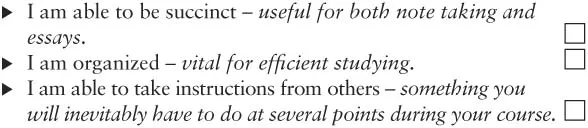
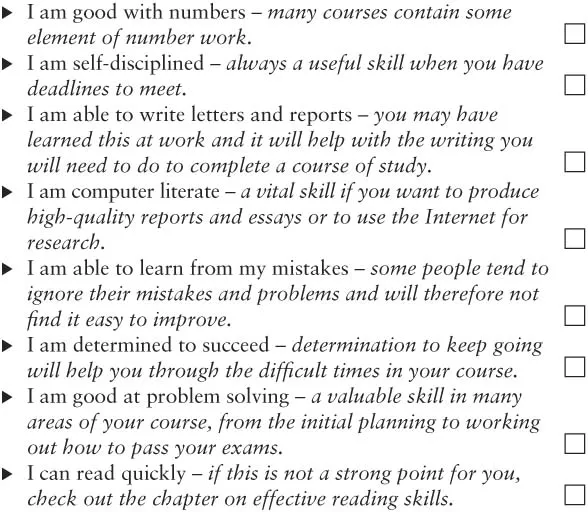
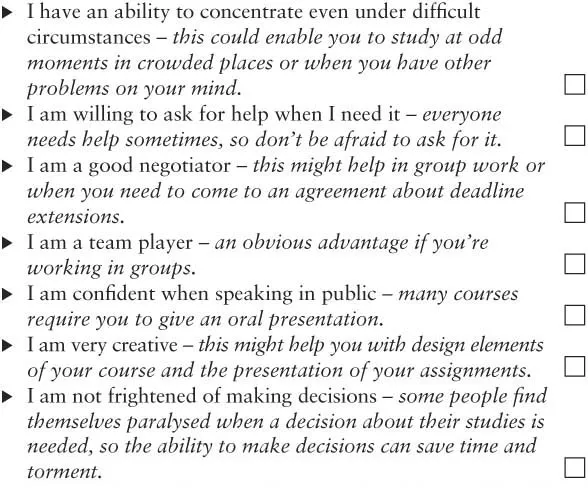
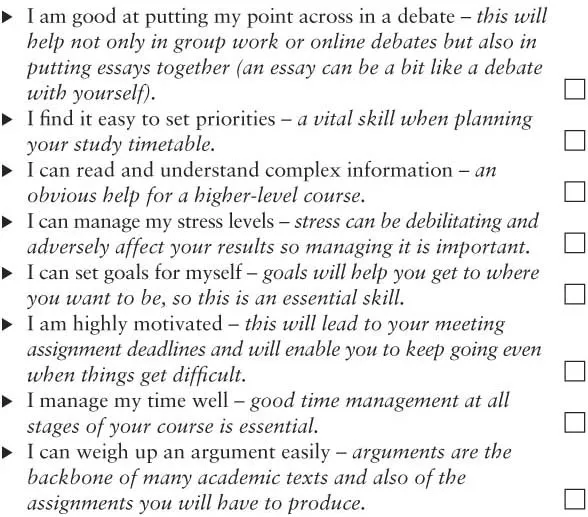
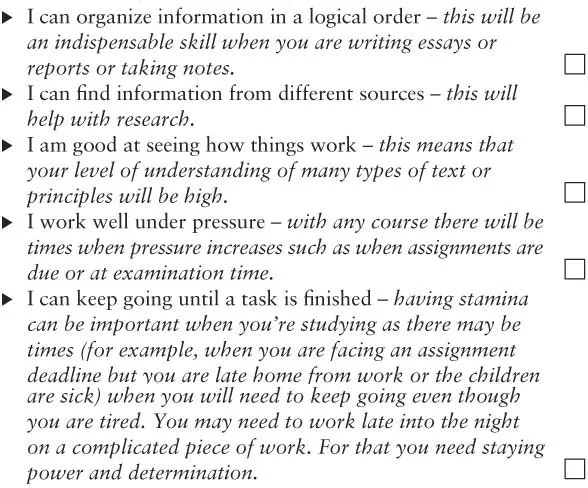
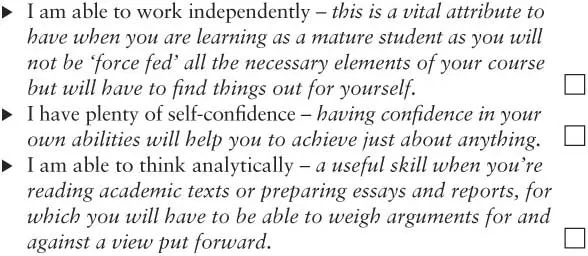
Were you surprised at just how many skills might be involved in studying? And surprised, too, at how many of them you already possess? These are all elements of the main skills you need to help you in your studies and you will need to master many of them over the course of your studies.
So, as you can see, study skills are vital and the ones that we do not already possess can certainly be learned. If you follow the advice in the appropriate chapters in this book and do the exercises and the revision tests, you will certainly be able to improve your study skills.
Study smarter – not harder or longer
Many people believe that, to be a successful student, it is necessary to study into the night, making endless notes, reading until your eyes hurt. This is not true. Of course, to pass exams and to get good coursework scores requires plenty of work but it should not be necessary to abandon all other things in your life or to do so much studying that you feel exhausted. With the right skills, applied in the right way, studying at any level can be easier than that. Lots of things can help you to cut down on the amount of time that must be spent and on the effort that must be made to ensure good results. These include:
- Making your notes brief and to the point – see Chapter 4.
- Reading more quickly – see Chapter 3.
- Being more selective in what you read – see Chapter 3.
- Planning … and more planning – see Chapter 2.
- Managing your time – see Chapter 2.
Working smarter – rather than harder or longer – is a vital skill for all students to learn, whatever their personal circumstances. You need to learn how to make every minute that you spend on your studies count. Your studying must be effective, so strategies like planning, time management, active learning and motivation are vital for success. So, don’t just sit there staring at your books and notes and not making any progress – that is not effective study. Get organized, know your learning style, set your goals, engage with your notes and books and get great results – quicker.
Insight
If you find it difficult to settle down to study, limit your studying time to just 10 minutes. If, at the end of that time, you do not feel you’ve made progress, go and do something else. Plan your next study period into your schedule immediately.
Confidence is a very important element of working smarter. You need to know – and have complete belief – that you can succeed. ...
Table of contents
- Cover
- Title
- Copyright
- Dedication
- Acknowledgements
- Contents
- Meet the author
- Only got a minute?
- Only got five minutes?
- Only got ten minutes?
- 1 Introduction
- 2 Getting organized
- 3 Effective reading
- 4 Note taking
- 5 Thinking critically
- 6 Research skills
- 7 Improving your writing skills
- 8 Writing essays and reports
- 9 Using technology to learn
- 10 Revision skills
- 11 Exam preparation
- 12 Where to next?
- Answers to quick tests
- Taking it further
- Index
Trusted by 375,005 students
Access to over 1.5 million titles for a fair monthly price.
Study more efficiently using our study tools.
Frequently asked questions
Yes, you can cancel anytime from the Subscription tab in your account settings on the Perlego website. Your subscription will stay active until the end of your current billing period. Learn how to cancel your subscription
No, books cannot be downloaded as external files, such as PDFs, for use outside of Perlego. However, you can download books within the Perlego app for offline reading on mobile or tablet. Learn how to download books offline
Perlego offers two plans: Essential and Complete
- Essential is ideal for learners and professionals who enjoy exploring a wide range of subjects. Access the Essential Library with 800,000+ trusted titles and best-sellers across business, personal growth, and the humanities. Includes unlimited reading time and Standard Read Aloud voice.
- Complete: Perfect for advanced learners and researchers needing full, unrestricted access. Unlock 1.5M+ books across hundreds of subjects, including academic and specialized titles. The Complete Plan also includes advanced features like Premium Read Aloud and Research Assistant.
We are an online textbook subscription service, where you can get access to an entire online library for less than the price of a single book per month. With over 1.5 million books across 990+ topics, we’ve got you covered! Learn about our mission
Look out for the read-aloud symbol on your next book to see if you can listen to it. The read-aloud tool reads text aloud for you, highlighting the text as it is being read. You can pause it, speed it up and slow it down. Learn more about Read Aloud
Yes! You can use the Perlego app on both iOS and Android devices to read anytime, anywhere — even offline. Perfect for commutes or when you’re on the go.
Please note we cannot support devices running on iOS 13 and Android 7 or earlier. Learn more about using the app
Please note we cannot support devices running on iOS 13 and Android 7 or earlier. Learn more about using the app
Yes, you can access Improve Your Study Skills: Teach Yourself by Bernice Walmsley in PDF and/or ePUB format, as well as other popular books in Personal Development & Self Improvement. We have over 1.5 million books available in our catalogue for you to explore.