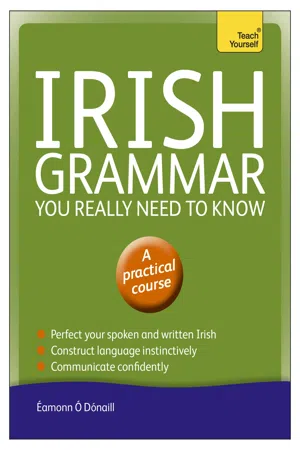
Comprehensive and clear explanations of key grammar patterns and structures are
reinforced and contextualized through authentic materials. You will not only
learn how to construct grammar correctly, but when and where to use it so you
sound natural and appropriate. Irish Grammar You Really Need to Know will help
you gain the intuition you need to become a confident communicator in your new
language.
- 272 pages
- English
- ePUB (mobile friendly)
- Available on iOS & Android
eBook - ePub
Irish Grammar You Really Need to Know: Teach Yourself
About this book
Information
1

Irish spelling, accents and stress
In this unit you will learn about
• The alphabet
• Changes to the beginning of words (lenition, eclipsis)
• Long and short vowels
• Broad and slender consonants
• Word order
• Slendering and broadening
• Syncopation
• Word stress
• Yes and no in Irish

The alphabet
The letters of the basic Irish alphabet are:
a, b, c, d, e, f, g, h, i, l, m, n, o, p, r, s, t, u
The letter v occurs in some loan-words:
veain (van)
vóta (vote)
The remaining letters (j, q, v, w, x, z) occur very rarely (they are mostly found in scientific and mathematical words).
Changes to the beginning of words (lenition, eclipsis)
In Irish (as in other Celtic languages), both the beginning and the ending of a word can change.
The change of form at the beginning of a word is caused by a preceding word. One such change is called lenition (or séimhiú in Irish) and the other eclipsis (urú in Irish). You will see many examples of lenition and eclipsis throughout this book.
Lenition
This change occurs to the following consonants:
b → bh
c → ch
d → dh
f → fh
g → gh
m → mh
p → ph
s → sh
t → th
The remaining consonants (h, l, n, r) cannot be lenited.
Eclipsis
This change occurs to both consonants and vowels.
Here are the consonants that are affected by eclipsis:
b → mb
c → gc
d → nd
f → bhf
g → ng
p → bp
t → dt
The remaining consonants (h, l, m, n, r, s) cannot be eclipsed.
t before vowels and s
t can be placed before an initial vowel. It is followed by a hyphen, except when the vowel is a capital letter:
t-a
t-e
t-i
t-o
t-u
tA
tE
tI
tO
tU
Insight
There is never a hyphen between t and an initial s:
Ts
n before vowels
n can be placed before an initial vowel. It is followed by a hyphen, except when the vowel is a capital letter:
n-a
n-e
n-i
n-o
n-u
nA
nE
nI...
Table of contents
- Cover
- Title
- Dedication
- Acknowledgments
- Contents
- Personal introduction
- 1 Irish spelling, accents and stress
- 2 Articles and nouns
- 3 The genitive case
- 4 Adjectives 1
- 5 Adjectives 2
- 6 Prepositions
- 7 Pronouns
- 8 The verb 1
- 9 The verb 2
- 10 The verb 3
- 11 The verb 4
- 12 The verb 5
- 13 The verb 6
- 14 The verb 7
- 15 The verb 8
- 16 The verb 9
- 17 Cardinal numbers
- 18 Personal numerals
- 19 Ordinal numbers
- 20 Adverbs
- 21 Relative clauses
- 22 Indirect speech
- Glossary of grammatical terms
- Appendix 1: Noun declension; adjectives in the genitive case singular
- Appendix 2: Names of people and places
- Taking it further
- Key to ‘Test yourself’
- Credits
- Copyright
Trusted by 375,005 students
Access to over 1.5 million titles for a fair monthly price.
Study more efficiently using our study tools.
Frequently asked questions
Yes, you can cancel anytime from the Subscription tab in your account settings on the Perlego website. Your subscription will stay active until the end of your current billing period. Learn how to cancel your subscription
No, books cannot be downloaded as external files, such as PDFs, for use outside of Perlego. However, you can download books within the Perlego app for offline reading on mobile or tablet. Learn how to download books offline
Perlego offers two plans: Essential and Complete
- Essential is ideal for learners and professionals who enjoy exploring a wide range of subjects. Access the Essential Library with 800,000+ trusted titles and best-sellers across business, personal growth, and the humanities. Includes unlimited reading time and Standard Read Aloud voice.
- Complete: Perfect for advanced learners and researchers needing full, unrestricted access. Unlock 1.5M+ books across hundreds of subjects, including academic and specialized titles. The Complete Plan also includes advanced features like Premium Read Aloud and Research Assistant.
We are an online textbook subscription service, where you can get access to an entire online library for less than the price of a single book per month. With over 1.5 million books across 990+ topics, we’ve got you covered! Learn about our mission
Look out for the read-aloud symbol on your next book to see if you can listen to it. The read-aloud tool reads text aloud for you, highlighting the text as it is being read. You can pause it, speed it up and slow it down. Learn more about Read Aloud
Yes! You can use the Perlego app on both iOS and Android devices to read anytime, anywhere — even offline. Perfect for commutes or when you’re on the go.
Please note we cannot support devices running on iOS 13 and Android 7 or earlier. Learn more about using the app
Please note we cannot support devices running on iOS 13 and Android 7 or earlier. Learn more about using the app
Yes, you can access Irish Grammar You Really Need to Know: Teach Yourself by Éamonn Ó'Dónaill in PDF and/or ePUB format, as well as other popular books in Languages & Linguistics & Grammar & Punctuation. We have over 1.5 million books available in our catalogue for you to explore.