Comprehensive and clear explanations of key grammar patterns and
structures are reinforced and contextualized through authentic
materials. You will not only learn how to construct grammar correctly,
but when and where to use it so you sound natural and appropriate.
"Italian Grammar You Really Need to Know will help you gain the
intuition you need to become a confident communicator in your new
language.
- 416 pages
- English
- ePUB (mobile friendly)
- Available on iOS & Android
eBook - ePub
About this book
Information
1

Asking for and giving personal information
In this unit, you will learn how to:
• say who you are / what your name is
• say where you are from / what nationality you are
• say what region or city you are from
• say what your occupation and marital status is
• ask other people for similar information
• give similar information about other people
Language points
• io, tu, lui, etc. (subject pronouns)
• essere (present tense)
• chiamarsi (present tense)
• adjectives of nationality, region, city of origin
• plurals of adjectives
• profession, marital status, titles
INTRODUCTION
To give or ask for personal information, you need to know the subject pronouns io, tu, Lei, etc. (I, you, etc.), the verb chiamarsi (to be called), and the verb essere (to be). Look at these examples before going on:
Mi chiamo Anna. | My name’s Anna. |
Sono inglese. | I’m English. |
Sono di Oxford. | I’m from Oxford. |
Lei è italiana? | Are you Italian? |
È di Roma? | Are you from Rome? |
Lui si chiama George. | He’s called George. |
È inglese. | He’s English. |
E lei? | And (what about) her? |
Lei si chiama Georgina. | She’s called Georgina. |
È inglese. | She’s English. |
Focus on grammar
1 IO, TU, LUI, LEI, LEI, NOI, VOI, LORO
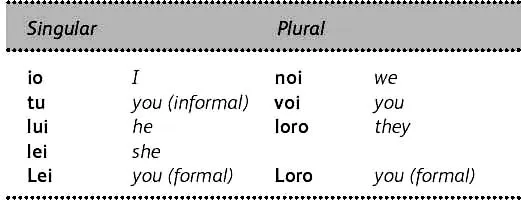
The subject pronouns io, tu, lui, lei, Lei, etc. (English I, you, etc.) are not normally needed in Italian, because the ending of the verb indicates the person carrying out the action. It will sound much more natural if you just use the verb on its own, without the subject pronoun. The subject pronouns can, however, be used:
a when you want to distinguish between he and she, which have the same verb form.
Lui è inglese. | He is English. |
Lei è italiana. | She is Italian. |
b when you want to emphasize a difference or contrast.
Io sono italiano. Lui è inglese. | I am Italian. He is English. |
Noi siamo inglesi ma loro sono scozzesi. | We are English, but they are Scottish. |
c after anche (also, too).
Noi siamo italiani, di Roma. | We are Italian, from Rome. |
Anche voi siete di Roma? | Are you from Rome, too? |
d to make a question sound less abrupt, particularly when using the polite form.
Lei è italiana? | Are you Italian? |
Here are all the subject pronouns:
2 TU OR LEI?
Italian has two forms of address meaning you in the singular: tu (the informal form) used with friends, family, children and animals; and Lei (the formal form, normally written with upper case ...
Table of contents
- Cover
- Title
- Contents
- Meet the author
- Introduction
- 1 Asking for and giving personal information
- 2 Identifying people and things
- 3 Asking about availability
- 4 Talking about location
- 5 Stating choice and preference
- 6 Talking about the present
- 7 Talking about routine and habits
- 8 Talking about possibility and asking permission
- 9 Giving orders and instructions
- 10 Talking about possession
- 11 Talking about events and actions in the past
- 12 Describing the past
- 13 Talking about the future
- 14 Talking about wants and preferences
- 15 Describing processes and procedures
- 16 Talking about likes and dislikes
- 17 Asking for and giving an opinion
- 18 Expressing obligation and need
- 19 Expressing emotions and uncertainty
- 20 Expressing wishes or polite requests
- 21 Expressing regrets
- 22 Expressing conditions
- Taking it further
- Key to the exercises
- Grammar appendix
- Glossary of grammatical terms
- Index
- Copyright
Trusted by 375,005 students
Access to over 1.5 million titles for a fair monthly price.
Study more efficiently using our study tools.
Frequently asked questions
Yes, you can cancel anytime from the Subscription tab in your account settings on the Perlego website. Your subscription will stay active until the end of your current billing period. Learn how to cancel your subscription
No, books cannot be downloaded as external files, such as PDFs, for use outside of Perlego. However, you can download books within the Perlego app for offline reading on mobile or tablet. Learn how to download books offline
Perlego offers two plans: Essential and Complete
- Essential is ideal for learners and professionals who enjoy exploring a wide range of subjects. Access the Essential Library with 800,000+ trusted titles and best-sellers across business, personal growth, and the humanities. Includes unlimited reading time and Standard Read Aloud voice.
- Complete: Perfect for advanced learners and researchers needing full, unrestricted access. Unlock 1.5M+ books across hundreds of subjects, including academic and specialized titles. The Complete Plan also includes advanced features like Premium Read Aloud and Research Assistant.
We are an online textbook subscription service, where you can get access to an entire online library for less than the price of a single book per month. With over 1.5 million books across 990+ topics, we’ve got you covered! Learn about our mission
Look out for the read-aloud symbol on your next book to see if you can listen to it. The read-aloud tool reads text aloud for you, highlighting the text as it is being read. You can pause it, speed it up and slow it down. Learn more about Read Aloud
Yes! You can use the Perlego app on both iOS and Android devices to read anytime, anywhere — even offline. Perfect for commutes or when you’re on the go.
Please note we cannot support devices running on iOS 13 and Android 7 or earlier. Learn more about using the app
Please note we cannot support devices running on iOS 13 and Android 7 or earlier. Learn more about using the app
Yes, you can access Italian Grammar You Really Need To Know by Anna Proudfoot in PDF and/or ePUB format, as well as other popular books in Languages & Linguistics & Italian Language. We have over 1.5 million books available in our catalogue for you to explore.