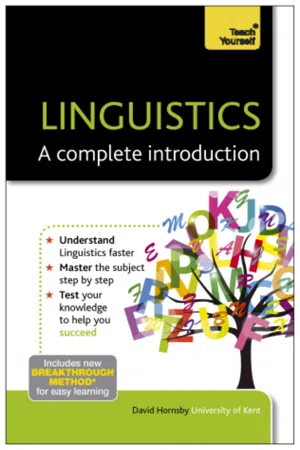
Written by David Hornsby, who is a current Linguistics lecturer and researcher at the
University of Kent, Linguistics - The Essentials is designed to give you everything you need to succeed, all in one place. It covers the key areas that students are expected to be confident in, outlining the basics in clear jargon-free English, and then providing added value features like summaries of key books, and even lists of questions you might be asked in your seminar or exam.
The book uses a structure that mirrors many university courses on linguistics - with
separate chapters focusing on linguistic thought, syntax, sound systems, morphology,
semantics, pragmatics, language acquisition, and much more.
- 256 pages
- English
- ePUB (mobile friendly)
- Available on iOS & Android
eBook - ePub
Linguistics: A Complete Introduction: Teach Yourself
About this book
Information

Thinking like a linguist

Our tasks in this chapter will be to explain what it means to ‘think like a linguist’ and to show how linguists’ assumptions about language often differ from those of the layperson. One might assume, for example, that a linguist would be the first person to turn to when seeking advice on good speech or writing. In fact, few linguists would see it as part of their role to prescribe how language should be used, preferring instead to describe the facts of language as it is used. As we will see later in the chapter, linguists are quick to point out that the bases for our linguistic value judgements generally turn out to be arbitrary, spurious and inconsistent.
In literate societies, we are also used to equating language with its written form, and treating speech as somehow deviant. Linguists make precisely the opposite assumption, reminding us that we all learn our mother tongue at a very young age without the aid of books, and if we learn to read and write in that language at all, we do so only after we have mastered speech. As we will see in this chapter, language looks radically different when we start from a spoken language perspective. It will also become clear that some everyday assumptions we take for granted – for example, the difference between a language and a dialect, or the notion of ‘beautiful’ or ‘primitive’ languages – become highly problematical once our linguistic prejudices are stripped away.
The science of language
It makes sense to start by asking what the term linguistics actually means. The following definition is taken from Collins English Dictionary:
‘Linguistics, n. (functioning as sing.) The scientific study of language’
As a working definition, ‘scientific study of language’ will probably do, but the word ‘scientific’ might appear problematic in this context, because language doesn’t seem to belong to the realm of science in its conventional sense. One certainly doesn’t imagine linguists in laboratories wearing white coats, and it isn’t immediately obvious how one could undertake experiments on language, something that resides ultimately in the head of a native speaker.
It might help if we construe ‘scientific’ here to mean something like ‘objective’, but achieving ‘objectivity’ in linguistics is far from a straightforward task, not least because speakers’ judgements about the same data can differ hugely, making reliable conclusions difficult to draw. For example, while most British English speakers would probably reject the sentence ‘I didn’t do it though but’, it’s perfectly acceptable in some British dialects. Likewise, many English speakers accept ‘innit?’ as a contraction of ‘isn't it?’ but reject it (often vehemently) as a tag question in sentences like: ‘We’re seeing him on Saturday, innit?’ – now commonly used in some varieties of British English. Even for a question as apparently innocuous as ‘Do you speak language X?’, native speaker intuitions may be contradictory or difficult to interpret: responses may be influenced by informants’ attitudes to the language in question (‘Do I approve of X, or even think of it as a proper language? Would I want people to think I use it?’) or to their understanding of the question, which might range from: ‘Do I speak this language every day?’ to ‘Can I understand it, even if I don’t speak it?’, or even ‘Can I manage a few words if the need arises?’ So linguists need to be especially careful when claiming ‘scientific’ objectivity for their findings.
To approach their subject matter objectively, linguists need first to shed a number of everyday assumptions, or ‘language myths’: we’ll be looking at some of these below. The good news is that learning to think like a linguist isn’t difficult: in a real sense, it’s a bit like releasing your inner child, as we’ll see in the next section. A further piece of good news is that, as a native speaker of any language, you’re already in possession of some ‘expert knowledge’! But before you start, you need to grasp two fundamental principles that underpin everything linguists do and that go some way to explaining what ‘scientific’ means for the study of language:
• Principle 1: ‘The spoken language comes first.’
• Principle 2: ‘Linguistics is descriptive, not prescriptive.’
Principle 1: The spoken language comes first
As we saw, thinking as a linguist does is like ‘releasing your inner child’. The following thought experiment will help get you started.
 | Spotlight: Try to forget you can read |
Imagine what your world would be like if the written word were completely alien to you, and letters on the page no more than meaningless squiggles. Since you’re already reading this book, you’re probably finding that quite difficult, but this is of course a world you once knew, albeit when you were rather younger, probably before you started school.

For most adults, the written word takes up a significant proportion of our lives, whether we be reading a novel or daily newspaper, consulting an instruction manual, updating our Facebook status, catching up with the latest Twitter feed or texting a friend. If you’re at university or college, the written word soon becomes a prime focus: you read for a degree, which may well involve writing notes at lectures, where you may be given handouts, and you’ll be asked periodically to commit your thoughts to paper in the form of written essays. Writing is all around us, and modern life and the technological advances we take for granted would be impossible without it.
For linguists, however, writing takes second place to speech. Linguists are not uninterested in the written word: indeed, written material, particularly from earlier, pre-mass media eras, can offer important clues to language structure and linguistic change. Linguists working in the field of literary stylistics devote much of their time to the analysis of written texts. But generally linguists follow the principle of according primacy to speech, for a number of very good reasons:
1 All the world’s existing and extinct natural languages have had native speakers, but only a minority of them have ever had a written form.
While languages such as English, Mandarin, Hindi or Russian all have a long written tradition, many others, particularly those with small numbers of speakers, do not. Many African languages (e.g. Ewe, Wawa, Lugbara), Australian aboriginal languages (e.g. Dyirbal, Warlbiri, Guugu Yimidhirr) and native American languages (e.g. Arawakan, Hopi, Miskito) are not generally used for writing. We know little of the Gaulish language, which was spoken in what is now France before Roman occupation, because Gauls had no written system, and much of what we do know about the language comes from attempts to transcribe it using Latin characters, which were not designed for Gaulish.
Speakers of minority languages in unsympathetic nation states have often been taught that writing is acceptable only in the dominant or ‘official’ language, making it harder for their supporters to develop an accepted written standard if and when those same states later adopt more tolerant attitudes.
Cockney, Brummie, Geordie and Glaswegian (see Case study on next page) have no written form and their speakers are dependent on the conventions of standard English for writing. Estimates put at around 6,000 the number of different languages spoken throughout the world, of which only a fraction have a written form: it would seem perverse – not to say ‘u...
Table of contents
- Cover
- Title
- Dedication
- Contents
- About the author
- Acknowledgements
- Preface
- How to use this book
- 1 Thinking like a linguist
- 2 A brief history of linguistic thought
- 3 Structural linguistics
- 4 The building blocks of language: describing speech sounds
- 5 Laying the foundations: sound systems in language
- 6 Building words: morphology
- 7 A grammar of sentences: syntax
- 8 The Chomskyan revolution: generative grammar
- 9 Semantics: the meaning of ‘meaning’
- 10 Pragmatics: saying what you mean
- 11 Exploring variation in language
- 12 Choosing your language: multilingualism and language planning
- 13 Mechanisms of language change
- Copyright
Trusted by 375,005 students
Access to over 1.5 million titles for a fair monthly price.
Study more efficiently using our study tools.
Frequently asked questions
Yes, you can cancel anytime from the Subscription tab in your account settings on the Perlego website. Your subscription will stay active until the end of your current billing period. Learn how to cancel your subscription
No, books cannot be downloaded as external files, such as PDFs, for use outside of Perlego. However, you can download books within the Perlego app for offline reading on mobile or tablet. Learn how to download books offline
Perlego offers two plans: Essential and Complete
- Essential is ideal for learners and professionals who enjoy exploring a wide range of subjects. Access the Essential Library with 800,000+ trusted titles and best-sellers across business, personal growth, and the humanities. Includes unlimited reading time and Standard Read Aloud voice.
- Complete: Perfect for advanced learners and researchers needing full, unrestricted access. Unlock 1.5M+ books across hundreds of subjects, including academic and specialized titles. The Complete Plan also includes advanced features like Premium Read Aloud and Research Assistant.
We are an online textbook subscription service, where you can get access to an entire online library for less than the price of a single book per month. With over 1.5 million books across 990+ topics, we’ve got you covered! Learn about our mission
Look out for the read-aloud symbol on your next book to see if you can listen to it. The read-aloud tool reads text aloud for you, highlighting the text as it is being read. You can pause it, speed it up and slow it down. Learn more about Read Aloud
Yes! You can use the Perlego app on both iOS and Android devices to read anytime, anywhere — even offline. Perfect for commutes or when you’re on the go.
Please note we cannot support devices running on iOS 13 and Android 7 or earlier. Learn more about using the app
Please note we cannot support devices running on iOS 13 and Android 7 or earlier. Learn more about using the app
Yes, you can access Linguistics: A Complete Introduction: Teach Yourself by David Hornsby in PDF and/or ePUB format, as well as other popular books in Languages & Linguistics & Linguistics. We have over 1.5 million books available in our catalogue for you to explore.