Live Ethically will clear a path through the minefield of information available on green issues and give you everything you need to know in order to make informed choices about the goods, services and products you use on a daily basis.
Designed for anyone who wants to live more responsibly without huge effort or cost, it is a realistic guide to understanding the issues surrounding every area of consumer life, from clothing and food to energy saving and environmentally friendly travel.
Each section explains the pros and cons of every choice we make as householders, then shows the practical steps you can take to make changes that will really have an impact.
NOT GOT MUCH TIME?One, five and ten-minute introductions to key principles to get you started.
AUTHOR INSIGHTSLots of instant help with common problems and quick tips for success, based on the author's many years of experience.
TEST YOURSELFTests in the book and online to keep track of your progress.
EXTEND YOUR KNOWLEDGEExtra online articles at www.teachyourself.com to give you a richer understanding of how to live ethically.
FIVE THINGS TO REMEMBERQuick refreshers to help you remember the key facts.
TRY THISInnovative exercises illustrate what you've learnt and how to use it.
- 240 pages
- English
- ePUB (mobile friendly)
- Available on iOS & Android
eBook - ePub
Live Ethically: Teach Yourself
About this book
Information
1
Basic ethics
In this chapter you will learn:
- about ethical living and ethical choices
- about ethical companies
- about the key environmental issues
- how to assess your environmental footprint
- about the (low) costs of ethical living
- how to start living ethically.
What is ‘ethical living’?
Ethical behaviour is that which is good, and we all have an inner voice which tells us what is good. And the basic principles of goodness remain the same, though how they are interpreted into actual behaviour does vary between cultures. An ethical person is one who has concern for the well being of others, and who is aware of the impact of their actions on others. It’s in the second part of that – the awareness of impact – where even the best-intentioned of us can fail. On a personal level, we can act with concern for others in a range of ways, from doing good at one end of the scale, to avoiding doing harm at the other.
The focus of this book is on our interactions with the environment and the world at large, rather than on interpersonal behaviour – on how we behave as consumers (and disposers!). For the ethical consumer, this could translate to supporting the local organic farmer, and not buying clothes produced in Burmese sweatshops. On a global level, the ethical person would want to promote international peace, justice and fair trade, and would accept a responsibility to care for the environment. For the ethical consumer this could translate to boycotting companies and countries that abuse human rights, supporting fair trade initiatives and minimizing use of non-renewable resources.
The obvious catch is that it is not always clear – and it is often very difficult to find out – how, with what, and by whom goods have been produced. Being a truly ethical consumer requires a lot of knowledge, regular research and careful thought before every new purchase, and it will have a major impact on your own lifestyle. This book will point you along the road to being a truly ethical consumer, but it will also offer stopping points along the way. If all of us, to a greater or lesser extent, apply an awareness of the ethical and environmental issues to our consumption, then we can help to make the world a better place – for ourselves and for our grandchildren.
Making ethical choices
When you start to apply ethical principles to consumption decisions, you will see that they fall into five broad categories – with a lot of crossing over the boundaries between them:
- The no-brainer. Here the ethical issues are clear-cut, and the choice incurs no significant cost and requires no special effort, apart from thinking. A simple example is the use of energy-efficient light bulbs wherever they are suitable – they do cost a little more than the traditional alternatives, but they more than save the difference over their lifespan.
- The must-do. With this type of decision, the ethical issues are clear-cut, and should override any considerations of costs, effort, etc. For example, we should not be investing in, buying goods from or going as tourists to states like Burma where a military dictatorship kills and jails its pro-democracy opponents, especially as their leaders have specifically asked outsiders to boycott the country.
- The worth doing. This is really a subset of the must-do, and applies where the ethical imperative is not quite so pressing. The ethical issues are again pretty clear, and should be enough to outweigh considerations of slight extra cost, effort or discomfort. Fair trade foods do give third world growers a better deal than they get from mainstream wholesalers, but they often cost a little more than normal and may take a little more effort to find on the shelves.
- The calculation. There are energy/resources decisions which depend upon a number of factors that have to be balanced against one another. For example, the most eco-friendly car may not be the one that uses least petrol per mile, if you look at the total energy and resource usage over its lifetime. The current generation of hybrids take more resources to manufacture, will probably have shorter lifespans and have fewer recyclable components than some of their conventional competitors, and it is questionable whether their better miles per gallon (mpg) makes up for the difference. One of the big problems with this type of decision is that some of the figures may not be knowable, and others will be no more than best estimates.
- The value-judgement. There are situations where ethical issues overlap, and it is for each individual to decide which should prevail and to what extent. Where, for example, do you stand in the balance of animal rights against human safety? Would you set an absolute line on this or does it depend on the product? Would you refuse a life-saving drug because it had been tested on animals? How about a routine painkiller, a beauty product, a household cleaner?
Fortunately a lot of decisions fall into the first three categories, and calculations will only normally be needed once a year or so when a larger, long-life purchase is to be made.
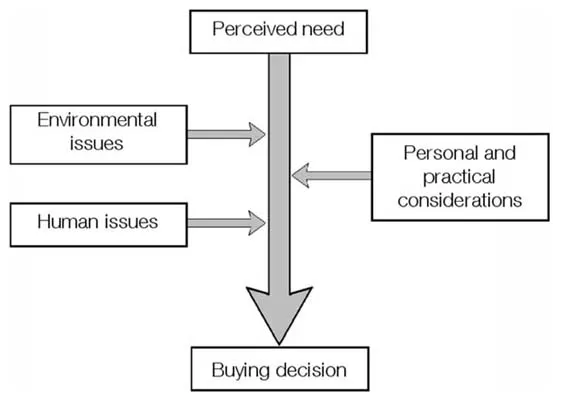
Figure 1.1 Factors in the buying decision.
Insight – Food for thought
Is it better to buy Fairtrade bananas from a multinational supermarket or multinational bananas from a local greengrocer?
Insight – Practical factors
Ethical considerations often have to be balanced against personal and practical ones – if you are a professional harpist, it’s hard to manage without a Volvo!
Ethical companies
Sometimes what you are buying is less of an issue than who you are buying it from. Read the business pages, and you might be inclined to think that ‘ethical company’ is an oxymoron – there are certainly some who act as if the pursuit of profit can justify anything.
- Nobody’s perfect. Some commercial activities are innately unethical. The oil business is the prime example. If a company is in the business of extracting, refining or selling oil, then it is actively contributing to global warming, pollution and the depletion of the earth’s scarce resources. The better companies in this field will be working harder to develop alternative energy supplies, to reduce spillages and waste, to encourage careful use, etc. If you have to buy petrol, all you can do is avoid buying from those who are particularly bad or seek out those who make the greatest efforts to be less damaging.
- It’s the company they keep. Some firms don’t seem to mind who they deal with. Those that trade in conflict diamonds bought from West African war lords are the extreme example, but far more common are those that source their toys or clothes from the cheapest possible manufacturer, no matter how low their workers’ wages or how bad the working conditions. You will find these firms in all fields, but fortunately you can normally also find those who do have ethical policies about who they will buy from.
- Corporate greed. We seem to live in an era where bigger is better and ‘greed is good’. Large corporations make enormous profits and these may be fair profits for goods and services supplied. But some have no hesitation in taking the customers for all they can. Some exploit their own workers instead of or as well as their customers, siphoning off the profits into directors’ pay and perks.
- Fair deals. There are some good companies out there, ones that strive to give a fair deal to their suppliers, workers and customers, and deal in eco-friendly products. Many of these are small, specialist firms, but there are bigger ones – the Co-op and the John Lewis partnership spring to mind.
Environmental issues
The ethical arguments here are essentially about ‘stewardship’. There is nothing unethical, per se, in using energy and other resources. The problem lies in using up finite resources. We have a duty to future generations – our children and grandchildren, and their children and grandchildren. The earth’s resources are finite and too many are being used up at an alarming rate. In the last 100 years, we have used the greater part of the world’s known supplies of oil, copper, tin, silver and other key materials, and we are not likely to find large new stores of any of them. We are chopping down the world’s great forests, emptying the once-teeming oceans of their fishes and whales, and burning so much coal and oil that we have changed the climate, making it hotter, wetter, wilder, more unpredictable and more damaging.
The rapid rise in CO2 (carbon dioxide) levels is probably the most urgent problem we face. CO2 is a part of the natural cycle, absorbed by plants where it is converted into starches, sugars and cellular material, and released through respiration, decay and natural forest and scrubland fires. It is also released – and in damaging quantities – by burning fossil fuels and clearing the great forests. In the 300 years since the start of the Industrial Revolution, concentrations of CO2 have increased steadily, and have been rising at an exponential rate more recently. CO2 is being produced at a rate faster than the natural world can absorb it, and levels are now higher than at any time in the last 160,000 years. CO2 is a ‘greenhouse gas’, in that it tends to trap the sun’s heat. To some extent this is a good thing – without the atmosphere’s greenhouse effect we would all freeze to death in the winter (if not every night) – but the current high levels of CO2 and other greenhouse gases are trapping too much and the earth is overheating.
Using renewable energy has no environmental impact in itself (though it does depend on what you use it for). The sun, wind, tides and rivers could provide all of the world’s energy many times over – if these sources could be harnessed.
Food, wood, textile crops and other stuff we can grow are also renewable, but they can have environmental costs which we need to be aware of. Energy goes into their production, processing and distribution. Fertilizers and insecticides can poison the land and the rivers that they drain into. Sustainability is the key word here. Can we continue to replace what we take away in the long term? Can the energy costs be met from renewable sources?
Tipping the balance
There may be an argument for buying an ‘energy-saving/-generating’ device even though the actual lifetime energy costs/savings balance is negative. Sometimes you need to invest in a new technology to help to get it off the ground. The early models may take more energy to produce because they are not able to benefit from the economies of scale that come with a developed market; they may not deliver all that is hoped, partly because the technology is still in its infancy and partly because their working lives may well be relatively short. The petrol/electric hybrid cars are a good example of this. The models on sale in 2009 are far from being the most energy-efficient cars on the market. More energy and resources are needed for their manufacture and maintenance – for a start, they need two engines (petrol and electric), and many of their components are so complex that they must be replaced, rather than repaired. As for fuel efficiency, there are plenty of cars with better miles per gallon figures – though most of them are smaller. But enough people are buying them to encourage ma...
Table of contents
- Cover
- Title
- Copyright
- Dedication
- Contents
- Meet the author
- About the author
- Only got a minute?
- Only got five minutes?
- Only got ten minutes?
- 1 Basic ethics
- 2 Energy
- 3 Electrical appliances
- 4 In the home
- 5 Food and drink
- 6 Shopping
- 7 Money
- 8 Motoring
- 9 Travel and tourism
- Taking it further
- Index
Trusted by 375,005 students
Access to over 1.5 million titles for a fair monthly price.
Study more efficiently using our study tools.
Frequently asked questions
Yes, you can cancel anytime from the Subscription tab in your account settings on the Perlego website. Your subscription will stay active until the end of your current billing period. Learn how to cancel your subscription
No, books cannot be downloaded as external files, such as PDFs, for use outside of Perlego. However, you can download books within the Perlego app for offline reading on mobile or tablet. Learn how to download books offline
Perlego offers two plans: Essential and Complete
- Essential is ideal for learners and professionals who enjoy exploring a wide range of subjects. Access the Essential Library with 800,000+ trusted titles and best-sellers across business, personal growth, and the humanities. Includes unlimited reading time and Standard Read Aloud voice.
- Complete: Perfect for advanced learners and researchers needing full, unrestricted access. Unlock 1.5M+ books across hundreds of subjects, including academic and specialized titles. The Complete Plan also includes advanced features like Premium Read Aloud and Research Assistant.
We are an online textbook subscription service, where you can get access to an entire online library for less than the price of a single book per month. With over 1.5 million books across 990+ topics, we’ve got you covered! Learn about our mission
Look out for the read-aloud symbol on your next book to see if you can listen to it. The read-aloud tool reads text aloud for you, highlighting the text as it is being read. You can pause it, speed it up and slow it down. Learn more about Read Aloud
Yes! You can use the Perlego app on both iOS and Android devices to read anytime, anywhere — even offline. Perfect for commutes or when you’re on the go.
Please note we cannot support devices running on iOS 13 and Android 7 or earlier. Learn more about using the app
Please note we cannot support devices running on iOS 13 and Android 7 or earlier. Learn more about using the app
Yes, you can access Live Ethically: Teach Yourself by Peter MacBride in PDF and/or ePUB format, as well as other popular books in Social Sciences & Self Improvement. We have over 1.5 million books available in our catalogue for you to explore.