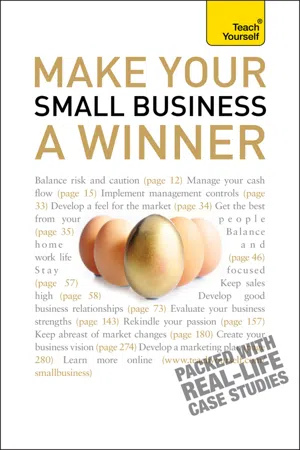
Make Your Small Business a Winner will equip you with all the skills and know-how you need to take your business to a higher level. Key tactics for successful businesses are universal. This book identifies those tactics and will help you to learn and apply them - however young or mature your business. Split into 3 sections, it tackles: Diagnosis - highlighting common mistakes and giving your business a health check; Solutions - detailing remedies for problems and strategies for future success; and Moving On - looking at a future vision, setting goals and assessing progress. Real case studies, interviews and a popular ""checklist"" approach underpin the unique insight of business consultant Anna Hipkiss - making this THE guide to fulfill your business future aims.
NOT GOT MUCH TIME?One and five-minute introductions to key principles to get you started.
AUTHOR INSIGHTSLots of instant help with common problems and quick tips for success, based on the author's many years of experience.
TEST YOURSELFTests in the book and online to keep track of your progress.
EXTEND YOUR KNOWLEDGEExtra online articles at www.teachyourself.com to give you a richer understanding of how to make your small business succeed.
FIVE THINGS TO REMEMBERQuick refreshers to help you remember the key facts.
TRY THISInnovative exercises illustrate what you've learnt and how to use it.
- 300 pages
- English
- ePUB (mobile friendly)
- Available on iOS & Android
eBook - ePub
Make Your Small Business A Winner: Teach Yourself
About this book
Information
Part 1 Diagnosis: the top ten reasons why small businesses fail
Part 1 Diagnosis: the top ten reasons why small businesses fail
One of the biggest challenges for small business owners is to diagnose their own problems. You may think that selling is the issue, when it is really your market analysis that is letting you down. You may blame the economy instead of your poor customer service. To help you to make a diagnosis, the first ten chapters in the book describe the major reasons why businesses fail. Each one tells the story of a real company that suffered, went to the brink and, in most cases, managed to recover. Each business owner then describes the lessons they have learned from their experience, and finally the company doctor identifies the success tactics which will avoid the problem altogether. The real names of the company doctors have been changed in this book.
The success tactics relate to the specifics of each pitfall, but most of them are common to more than one pitfall. Flexibility in business structure, for example, is a success tactic in avoiding five of the ten pitfalls.
1
Costs too high
When your business takes off and you suddenly find that you are struggling to keep up with demand, it is easy to spend money to solve the problem. You hire more staff, you need bigger premises, and you may feel that your new premises should reflect the image of the successful company you have become.
You may also invest in projects to broaden your offering or to create your own products, which will eventually be more profitable than your current range. Eventually can be a long time – longer than you had planned – which is exactly what Jelonair found, and this was all seriously compounded by a personal problem in the partnership.
Company profile: Jelonair
Howard and Josh had worked together in a large multinational company for many years. The company produced a range of consumer products, and they both specialized in the cleaning sector. With backgrounds in chemistry and biochemistry, and experience in sales and marketing, Howard and Josh were experts in their field. One day, Howard came up with the idea of a specialist cleaning product for hospitals. They put a plan together and presented it to the product review board, and were desperately disappointed when it was turned down.
Howard and Josh decided to set up their own business and do it themselves. They formed a partnership, called it Jelonair, and set about sourcing and selling their new product, which rapidly became a range of products. Although it was slow at the beginning, things suddenly took off and for five years the business thrived. Howard and Josh moved from their home to nice premises, rapidly recruiting a staff of ten. Josh would have gone for cheaper premises and slower recruitment, but Howard told him that he needed to think big and not hold the business back.
Josh also felt uncomfortable with the partnership structure as the business grew, most particularly because Howard spent money very readily and took little interest in the financial side of the business. Josh persuaded him to agree to limited company status, partly to reduce their personal financial exposure, but also because it would be necessary in any case as they planned to raise money for investment. Howard had a pet project, which Josh was a little nervous about, which involved funding the development of a specialized cleaning product complete with its own dispenser. Josh knew that there could not be a better time to sell cleaning products to hospitals but was still uncomfortable about the financial exposure. However, he also recognized that one of the reasons why he was in business with Howard was because he knew that he tended to be overcautious, and Howard was a risk taker. Josh did not want to be accused of holding the business back.
Howard and Josh raised the funding and the development began. It took longer than expected and Howard became bored with the project. It was at this point that Josh noticed that a large sum had gone from the company account and been paid back three days later. Only he and Howard could sign company cheques, so he knew Howard must have taken the money. Although he was concerned that Howard had not mentioned it to him, he let it pass, since it had been so promptly replaced. This happened again over the next few months, generally small sums would go, and then be repaid. He asked Howard, who simply said that he had a few personal cash flow problems which he was in the process of sorting out, and not to worry, it was all under control. Since this was such uncharacteristic behaviour, Josh believed him and let the matter drop.
It was at this point that Howard’s mother, Mary, rang Josh. Josh had met her a few times, and knew her to be a strong and direct woman, widowed many years before, and very fond of her only son. Mary said: ‘Josh, I’m concerned at the amount of investment funds the company needs. Howard keeps telling me that I’ll have to be patient, and I keep paying out, but now I’ve no more money that is free to invest, and Howard is asking for more. I thought you could give me your view of the situation.’
This left Josh with a dilemma. Mary had indeed invested £10,000 some time ago, but he was not aware of any other funding from her. If he asked, she would smell a rat. He decided that he needed to be loyal to Howard, for now, at least.
‘I know it’s frustrating, Mrs Ashby, but our new project is taking up more time and money than we planned. It will be a great product when it’s ready, believe me. We can manage with the investment we have to date – Howard is just covering himself by asking for more. I don’t think you should release tied investments now. I’m sure we’ll start showing you a return soon.’
Josh went to Howard and told him about the call:
‘Your mother says she has been investing regularly in the company, Howard, but there was only that initial £10,000, wasn’t there?’
‘Why was she ringing you, Josh?’
‘I’ve no idea, Howard. She said you kept fobbing her off, so she wanted my view.’
‘Take no notice, Josh, she’s getting a bit forgetful now. I borrowed a little from her for personal stuff – she’s probably got confused. You said the right thing, anyway. I’ll go and see her tonight, and calm her down a bit – she’s 80 next month, you know.’ Josh did not think that Mary sounded confused at all, but there was nothing more he could do. As he left, he noticed that Howard had been viewing a betting website on his PC – it was not the first time that he had noticed this, and it did nothing to allay his fears.
Howard had a great network in the industry and he heard about a small company, selling cleaning utensils, which was in some financial difficulty. Howard and Josh investigated thoroughly, and liked Annette, the owner. Her problem was simple cash flow, and only small sums were involved. They arranged to buy a majority shareholding and keep her running the business. She readily agreed, and from then on she worked hard to build up sales, in which she was very successful.
One day she reported to Josh that a major sum had disappeared from her business account. It was obvious that Howard was responsible, and they confronted him. He blithely explained that this was money needed for reinvestment elsewhere, and refused to go into details. At this point, Josh decided to have a heart to heart with Howard. He knew that Howard’s wife had left him just before they set up the business together, and that Howard had been playing the field for some time. He asked Howard to talk about the financial pressures that he was under, and mentioned the online betting, but Howard’s response was glib: ‘The online betting is peanuts, Josh, just an occasional distraction. The real problem was Lisa. I took her to Monaco for the weekend and she has expensive tastes, especially when it comes to the roulette wheel. I shan’t be seeing her again though; she lost interest when she discovered I didn’t have bottomless pockets, so not to worry.’
But Josh did worry. He had also observed Howard closing deals which he did not like the look of at all. He felt that Howard was behaving like someone who was desperate for money, perhaps someone who had caught the gambling bug. He went to see his old friend Jeremy, who knew all there was to know about business problems, and he told him the story. ‘I think I may have to walk away from all this, Jeremy. Howard just isn’t the man I set up in business with. He’s draining the company dry. I can’t trust him anymore, nor can I be associated with the kind of deals he’s now doing.’
Jeremy went through the business numbers with Josh, and agreed that the situation was grave, but salvageable. Howard was the majority shareholder by 2 per cent. If that majority could be eroded, he could be voted out. This proved easier than expected because they were always trying to raise money, and so Josh went to Howard with a new investor, someone Jeremy knew. Since Howard was always keen to bring in more cash, he happily signed the share certificates that diluted his holding. If Howard had done the calculation, he could have worked out the effect, but he was too keen to get his hands on the money. An extraordinary general meeting was then called, and Howard was voted out. He reacted very badly, refused to leave, and accused Josh of conspiring against him. Eventually he stormed out, and Josh has not spoken to Howard since.
Jeremy then helped Josh to sort out the company finances since it was practically insolvent. The only major saleable asset was the new product. If they could sell it outright, then they would have enough money to pay all the creditors. Howard’s share in the business could be given to him in the form of the cleaning products company, of which he would have sole ownership. This would leave Josh and Annette in a solid financial position to run the utensils company together.
Josh went to see all the creditors, and explained the situation. They could either wait and get their money back, or foreclose and get little or nothing. With Jeremy acting as intermediary, Howard agreed to take over the original business, and relinquish any interests in the rest. Josh already knew someone who was very interested in their new product, and with Jeremy’s help he made a good deal, and paid off the creditors in full, with some funding left to invest in the utensils business.
At this point, Josh got a call from Mary, demanding to know what was going on. Her son would tell her nothing, it seemed, except that there would not be any new product from which to recover her investment.
‘That’s £55,000 I’ve invested in your operation – now tell me what you’ve done with it!’
‘Mrs Ashby, I’m devastated to hear that, because this company has only seen £10,000 of your money, as far as I’m aware. Let me investigate and come back to you.’
Josh was convinced that no other funds had ever made their way into the company, and he discussed the issue with Jeremy. In the end, they decided that an independent audit was the only way to convince Mary of the facts.
Josh rang and told her this, and asked if she wanted to choose an auditor. She did, the audit was completed and indeed, there was only £10,000 of her money in the business. Josh went to see her with the report, and explained it to her. As he left, he said, ‘I’m very sorry Mrs Ashby, but Howard seems to have some major debts, which is why we are no longer in business together. You still have shares in Howard’s business, so I hope you can help him to make a success of it.’ They exchanged glances and both knew how unlikely this was.
With the slate now clean, Josh put all his energy into the utensils business, which is growing steadily. He and Annette still work from home, and now they have taken on a full-time administrator, but will not move into office premises until their size justifies it. Josh looks back on Jelonair as a very harrowing experience, but feels he has learned a great deal from it and is operating more effectively as a result.
Insight
Now Josh has told his story, he tells Helen, the company doctor, what he has learned from the experience. She then gives him advice for the future and outlines tactics for success. We will follow this pattern for all of the stories in Part 1.
Lessons learned
Josh was keen to tell Helen, the company doctor, where things went wrong.
‘Howard and I relied far too much on the fact that we had known each other well for ten years. That meant that we didn’t set up the formal processes that a business needs. The most obvious of these was to have dual signatures on cheques. If we’d had that in place, I would have been in control, and would have seen the problem immediately. I did still see it pretty promptly, but Howard would...
Table of contents
- Cover
- Title
- Copyright
- Acknowledgements
- Contents
- Meet the author
- Only got a minute?
- Only got five minutes?
- Diagnostic kit – finding a winning formula
- Part 1 Diagnosis: the top ten reasons why small businesses fail
- Part 2 Solutions: the top tactics for success
- Part 3 Moving on: taking your business to the next stage
- Appendix
- Taking it further
- Index
Trusted by 375,005 students
Access to over 1.5 million titles for a fair monthly price.
Study more efficiently using our study tools.
Frequently asked questions
Yes, you can cancel anytime from the Subscription tab in your account settings on the Perlego website. Your subscription will stay active until the end of your current billing period. Learn how to cancel your subscription
No, books cannot be downloaded as external files, such as PDFs, for use outside of Perlego. However, you can download books within the Perlego app for offline reading on mobile or tablet. Learn how to download books offline
Perlego offers two plans: Essential and Complete
- Essential is ideal for learners and professionals who enjoy exploring a wide range of subjects. Access the Essential Library with 800,000+ trusted titles and best-sellers across business, personal growth, and the humanities. Includes unlimited reading time and Standard Read Aloud voice.
- Complete: Perfect for advanced learners and researchers needing full, unrestricted access. Unlock 1.5M+ books across hundreds of subjects, including academic and specialized titles. The Complete Plan also includes advanced features like Premium Read Aloud and Research Assistant.
We are an online textbook subscription service, where you can get access to an entire online library for less than the price of a single book per month. With over 1.5 million books across 990+ topics, we’ve got you covered! Learn about our mission
Look out for the read-aloud symbol on your next book to see if you can listen to it. The read-aloud tool reads text aloud for you, highlighting the text as it is being read. You can pause it, speed it up and slow it down. Learn more about Read Aloud
Yes! You can use the Perlego app on both iOS and Android devices to read anytime, anywhere — even offline. Perfect for commutes or when you’re on the go.
Please note we cannot support devices running on iOS 13 and Android 7 or earlier. Learn more about using the app
Please note we cannot support devices running on iOS 13 and Android 7 or earlier. Learn more about using the app
Yes, you can access Make Your Small Business A Winner: Teach Yourself by Anna Hipkiss in PDF and/or ePUB format, as well as other popular books in Business & Small Business. We have over 1.5 million books available in our catalogue for you to explore.