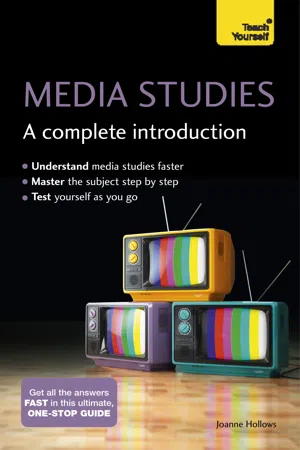
Written by an academic and researcher with over twenty years' experience in teaching and convening Media Studies courses, Media Studies: A Complete Introduction is designed to give you everything you need to succeed, all in one place. It covers the key areas that students are expected to be confident in, outlining the basics in clear jargon-free English, and then providing added-value features like case studies, and even lists of questions you might be asked in your seminar or exam.The book uses a structure that mirrors the way Media Studies is taught on many university courses. Chapters include essential coverage of the history, organization and production of the media industries, and regulation of the media. The analysis of media texts is covered in detail, as are the issues of identity and gender, the idea of globalization and the shifting face of social media in its many contexts.
- 336 pages
- English
- ePUB (mobile friendly)
- Available on iOS & Android
eBook - ePub
Media Studies: A Complete Introduction: Teach Yourself
About this book
Information
1
Introduction: Why Study the Media?

For most people in developed societies, it is difficult to imagine life without the media. They are a fundamental part of contemporary life. Indeed, rather than ask why we should study the media, it might make more sense to ask why on earth we wouldn’t want to make sense of them.
Unless you reached for this book the moment you woke up, it’s highly likely that you will have engaged with a range of media today. It is worth taking a moment to make a list of all those you’ve used and encountered in the past 24 hours.
The first thing to notice about your list is which media you have encountered. You have probably been confronted by a wide range of forms. You may have used Twitter, turned on the TV for a favourite show, listened to a podcast, played games on your phone, checked out online news or read a magazine. Some of your encounters with the media might have been more accidental. There may have been a radio on in the café, billboards along the side of the road, MTV in the gym, a video about healthy eating in the doctor’s waiting room, a free newspaper through your letterbox or music in the elevator.
This quickly alerts us to the fact that the media are not one thing. The word itself is the plural of the word ‘medium’. There are a wide variety of media forms and we need to understand what makes them different as well as what they have in common.
The second thing you may notice about your list is just how much the media saturate our lives. They are part of the experience of living in the modern world. To understand the significance of this, it is worth imagining a day without the media. What would that day be like? What wouldn’t you be able to do?
It should become clear that media and communications devices are central to your everyday life and part of the structure of your days. Your smartphone may be your alarm clock. By the time you’ve eaten breakfast, you may have checked email, messages or social media such as Facebook or Twitter, listened to the radio, watched TV or checked out online news.
This raises a third issue in relation to your list: why have you used different media? Media play a wide range of roles in modern society. You might have used different forms for information or entertainment, to kill time, to maintain connections with friends and family or to express your opinion. If you start to pick these activities apart, they become increasingly complex. Seeking out information can take a variety of forms. You might want to know about a war on the other side of the world or whether your local football team won, about this summer’s must-have shoes or how to cook a chicken, about the crime wave in your town or your friend’s blind date.
This helps us to understand how many people depend on the media in modern societies. They use the media for information, for pleasure and leisure, for continuity and security. If you were to spend a day without media, you would probably feel unsettled and disoriented. Without a sense of connection, you might quickly feel lonely and excluded from wider society.
Media are entangled with our experience of the modern world. This means media have considerable power over our lives. Media Studies aims to make sense of these issues.
 | Spotlight: Time for media and communications |
A study by Ofcom in 2014 (Ofcom 2014a) revealed that people in the UK spend more time ‘using media and communications’ than they spend asleep. On average, UK adults spend 8 hours 41 minutes per day on media and communications. In 2013, 3 hours 52 minutes of that time was spent watching TV. Radio listeners spent an average of 21.5 hours a week on the activity.

Ten reasons why we should study the media

How do we assess the ways in which the struggles over and within the media are played out: struggles over the ownership and control of both institutions and meanings; struggles over access and participation; struggles over representation; struggles which inform and affect our sense of each other, our sense of ourselves?
Roger Silverstone 1999: 5
1 The media are a crucial source of information and knowledge about the world. When they want information, many people will turn to the media for an answer. Because we have little direct experience of most aspects of the world, media have considerable power to shape what we know – and how we think – about it. This makes it essential that we understand how media construct knowledge and the nature of the power they exert over our lives.
2 The media play a key role in the political life of modern societies. Many commentators argue that the media should provide space for information, debate and public participation. These functions are indispensable in democratic societies. If these functions are not fulfilled, it can have a profound impact on how societies are governed and how power is exercised.
3 We need to understand who owns and controls media production. In some nations the government owns the media, but in much of the world they are owned by a small number of large corporations. The activities of the people who own the media – and the people who work for them – shape the texts that are produced.
4 We need to understand who has access to the media. Not everyone has the opportunity to produce media texts. Media Studies investigates who can participate in media cultures and whether the media represent the views and experiences of a diverse range of people. Similarly, not everyone has the same opportunities to use media. Media Studies examines whether the media address all types of audiences and whether different social groups have the same access to the media.
5 The media play a key role in defining values and ideas. Media representations shape how people understand, experience and live in the world. It is crucial to study them in order to understand which values and ideas are defined as being important and which are marginalized.
6 Media representations shape how people understand identities. They shape how we view ourselves and other people. The media can unite a group around common identities and common aims but can also produce divisions and conflict.
7 We need to assess whether, and how, media should be regulated. Some commentators argue that there is little need for regulation. However, many others argue that the media have so much power in society that it is essential to regulate their actions and practices. Media Studies therefore involves thinking about whether the media should have particular responsibilities and how we should guard against the misuse of media power.
8 We need to understand what impact media have on audiences. We cannot understand how media shape modern life if we do not understand how people use and make sense of them. Audiences are not just passive consumers of the media but actively engage with, and interpret, media texts.
9 The media shape the experience of everyday life. People use the media in living rooms, cafés, cars and workplaces, alone or with families or friends. It is necessary to understand how media shape people’s experience of the world around them.
10 The media are an important employer. You may be reading this book because you want a career in the media. If this is the case, it’s crucial that you understand the media industries and the impact they have on society. This will help you to think about what contribution you could make to the media.
What does Media Studies involve?
A common misconception about Media Studies is that it involves little more than the everyday talk about the media that most people engage in. In fact, similar concerns were once raised about the study of literature. Commentators asked why literature needed to be an academic discipline when everyone could debate the merits of a good book.
Talking about media is not the same as studying them. We might discuss the plots of favourite TV shows, make judgements about good and bad movies or ridicule magazine stories about celebrity diets. There is nothing wrong with these discussions but it is not the same as doing Media Studies.
It is the sheer familiarity of media that can make them so challen...
Table of contents
- Cover
- Title
- Contents
- How to use this book
- 1 Introduction: Why Study the Media?
- 2 Histories of Media and Communication
- 3 Understanding Media Industries
- 4 Producing Media
- 5 Changing Media Industries
- 6 Media, Politics and the Public Sphere
- 7 Media Regulation
- 8 The Meaning of Media Texts
- 9 The Power of Media Texts
- 10 Structuring Media Texts
- 11 Media, Representation and Identity
- 12 Media, Representation and Gender
- 13 Media Effects
- 14 Media Audiences
- 15 Consuming Media Technologies
- 16 Media Fandom
- 17 Globalization and the Media
- A Quick Guide to Media Studies Assessments
- References
- Fact-check: Answers
- Copyright
Trusted by 375,005 students
Access to over 1.5 million titles for a fair monthly price.
Study more efficiently using our study tools.
Frequently asked questions
Yes, you can cancel anytime from the Subscription tab in your account settings on the Perlego website. Your subscription will stay active until the end of your current billing period. Learn how to cancel your subscription
No, books cannot be downloaded as external files, such as PDFs, for use outside of Perlego. However, you can download books within the Perlego app for offline reading on mobile or tablet. Learn how to download books offline
Perlego offers two plans: Essential and Complete
- Essential is ideal for learners and professionals who enjoy exploring a wide range of subjects. Access the Essential Library with 800,000+ trusted titles and best-sellers across business, personal growth, and the humanities. Includes unlimited reading time and Standard Read Aloud voice.
- Complete: Perfect for advanced learners and researchers needing full, unrestricted access. Unlock 1.5M+ books across hundreds of subjects, including academic and specialized titles. The Complete Plan also includes advanced features like Premium Read Aloud and Research Assistant.
We are an online textbook subscription service, where you can get access to an entire online library for less than the price of a single book per month. With over 1.5 million books across 990+ topics, we’ve got you covered! Learn about our mission
Look out for the read-aloud symbol on your next book to see if you can listen to it. The read-aloud tool reads text aloud for you, highlighting the text as it is being read. You can pause it, speed it up and slow it down. Learn more about Read Aloud
Yes! You can use the Perlego app on both iOS and Android devices to read anytime, anywhere — even offline. Perfect for commutes or when you’re on the go.
Please note we cannot support devices running on iOS 13 and Android 7 or earlier. Learn more about using the app
Please note we cannot support devices running on iOS 13 and Android 7 or earlier. Learn more about using the app
Yes, you can access Media Studies: A Complete Introduction: Teach Yourself by Joanne Hollows in PDF and/or ePUB format, as well as other popular books in Social Sciences & Film & Video. We have over 1.5 million books available in our catalogue for you to explore.