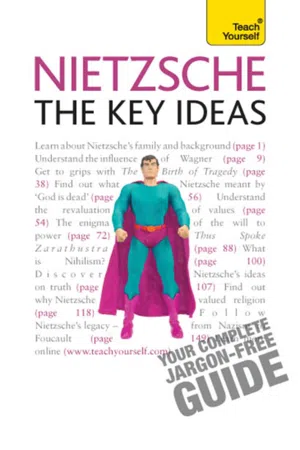
Nietzsche remains one of the most influential philosophers of our time and this book is the definite guide to his philosophy. Whether you're a philosophy student struggling with phrases like 'the superman' and 'the will to power', or whether you simply want to understand more about the life and work of this fascinating man, this easy-to-navigate guide will help you to demystify Nietzsche's influential ideas and discover his legacy to modern thought.NOT GOT MUCH TIME?One, five and ten-minute introductions to key principles to get you started.
AUTHOR INSIGHTSLots of instant help with common problems and quick tips for success, based on the author's many years of experience.
TEST YOURSELFTests in the book and online to keep track of your progress.
EXTEND YOUR KNOWLEDGEExtra online articles at www.teachyourself.com to give you a richer understanding of psychology.
FIVE THINGS TO REMEMBERQuick refreshers to help you remember the key facts.
TRY THISInnovative exercises illustrate what you've learnt and how to use it.
- 208 pages
- English
- ePUB (mobile friendly)
- Available on iOS & Android
eBook - ePub
Nietzsche - The Key Ideas: Teach Yourself
About this book
Information
Topic
PhilosophySubtopic
Philosophy History & Theory1
Nietzsche’s early life 1844–79
In this chapter you will learn:
- about Nietzsche’s family and background
- about his education at school and university
- about his teaching career
- about the influences of Wagner and Schopenhauer.
All in all I could not have endured my youth without Wagnerian music. For I was condemned to Germans. If one wants to get free from an unendurable pressure one needs hashish. Very well, I needed Wagner. Wagner is the counter-poison to everything German par excellence – still poison, I do not dispute it.
(EH, Why I Am So Clever)
Nietzsche’s background
Insight
The importance of a person’s childhood on their views in maturity should never be underestimated. Nietzsche himself states clearly in his writings that our philosophies are moulded by our upbringing, which is why he is so critical of attempts by philosophers to be objective and to believe they can ever step outside themselves.
Nietzsche was born on 15 October 1844 in Röcken, a municipality in the district of Burgenlandkreis in Saxony-Anhalt in Germany. Even today Röcken is a small village with a population of less than 200. You can still see the house, the Pastor’s house, where Nietzsche was born, and which has now become a museum. You can also visit the ancient church (one of the oldest in Saxony) where he was baptized, his village school, and the well-kept family grave where he is buried next to his sister Elisabeth and his parents. Röcken was surrounded by farms, and the nearest town, Lützen, was a half-hour walk away and was itself a very small market town.
Nietzsche’s ancestry has been traced back to the sixteenth century of some 200 German forebears. None were aristocrats and most were small tradesmen such as butchers and carpenters. However, he is also the heir of some 20 clergymen. Nietzsche’s grandfather was a superintendent (the equivalent of a bishop) in the Lutheran Church, and the philosopher’s father, Karl Ludwig, became pastor for the village. Friedrich’s mother, Franziska Oehler, was the daughter of the Lutheran pastor of a neighbouring village. The first five-and-a-half years of Nietzsche’s life were spent in a parsonage, and even after that he was brought up in a pious environment. It is curious to note that the philosopher who came to symbolize more than any other the rejection of religious dogma, was brought up within such an observant household. His philosophy has, as a result, been seen as a deliberate rebellion against a strict, oppressive and conformist upbringing. Yet the Lutheran Church resembles more the Anglican rather than some fundamentalist, puritan church. In fact, the Lutheran tradition has contributed greatly to German intellectual and cultural life and has encouraged cultural and social improvement. There is every indication that the young Friedrich had a happy and fulfilling childhood, and he never spoke in his writings of any kind of rebellion against his upbringing. If anything, the young Nietzsche was more strict and conformist than his peers.
Nietzsche’s father was 30 years old when, in 1843, he married the 17-year-old Franziska. Nietzsche shared a birthday with the reigning King of Prussia and so was named Friedrich Wilhelm after him. After Friedrich, they gave birth to a daughter, Elisabeth, in 1846, and a second son, Joseph, in 1848. Also residing in the house were Nietzsche’s two rather dotty aunts and Franziska’s widowed mother. By all accounts, Nietzsche’s mother possessed a great deal of common sense and unquestioning piety, but had not been well-educated. The first years of Nietzsche’s life were quiet ones as the family settled down to their existence together. The descriptions of the house and its surroundings conjure up an idyllic setting, with a small farmyard, an orchard, a flower garden and ponds surrounded by willow trees. Here Nietzsche could fish and play, exercising his imagination as all children do. According to his sister Elisabeth’s memoirs, Nietzsche took up talking rather late to the extent that, at the age of two-and-a-half, his parents consulted a physician who suggested that the reason he hadn’t spoken was because the family were so excessive in their devotion towards him he did not feel the need to ask for anything. His first word, apparently, was ‘Granma’, an indication of the female influence in the household, and by the age of four he began to read and write.
Tragedy strikes
Although childhood was, on the whole, a happy one for Friedrich, in 1849 tragedy struck with the death of his father. Karl Ludwig was only 36. A year later, Nietzsche’s younger brother also died. The traditional family existence was shattered and they were compelled to leave Röcken to go to the nearby walled town of Naumburg. The young Friedrich now lived with his mother, sister, two maiden aunts and a maternal grandmother. Women, therefore, surrounded Nietzsche, and his younger sister, especially, doted upon him. Nietzsche’s mother was still very young, but she was never to remarry. Nietzsche was very close to his father and there has been much speculation over the psychological impact that his father’s death, as well as the causes of his death, might have had upon the philosopher. There is little evidence to show why the Pastor died so young, other than he was the victim of minor epileptic fits, and that he died from some kind of brain affliction. The speculation that he suffered from insanity is not substantiated, but it was a belief for Nietzsche that diseases are hereditary and that he was therefore destined for a short life himself. In his later writings, Nietzsche often paints an idealistic picture of his father. Perhaps the most famous account is in his work Ecce Homo which Nietzsche wrote when he was 44 years of age:
… he was delicate, lovable and morbid, like a being destined to pay this world only a passing visit – a gracious reminder of life rather than life itself.
(EH ii)
In many respects, life at Naumburg would have differed little from Röcken, for it too was a small town that saw or cared little for the outside world. Nietzsche was to live there until he was 14. His mother, as a result of legacies left by her own mother on her death in 1856, had the financial means to set up a home of her own. Nietzsche attended the local boys’ school where he made his earliest friends, Wilhelm Pinder and Gustav Krug. Pinder, at the age of 14, wrote an autobiography in which he makes regular mention of Nietzsche, describing his initial encounter with the young Friedrich as one of the most important events in his life. The picture Wilhelm presents of the boy Nietzsche is of someone who loved solitude and had a pious, tender temperament whilst having a lively, inventive and independent mind. Significantly his character is portrayed as someone who displayed the virtues of humility and gratitude and was preparing himself for a future vocation as a pastor. Pinder’s father was a town councillor and lover of literature, and he used to read Goethe to the three boys. Krug’s father was an amateur musician, and we can detect Nietzsche’s lifelong love of music originating here as he took it upon himself to learn to play the piano.
Nietzsche’s education
In 1851, the three boyhood friends were transferred from the town school to the private preparatory school until 1854. Here, Nietzsche received his first taste of Latin and Greek. They all went on to the higher school, the Domgymnasium, until 1858 when Nietzsche – no doubt due to his intellectual talents – was awarded a free boarding place at the exclusive and strict Pforta school. Nietzsche was studious, certainly, but he enjoyed outdoor activities such as walking, swimming and skating, and grew to be physically well-built. However, he suffered from illnesses throughout most of his life and it was during these years that the headaches began, possibly linked also to his short-sightedness and the large amount of reading and writing he did as a child.
Pforta School was disciplined and traditional. Pupils were awoken at 4 a.m., classes started at 6 a.m. and continued until 4 p.m. There were further classes in the evening. The school concentrated on a classical education – especially Latin and Greek – rather than mathematics and the sciences. Nietzsche developed an enthusiasm for poetry, literature and music, as well as scholarly criticism, which first led him to doubt the tenets of the Bible.
When he went to the University of Bonn in 1864 to read philology (the study of language and literature) and theology he had already ceased to believe in the existence of God. At the university, Nietzsche soon abandoned the study of theology altogether, a subject which he had probably only agreed to do because of his mother’s eagerness for him to become a pastor. Nietzsche never really settled down in Bonn and decided to go to Leipzig University in 1865 where he became much more studious.
During the Leipzig years (1865–9) there were a series of life-changing encounters. First of all, it was during this period that Nietzsche quite likely contracted syphilis after attending a brothel. Syphilis was incurable and could result in a life of periodic illness leading to insanity and early death. Secondly, while wandering around a second-hand bookshop, Nietzsche came across The World as Will and Idea (1819) by the German philosopher Arthur Schopenhauer (1788–1860). Nietzsche became a ‘Schopenhauerian’. Schopenhauer’s pessimistic view that the world is supported by an all-pervasive will that pays no attention to the concerns of humanity fitted well with Nietzsche’s feelings at the time. He also read the History of Materialism (1867) by the philosopher and social scientist F.A. Lange (1828–75) which introduced Nietzsche to a form of Darwinism. And thirdly, on 28 October 1868, Nietzsche announced his conversion to the hugely influential composer and musical theorist Richard Wagner (1813–83) after hearing a performance of the Tristan and Meistersinger preludes. Only 11 days later he met Wagner in person. During that brief meeting, in which Wagner turned on the charm and entertained on the piano, Nietzsche discovered Wagner was also a Schopenhauerian. Wagner was born the same year as Nietzsche’s father and bore some resemblance to him, and so developed into a father figure for Nietzsche.
Nietzsche’s university professor considered him to be the finest student he had seen in 40 years. Consequently, Nietzsche was awarded his doctorate without examination and was recommended for a chair in classical philology at Basel University in 1869. At the age of 24, Nietzsche was already a university professor.
Insight
A lot has been written on what led Nietzsche to question his religious beliefs, especially given his early piety. However, it must be remembered that Nietzsche was never an ‘atheist’ and, as will be explored later, was actually quite a religious person, although not in the conventional, institutionalized sense.
The professor
Between the ages of 6 and 34 – a total of 28 years – Nietzsche was never to leave the environs of the classroom for more than a few months during the holiday periods. This was, therefore, a period of intense and cloistered learning and it is perhaps no wonder that Nietzsche was to reject a career in academia. For the next ten years at Basel University, Nietzsche became less interested in philology and more enthusiastic towards philosophy. For Nietzsche, however, philosophy was not to be found by being immersed in books – which, essentially, was all that philology was concerned with – and he longed to expand his horizons. However, the lure of a salary and being able to support his mother was an important inducement in keeping the post.
Basel was essentially a German town, although it rested within Switzerland. In taking the post, the university asked that he become a Swiss national so that he would not be called up for Prussian military service at any time that would interfere with his work. Nietzsche ceased to be a citizen of Prussia, but never succeeded in satisfying the residential requirements for Swiss citizenship. From 1869 onwards, Nietzsche remained stateless. Nonetheless, this did not prevent him from applying to be a nursing orderly for the Prussian forces during the Franco-Prussian War. It is quite possible that Nietzsche saw this as his opportunity to escape from the world of books, at least for a while. However, he suffered from diphtheria and ended up being nursed rather than being the nurse. After which, he returned to his teaching.
Despite his reservations, Nietzsche proved to be an able and popular teacher. Students spoke of his enthusiasm and their sense that this man had been transported through time from Ancient Greece; such was his knowledge and explication of the subject. A famous incident in class was when he suggested that the students read the account of Achilles’ shield in Homer’s Iliad over the summer vacation. At the beginning of the next term, Nietzsche asked a student to describe Achilles’ shield to him. The embarrassed student had not read it, however, and there followed ten minutes of silence during which Nietzsche paced up and down and appeared to be listening attentively. After the time had elapsed, Nietzsche thanked the student for the description and moved on!
Nietzsche also developed his own physical appearance. By most accounts he was a smart dresser, almost to the extent of being something of a dandy. He began to cultivate his celebrated moustache that, in a famous photo of 1882, covered the whole of his mouth. There is another photo of Nietzsche with his mother taken in 1890, which shows the moustache reaching down to his chin!
At Basel University, Nietzsche developed a strong affection towards Jakob Burckhardt (1818–97), professor of the history of art and civilization. Burckhardt’s greatest work, The Civilisation of the Renaissance in Italy (1860) continues to be important to this day. In it, Burckhardt outlined the historical transition from the Middle Ages to the Renaissance as a transformation from people who perceived themselves as belonging to a community to the idea of self-conscious individualism. When Nietzsche met him, Burckhardt had already been teaching at Basel for 26 years (and was to continue teaching there for another 24) and, although Nietzsche was in awe of this man, Burckhardt preferred a polite distance. Nietzsche’s primary father figure, Wagner, however, now lived only 40 miles away in his villa called Tri...
Table of contents
- Cover
- Title
- Copyright
- Dedication
- Contents
- Only got a minute?
- Only got five minutes?
- Only got ten minutes?
- Meet the author
- Introduction
- 1 Nietzsche’s early life 1844–79
- 2 Nietzsche’s later life and death 1879–1900
- 3 The Birth of Tragedy
- 4 The revaluation of all values
- 5 The will to power
- 6 Zarathustra, the Superman and the eternal recurrence
- 7 On truth and perspectivism
- 8 Nietzsche and religion
- 9 Nietzsche and politics
- 10 Nietzsche’s legacy
- Glossary
- Taking it further
- Index
Trusted by 375,005 students
Access to over 1.5 million titles for a fair monthly price.
Study more efficiently using our study tools.
Frequently asked questions
Yes, you can cancel anytime from the Subscription tab in your account settings on the Perlego website. Your subscription will stay active until the end of your current billing period. Learn how to cancel your subscription
No, books cannot be downloaded as external files, such as PDFs, for use outside of Perlego. However, you can download books within the Perlego app for offline reading on mobile or tablet. Learn how to download books offline
Perlego offers two plans: Essential and Complete
- Essential is ideal for learners and professionals who enjoy exploring a wide range of subjects. Access the Essential Library with 800,000+ trusted titles and best-sellers across business, personal growth, and the humanities. Includes unlimited reading time and Standard Read Aloud voice.
- Complete: Perfect for advanced learners and researchers needing full, unrestricted access. Unlock 1.5M+ books across hundreds of subjects, including academic and specialized titles. The Complete Plan also includes advanced features like Premium Read Aloud and Research Assistant.
We are an online textbook subscription service, where you can get access to an entire online library for less than the price of a single book per month. With over 1.5 million books across 990+ topics, we’ve got you covered! Learn about our mission
Look out for the read-aloud symbol on your next book to see if you can listen to it. The read-aloud tool reads text aloud for you, highlighting the text as it is being read. You can pause it, speed it up and slow it down. Learn more about Read Aloud
Yes! You can use the Perlego app on both iOS and Android devices to read anytime, anywhere — even offline. Perfect for commutes or when you’re on the go.
Please note we cannot support devices running on iOS 13 and Android 7 or earlier. Learn more about using the app
Please note we cannot support devices running on iOS 13 and Android 7 or earlier. Learn more about using the app
Yes, you can access Nietzsche - The Key Ideas: Teach Yourself by Roy Jackson in PDF and/or ePUB format, as well as other popular books in Philosophy & Philosophy History & Theory. We have over 1.5 million books available in our catalogue for you to explore.