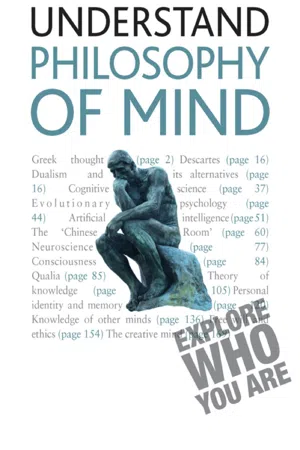
What is your mind? How is it related to your body? What is the effect of artificial intelligence and information technology? These and many other issues are explored in TEACH YOURSELF PHILOSOPHY OF MIND. - Investigate ideas about the mind, from ancient Greece to present-day cognitive science. - Explore the concepts of memory and free will. - Consider issues relating the mind to religion and artistic creativity. - Examine the impact of information technology on our understanding of the mind and the way it works.
- 192 pages
- English
- ePUB (mobile friendly)
- Available on iOS & Android
eBook - ePub
Philosophy of Mind: Teach Yourself
About this book
Information
Topic
PhilosophySubtopic
Philosophy History & Theory1

From the Greeks to the 16th century
In this chapter you will:
• examine the ideas of Plato and Aristotle on the soul
• explore the legacy of ancient Greek philosophy
• consider some religious and philosophical views on the self.
The Greek word that most obviously describes the self or mind is psyche, from which, of course, we get the word psychology. But the psyche was not exactly what we would call mind, since it was often used in a much wider sense as the power of a living thing to grow and move and have an effect upon its surroundings, as well as to will something to happen, and other aspects of what we would call ‘mental states’. Thus, for example, both Plato and Aristotle thought that plants had psyche, and the very first philosopher and scientist, Thales of Miletus (6th century BCE), described magnets as having psyche because of their power to move other things, and declared that ‘all things are full of gods’, implying that psyche is universal.
Notice therefore that the ancient philosophers looked at mental states without trying to relate them to a separate, immaterial substance called ‘mind’. Psyche was simply the word used to describe the distinctive features of living things, as opposed to inanimate objects.
The ancients were as much scientists as philosophers. Democritus (b. mid-5th century BCE), who analysed everything in terms of atoms in space, thought that the psyche comprised the very simplest of atoms (spherical ones); Heraclitus (540–480 BCE), contemplating the process of change, thought that the psyche was a kind of transforming fire. The Pythagoreans (as described by Plato in Timaeus) thought of the psyche as a controlling and balancing principle of harmony within the body.
The ancients were also influenced by the idea of reincarnation. Herodotus knew of the Egyptian idea of an immortal soul being able to leave a body at death and move into another about to be born. Indeed, Pythagoras (c.570–497 BCE), who was a notable philosopher as well as a mathematician, held that the souls of those who had died could enter into animals for their future lives.
Insight
The implications of reincarnation for Greek thought are quite profound. If there is a soul (or psyche) that can enter into an animal after having been a human, then it cannot be identified exclusively with the thinking element of the self – otherwise you would end up with ‘thinking’ animals. Rather the psyche that they thought able to be reincarnated is much broader, comprising the basic power to animate a body and give it character.
In the next chapter we shall consider Descartes’ dualism of an unextended, thinking mind and an extended physical body. The psyche of the ancient Greeks was far more than that; for the narrower sense of a thinking element, the Greeks would have used the term nous. A key question in the philosophy of mind is therefore whether one should be considering ‘mind’ (in the narrow sense of a thinking self) at all, or rather the broader concept of psyche.

An immortal soul?
A good starting point for examining Plato’s view of the soul lies with the source of his original inspiration – Socrates. Plato (427–347 BCE) presents Socrates (469–399 BCE) as a thinker who was concerned above all with the question about what it means to live well. In other words, he is concerned with the nature and purpose of a human life – that which raised the human above the animal. When Socrates was condemned, he accepted death calmly, not thinking of himself as limited to his physical body. For Socrates, the self is largely non-physical, and the body is not the true person. His task, shown in his challenge to conventional thought and in his acceptance of death, was to explore the spiritual, or non-material, aspects of human life.
Plato argued for a dualism of immaterial substance (psyche) and physical body. In Timaeus, he claims that it is an essential feature of the psyche to be self-moving, since it is the power to move and change other things, rather than being itself moved by the physical body. The psyche is the animating principle, and without it we are left with a corpse. But in the same dialogue he introduces the idea that the relation of soul to body may be likened to the way in while a lyre is tuned – in other words, that the soul is not part of the physical body, but as the arrangement through which the whole body is able to live. Later, in Phaedo, Plato was to change his theory somewhat. Instead of seeing the psyche as responsible for animating and giving rise to human activity and mental states, he limits the mind to the reasoning part, and leaves emotions and other aspects of human life – like the ability to perceive and respond to something – to the realm of the body. By the time he wrote The Republic, however, he saw the psyche as more complex, and allowed that it was concerned with all aspects – both those connected with emotion and activity, and those connected with thought.
In The Republic, he makes the analogy between the city and the soul. Just as the soul has three parts – reason, the spirited (or seat of passions) and the basic appetites – so the city has its philosopher-rulers or guardians, those who defend it and make it work, and the workers, who seek only the satisfaction of their needs. The self, therefore, for Plato includes, but is not limited to, the reasoning part. He sees the ideal life is one in which all three aspects of the self are balanced. The basic appetites are held in check by the active faculties, which are themselves guided by reason. The good life is achieved through integrity, not elimination. He does not deny the appetites and actions, but places them firmly under the control of reason.
Overall, for Plato, the self has as its goal an understanding of the good and the beautiful, and it is capable of doing this in spite of the hazards, frustrations and limitations of the particular things with which we are surrounded in this life. The impulse - led by reason, but not limited to reason - is to aspire to something higher. Thus, given the choice of seeking truth or pleasure, Plato suggests that we should opt for truth, since pleasure is limited and transient. In an unstable and hazardous world, the mind aspires to understand the good and the beautiful – thus displaying both its origin and its true home.
Insight
Plato has been enormously influential in this area, partly because – through the Neoplatonists and then Christian philosophers like St Augustine – his views have been introduced into the Christian world-view, which formed the background of so much Western thought. Partly also because, unlike the pre-Socratics who speculated about the nature of mind, Plato relates the mind to broader issues of psychology – to the questions of ethics, knowledge and the appreciation of beauty, and to the basic question of what it means to lead the good life. In other words, Plato sets the agenda; he shows that questions about the self are fundamental to the issue of how we can know things, how we should relate to one another, and how we should seek personal balance and integrity.
Plato argues that the psyche has knowledge of the ‘Forms’ (his term of the universals in which particular things participate) rather than simply of the particular things that we see in experience. So, for example, we have a general concept of ‘tree’ although we have seen only particular trees. But, since he believes that the Forms are eternal, he reasons that the psyche must be immortal, having gained knowledge of the Forms before birth. For Plato, there is a real feeling that the self has a come down to earth from its natural heavenly abode, and is entombed within the physical body, but at the same time – through reason and knowledge of the Forms – it cannot help but betray its origins. This is emphasized by a pun that arises in the Greek, for the body (soma) becomes the tomb (sema) of the soul. Naturally enough, the soul is not at home in this tomb, and aspires to transcend it.
However, Plato’s concern for the distinction between soul and body should not lead us to assume that he saw individuals as in some way arriving on earth fully formed. He took the view (e.g. in The Republic, Book 6) that people were like plants, developing according to the soil in which they are planted, arguing that the soul takes on the characteristics of its environment. He was also very aware of the ability of society to influence the individual. Clearly, Plato needs to account for the very obvious influence that nurture and environment have on individuals, if he is also to claim that the mind pre-dates the body and is linked with the eternal realm of the Forms.
Insight
This raises a broad but fascinating issue, which is seen most keenly in the case of the very gifted. Is the genius – the brilliant musician, artist, scientist, writer or philosopher – ‘born’ as such, or is he or she simply the product of heredity and environment? Is there anything in their background that can ‘explain’ a Shakespeare, a Mozart or an Einstein?
For Plato and his three aspects of the self, the thinking element is primary, and has responsibility for guiding the others. Logically, therefore, philosophers should strive to remain philosophers, even if the environment within which they find themselves is not conducive to their craft. Emotions and basic urges may have shaped Mozart’s day-to-day living, but in any overall assessment, the primary element is that which links him with the realm of the eternal.
Making us what we are
Aristotle (384–322 BCE) thought that all living things had souls, and that the psyche was a ‘principle of life’ – that which distinguishes the living from the inani...
Table of contents
- Cover
- Title
- Contents
- Meet the Author
- In One Minute
- Introduction
- 1 From the Greeks to the 16th Century
- 2 Descartes’ Legacy
- 3 Cognitive Science
- 4 Physicalism and Neuroscience
- 5 Consciousness
- 6 Mind and the theory of Knowledge
- 7 Personal Identity and Memory
- 8 Knowledge of Other Minds
- 9 Free will and Ethics
- 10 The Creative Mind
- Postscript: Of Maps and Pathways
- Glossary
- Further Reading
- Copyright
Trusted by 375,005 students
Access to over 1.5 million titles for a fair monthly price.
Study more efficiently using our study tools.
Frequently asked questions
Yes, you can cancel anytime from the Subscription tab in your account settings on the Perlego website. Your subscription will stay active until the end of your current billing period. Learn how to cancel your subscription
No, books cannot be downloaded as external files, such as PDFs, for use outside of Perlego. However, you can download books within the Perlego app for offline reading on mobile or tablet. Learn how to download books offline
Perlego offers two plans: Essential and Complete
- Essential is ideal for learners and professionals who enjoy exploring a wide range of subjects. Access the Essential Library with 800,000+ trusted titles and best-sellers across business, personal growth, and the humanities. Includes unlimited reading time and Standard Read Aloud voice.
- Complete: Perfect for advanced learners and researchers needing full, unrestricted access. Unlock 1.5M+ books across hundreds of subjects, including academic and specialized titles. The Complete Plan also includes advanced features like Premium Read Aloud and Research Assistant.
We are an online textbook subscription service, where you can get access to an entire online library for less than the price of a single book per month. With over 1.5 million books across 990+ topics, we’ve got you covered! Learn about our mission
Look out for the read-aloud symbol on your next book to see if you can listen to it. The read-aloud tool reads text aloud for you, highlighting the text as it is being read. You can pause it, speed it up and slow it down. Learn more about Read Aloud
Yes! You can use the Perlego app on both iOS and Android devices to read anytime, anywhere — even offline. Perfect for commutes or when you’re on the go.
Please note we cannot support devices running on iOS 13 and Android 7 or earlier. Learn more about using the app
Please note we cannot support devices running on iOS 13 and Android 7 or earlier. Learn more about using the app
Yes, you can access Philosophy of Mind: Teach Yourself by Mel Thompson in PDF and/or ePUB format, as well as other popular books in Philosophy & Philosophy History & Theory. We have over 1.5 million books available in our catalogue for you to explore.