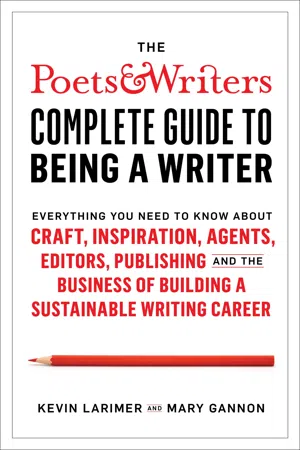
For half a century, writers at every stage of their careers have turned to the literary nonprofit organization Poets & Writers for help with their professional development. In this book Poets & Writers provides the authoritative guide for writers that answers every imaginable question about craft and career. From kickstarting your creativity and developing your style to getting your work read and published, this is the bible for authors of all genres and forms.Written by Kevin Larimer and Mary Gannon, the two most recent editors of Poets & Writers Magazine, this book brings an unrivaled understanding of the areas in which writers seek guidance and support. Filled with insider information like sample query letters, pitch letters, lists of resources, and worksheets for calculating freelance rates, tracking submissions, and managing your taxes, the guide does more than demystify the writing life-it also provides an array of powerful tools for building a sustainable career as a writer. In addition to the wealth of insights into creativity, publishing, and promotion are first-person essays from bestselling authors, including George Saunders, Christina Baker Kline, and Ocean Vuong, as well as reading lists from award-winning writers such as Anthony Doerr, Cheryl Strayed, and Natalie Diaz. Here, at last, is the ultimate comprehensive resource that belongs on every writer's desk
- 496 pages
- English
- ePUB (mobile friendly)
- Available on iOS & Android
eBook - ePub
Poets & Writers Complete Guide to Being A Writer
About this book
Information
Subtopic
Kreatives SchreibenI
INTRODUCTION
The Freedom and the Power
Being a writer—or, to put it another way, telling stories, which is what we’re really talking about when we talk about writing, whether it’s poetry, fiction, nonfiction, or some combination thereof—is not a hobby. That might be how your big-shot uncle thinks of it, or your cousin who works in corporate finance, or anyone who is decidedly not a writer. We develop words, language, expressions of thought and feeling as tools with which to tell stories, and these stories help us make sense of ourselves and the world around us. We recognize the power of thinking deeply about our stories, what they mean and how to tell them, and then we record them in the best, most powerful way we know: We write them. As Coleridge said about poetry, putting “the best words in the best order.” And that act has the power to change the world.
There is no higher art form, in its intrinsic beauty and complexity, its capacity for delivering truth, its illumination of emotion and feeling, and its potential for personal transformation. Writing is bigger than borders, it’s bigger than governments, it’s bigger than the biggest corporation in the Dow Jones Industrial Average. Through writing we are able to get closer to what it means to be human than through any other activity—and if that sounds bold, consider what science and religion and philosophy would be without stories. The stories we write—the poems, the novels, the essays—they define us.
“The universe is made of stories, not of atoms.”
—MURIEL RUKEYSER
We all have a different story to tell, of course. Talk to anyone, anywhere, for long enough and you’ll hear it eventually. And maybe that’s your project as a writer, telling someone else’s story. Or maybe it’s telling your own. Or maybe it’s making up the stories of people who don’t even exist except as characters in a story of your creation, summoned out of the ether by the sheer force of your imagination. No matter how seemingly mundane or traumatic, no matter how far-fetched or fantastical, each and every one of our stories, fact or fiction or poetry, is connected through human experience, and it is our self-appointed job as writers to make those connections through empathy and understanding, imagination and emotion. So, the fiction writer in Houston who writes at night after her shift at the twenty-four-hour diner and the grad student sleeping on his friend’s couch in Portland, Oregon, and the poet who tends bar in Austin after caring for her mother who is suffering from dementia and the tattoo artist in Toronto and the grandmother in Cleveland and the adjunct professor in Boise who drives a rusted-out Toyota Celica can read one another’s stories and recognize something of themselves. And by reading these stories they can understand themselves—and the shared world in which we live—a little better. “Writing remains the best route we know toward clarity of thought and feeling,” writes Pulitzer Prize–winning nonfiction writer Tracy Kidder and writer/editor Richard Todd in Good Prose: The Art of Nonfiction. Amen.
Toni Morrison was acutely aware of the writer’s unique ability to make sense of the great suffering inherent in the human experience. “Certain kinds of trauma visited on peoples are so deep, so cruel, that unlike money, unlike vengeance, even unlike justice, or rights, or the goodwill of others, only writers can translate such trauma and turn sorrow into meaning, sharpening the moral imagination,” the Nobel laureate said upon accepting the 2008 PEN/Borders Literary Service Award in New York City.
Carolyn Roy-Bornstein turned to writing after her seventeen-year-old son was hit by a drunk driver while walking his girlfriend home from a study date. Carolyn’s son sustained a traumatic brain injury; his girlfriend was killed. In the months and years that followed, journaling became a way to document her son’s recovery and process her parallel trauma. It was also a way for her to exert power over something none of us can ever control—the past. “Ultimately, revisiting the pain through writing … helped those wounds to heal,” she writes. For her, and for countless writers like her, writing is a redemptive act that can provide, if not a way to change the past, at least a way to understand it better and regain some semblance of control. Although the subject matter that drives us to write may be dark, the act of writing is ultimately an illuminating and positively radiant act—a way of applying order to disorder, reclaiming what was lost or taken away. In Roy-Bornstein’s case, her early writing led to the publication nine years later of a memoir, Crash: A Mother, a Son, and the Journey from Grief to Gratitude.
For Kaveh Akbar, author of the poetry collection Calling a Wolf a Wolf, writing poetry became a life raft once he became sober after years of alcoholism and drug use. “I had no idea what to do with myself, what to do with my physical body or my time. I had no relationship to any kind of living that wasn’t predicated on the pursuit of narcotic experience,” says Akbar, who teaches at Purdue University and in the low-residency MFA program at Randolph College. “In a very real way, sobriety sublimated one set of addictions (narcotic) into another (poetic). The obsessiveness, the compulsivity, is exactly the same. All I ever want to do today is write poems, read poems, talk about poems. But this new obsession is much more fun (and much easier on my physiological, psychological, and spiritual self).”
Poet Robin Coste Lewis, whose debut collection, Voyage of the Sable Venus and Other Poems, won a National Book Award, has a story of turning to poetry that has much in common with the stories of Roy-Bornstein and Akbar. In 2000 Lewis fell through a hole in the floor of a San Francisco restaurant and suffered injuries that left her unable to read or write more than a sentence a day. Even with such dramatic physical and neurological constraints, Lewis pushed on, focusing her imagination and honing her poetic craft, every day over many months, to write just one line of poetry. “Poetry was the means by which I learned to reenter the world,” Lewis says. “What compelled me to write was the desire to continue living an engaged life. Poetry allowed me to reenter my work, but from a different door.”
To live an engaged life. Whether moved by a traumatic event or a more ordinary occurrence in our lives—maybe just a creative impulse that has no identifiable trigger—as creative people we want to dig just a little deeper, think a little harder about the world and our place in it, or simply celebrate life by investigating it a little further. The act of writing allows us to do this. Or maybe, like poet Jonathan Fink, whose debut collection, The Crossing, was published by the Detroit-based small press Dzanc Books, we are simply in love with the feeling of writing. “What poetry offers,” Fink says, “is the visceral engagement with language that welcomes attention to imagery, tone, rhythm, narrative, metaphor, politics, ethics, humor, myth, and justice, among many other things. Like a painter who simply likes the smell of paint or a potter who likes the feel of clay, the pleasure of embarking on a writing project, for me, always resides in the tactile pleasures of language.”
Even someone as successful as Salman Rushdie, who has published nearly twenty books, most famously the novel The Satanic Verses, takes a rather workmanlike approach to his craft and those tactile pleasures of language. “I’ve always had this view that you wake up every day with a little nugget of creative juice for the day and you can either use it or you waste it,” he told fellow author Porochista Khakpour. “My view is, therefore, you write first. Get up, get out of bed, get to your desk, and work. … Do the work first; otherwise it doesn’t get done. I’ve always thought of the novelist as a long-distance runner; that’s the marathon. … It’s long-form, you have to chip away at it, let the mark posts go by and trust that one day the finish line will come. You can’t even think about the finish line when you start.”
We all start writing—and continue writing—for different but equally important reasons. This book is intended, first and foremost, to serve, assist, recognize, validate, and celebrate that remarkable fact. Writing is also, most of the time, a solitary activity: an act of intellectual and emotional faith typically undertaken apart from the bustling crowds, removed from the noise of the day. It is work that is done in the still-dark, as you try to squeeze a few minutes of writing from your morning—before the busy workday begins, or classes start, or the chores take over, or the kids wake up—before the machine of everyday life starts to whir into motion. Or after it’s wound down, when the rest of the world is asleep. Or, for some, it’s work that is done right smack in the maw of the machine—in the middle of the great chaos of the city, or the clamor of workaday life. You write. Whether you write poems, stories, essays, articles, memoirs, novellas, or novels—no matter the genre—you write. You are a writer, and that is a remarkable, miraculous, life-fulfilling, soul-sustaining thing. It’s a way of life, but it can also be a means to building a rewarding career.
In the following chapters we will look at the writer’s journey from inspiration to publication and beyond. One of our goals in this book is to offer professional perspectives on the entire ecosystem of writing and publishing, that ever-changing network of teachers, tech leaders, agents, editors, publicists, small-press publishers, designers, literary arts administrators, contest coordinators, reviewers, critics, booksellers, and so many others. As a writer, you stand in the center of this incredibly engaging and engaged community of passionate people working in literary agencies, publishing houses, writing programs, nonprofit organizations, bookstores, and publications large and small. And as a writer, your focus is often on sitting down to write and making the words flow. And that’s how it should be. But if you really want to make the most out of your life as a writer—if you’re in it for the long haul—it’s imperative that you also learn as much as you can about this ecosystem and your place as a writer within it.
The two of us have been offering guidance to those on this journey for a combined twenty-five years; o...
Table of contents
- Cover
- Contributors
- Title Page
- Dedication
- Contents
- I
- II
- III
- IV
- About Poets & Writers, Inc.
- Free Resources at pw.org
- 15 National Organizations Serving Writers and Writing
- 140 Books for Every Serious Writer’s Bookshelf
- 20 Top Podcasts for Writers
- 5 Video Playlists for Writers
- Acknowledgments
- Sources
- About the Authors
- Copyright
Trusted by 375,005 students
Access to over 1.5 million titles for a fair monthly price.
Study more efficiently using our study tools.
Frequently asked questions
Yes, you can cancel anytime from the Subscription tab in your account settings on the Perlego website. Your subscription will stay active until the end of your current billing period. Learn how to cancel your subscription
No, books cannot be downloaded as external files, such as PDFs, for use outside of Perlego. However, you can download books within the Perlego app for offline reading on mobile or tablet. Learn how to download books offline
Perlego offers two plans: Essential and Complete
- Essential is ideal for learners and professionals who enjoy exploring a wide range of subjects. Access the Essential Library with 800,000+ trusted titles and best-sellers across business, personal growth, and the humanities. Includes unlimited reading time and Standard Read Aloud voice.
- Complete: Perfect for advanced learners and researchers needing full, unrestricted access. Unlock 1.5M+ books across hundreds of subjects, including academic and specialized titles. The Complete Plan also includes advanced features like Premium Read Aloud and Research Assistant.
We are an online textbook subscription service, where you can get access to an entire online library for less than the price of a single book per month. With over 1.5 million books across 990+ topics, we’ve got you covered! Learn about our mission
Look out for the read-aloud symbol on your next book to see if you can listen to it. The read-aloud tool reads text aloud for you, highlighting the text as it is being read. You can pause it, speed it up and slow it down. Learn more about Read Aloud
Yes! You can use the Perlego app on both iOS and Android devices to read anytime, anywhere — even offline. Perfect for commutes or when you’re on the go.
Please note we cannot support devices running on iOS 13 and Android 7 or earlier. Learn more about using the app
Please note we cannot support devices running on iOS 13 and Android 7 or earlier. Learn more about using the app
Yes, you can access Poets & Writers Complete Guide to Being A Writer by Kevin Larimer,Mary Gannon in PDF and/or ePUB format, as well as other popular books in Sprachen & Linguistik & Kreatives Schreiben. We have over 1.5 million books available in our catalogue for you to explore.