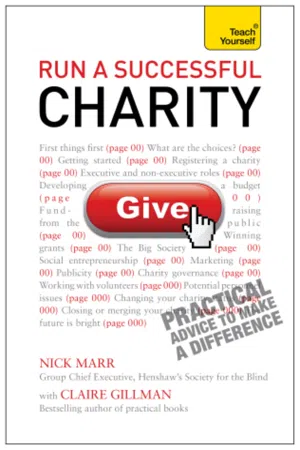
Running a Charity: Teach Yourself is the complete practical guide for anyone who is involved with setting up or running a charity. So whether you are a worker or colunteer in the third sector, a charity trustee, or are considering starting a charity yourself, this book will tell you everything you need to know, right from the beginning. It includes bang-up-to-date advice on charity registration and governance, proven tips for fund-raising and publicity, and practical insight into the day-to-day and strategic challenges of running a charity.
- 256 pages
- English
- ePUB (mobile friendly)
- Available on iOS & Android
eBook - ePub
Run a Successful Charity: Teach Yourself
About this book
Information
1
First things first

In this chapter, you will learn:
• Whether you need to start a charity
• Is this work already being done elsewhere?
• Are you cut out to run an organization?
• Is the time right to start up?
• How can you best help your service users?
The great thing about people who set up and run charities is the energy and the passion that they bring to the venture. If you are reading this book, you are almost certainly committed to helping a specific sector of the community or you are passionate about a particular cause or an issue, and you want to make a difference.
Undoubtedly, you will have your own very personal reasons for wanting to set up and run a charity. And while I do not question your intentions, nonetheless there are certain frank questions that you should ask yourself before getting started, if you are to do the best work for the subject that is so close to your heart.
Do you need to set up a charity?
Whatever the subject that you espouse, setting up a charity is not always necessarily the best way to serve that cause – and occasionally it is not even legally possible.
A charity has a legal status as a specific form of voluntary organization. The first thing that distinguishes a charity is that it must benefit the public as opposed to a specific individual – and the aims, purposes and objectives of your charity must conform to the legal definition of charitable (see Chapter 3). There are other criteria that have to be met (also dealt with in detail in Chapter 3), none of which are too difficult to understand or insurmountable but sometimes, such requirements may limit what you hope to achieve, and there may possibly be a better alternative for you and your venture.
BELOW THE RADAR ENTERPRISES
Once your charitable venture has an income of £5,000 or more, you are required by law to register with the Charity Commission. However, there are plenty of groups and small organizations that do not have that level of funding, but that still fulfil an important role at community level, for example.
These smaller grassroots groups and ‘volunteer led’ social organizations such as faith groups, arts groups, minority or ethnic focus groups, rural groups and community groups are known within the third sector as ‘Below The Radar’ or BTR groups, and they have an important role to play. Most importantly, in the context of this chapter, might your venture be better suited to having a BTR-style set-up?
A recent report by the Third Sector Research Centre (TSRC) concluded that BTR groups are ‘… driven by need, responding to gaps in mainstream provision, sharing common interests, acting holistically and flexibly, using resources sourced internally, a key factor is that they base their actions upon their own distinctive local, and specific, knowledge that can only result from lived experience. They also operate using social networks only available to those who share experience or geography.’
One of the biggest advantages of operating as a BTR is that your venture is largely free of the burden of bureaucracy and targets that can sometimes prevent flexible and holistic responses by larger charities. You can respond to specific needs as they arise – needs that may be unmet because of lack of resources, or the failure of the state and other agencies to identify them.
You may well still feel that your cause has a broader remit, perhaps a national or international appeal, that would be best served by becoming a registered charity, but before we look at some of the qualities required by those who set up a charity, let’s briefly consider some other situations where going down the route of setting up a new charity may not be the best way forward, even if it were possible.
OTHER OPTIONS
If you want to set up a charity to help an individual who is suffering from a rare disease or disorder, you would have to broaden your remit. In order to qualify for charity status, you would have to consider how the money you raise and the services you offer might also benefit others in similar circumstances, rather than just the one individual.
In the case of wanting to help an individual, you could look at setting up a non-charitable trust fund to benefit that specific person(s) or perhaps you might prefer to sink your energies into and feel funds could be donated more efficiently by supporting an existing charity that is already researching into or benefiting sufferers of their condition, for example.
When a national or international disaster occurs, it is only natural to want to help and, for various reasons or due to personal connections, sometimes people feel drawn to setting up a new charitable appeal fund rather than contributing donations or volunteering for an existing charity.
This is an option but it takes time and if you want to respond quickly to a disaster, it may be better to find an appeal that suits your ideas, and to offer money or services to that charity. For example, the Disasters Emergency Committee is an umbrella organization which launches and co-ordinates responses to major disasters overseas. It enables the British public to donate to British aid agencies who provide effective and swift humanitarian assistance in the disaster area wherever it may be in the world.
It is a very natural instinct to wish to commemorate someone by setting up a charity in their name. However, if there is an existing charity operating in that area of expertise, it may well be a better idea to create a separate, named fund within that existing charity. In that way, you still honour your loved one, their name is commemorated but you do not waste any energy or funds on duplicating what is already in existence.
You can check out if there is a charity already established for a particular condition, disease or situation by using the Register of Charities from the Charity Commission for England and Wales, or the Office of the Scottish Charity Regulator.
Sometimes the motivation for setting up a charity comes when your life has been touched or transformed by a particular issue and you want to help others who find themselves in a similar situation. A new charity might be appropriate but, yet again, collaborating with an existing charity may be a better option.
Another interesting option could be to use the services of a charity such the Charities Aid Foundation (CAF). They can set up a Managed Trust Account for you, and as a subsidiary fund of an established charity the same charitable tax benefits will apply. You can then fundraise and place proceeds in the Managed Trust Account, and you tell CAF which charitable purposes you would like the money to go towards.
You cannot set up a charity with a political purpose. That’s not to say that a charity cannot undertake campaigning or political activities in order to achieve one of its charitable purposes, but it is not possible to have political aims. If you want to make a difference in society by pursuing a political aim, whether it is to oppose a new runway at an airport or to change legislation on gay marriage, you would be better served setting up a pressure group or a non-charitable campaigning body. If you applied to become a charity with such a political aim, your application would be rejected.
If you have considered all of the above, and you still feel sure that you would like to set up and run a charity, then there are just a few more considerations that I would urge you to take into account before you commit.
 | Remember this: Lottery funding |
You do not have to be a registered charity to be accepted for a lottery grant. If you want to apply for lottery funding, check out the various different lottery grants’ distributors to see what their grant eligibility requirements are (see Useful Addresses at the end of this book), but most will consider Below the Radar grassroots organizations, voluntary and community groups, without the need for charitable status. Be aware that lottery funding takes time and a lot of effort and is often not successful.

 | Try it now |
Irrespective of whether you have finally decided that setting up a charity is the right thing to do, why not investigate how many existing charities are already operating in your area of interest, using the Charity Commission’s register. You will probably be pleasantly surprised to know what services already exist and who is competing for funds.
Are there existing charities serving the same purpose?
According to the Charity Commission, there are around 180,000 registered charities, and the latest National Council of Voluntary Organizations Almanac Data suggests there are just as many smaller voluntary organizations (VOs). In all probability, there will be one or more of these organizations doing the kind of charitable work that you may have in mind for your new charity.
In the current economic climate, that means that there are a lot of charities and VOs all competing for limited funding, which is in shorter supply at this time – CAF research shows certain areas of funding are down 20 per cent from 2012 to 2013. Added to which, the pu...
Table of contents
- Cover
- Dedication
- About the Author
- Title
- Acknowledgements
- Contents
- Foreword
- Introduction
- How to use this book
- 1 First things first
- 2 Getting started
- 3 Registering a charity
- 4 Management and governance
- 5 Developing a budget
- 6 Funding and income generation
- 7 Fundraising
- 8 Marketing and publicity
- 9 Team dynamics and staff development
- 10 Looking after your people
- 11 Storm-proofing your charity
- 12 Partnerships and mergers
- 13 Making changes
- 14 The future is bright
- Useful contacts and addresses
- Copyright
Trusted by 375,005 students
Access to over 1.5 million titles for a fair monthly price.
Study more efficiently using our study tools.
Frequently asked questions
Yes, you can cancel anytime from the Subscription tab in your account settings on the Perlego website. Your subscription will stay active until the end of your current billing period. Learn how to cancel your subscription
No, books cannot be downloaded as external files, such as PDFs, for use outside of Perlego. However, you can download books within the Perlego app for offline reading on mobile or tablet. Learn how to download books offline
Perlego offers two plans: Essential and Complete
- Essential is ideal for learners and professionals who enjoy exploring a wide range of subjects. Access the Essential Library with 800,000+ trusted titles and best-sellers across business, personal growth, and the humanities. Includes unlimited reading time and Standard Read Aloud voice.
- Complete: Perfect for advanced learners and researchers needing full, unrestricted access. Unlock 1.5M+ books across hundreds of subjects, including academic and specialized titles. The Complete Plan also includes advanced features like Premium Read Aloud and Research Assistant.
We are an online textbook subscription service, where you can get access to an entire online library for less than the price of a single book per month. With over 1.5 million books across 990+ topics, we’ve got you covered! Learn about our mission
Look out for the read-aloud symbol on your next book to see if you can listen to it. The read-aloud tool reads text aloud for you, highlighting the text as it is being read. You can pause it, speed it up and slow it down. Learn more about Read Aloud
Yes! You can use the Perlego app on both iOS and Android devices to read anytime, anywhere — even offline. Perfect for commutes or when you’re on the go.
Please note we cannot support devices running on iOS 13 and Android 7 or earlier. Learn more about using the app
Please note we cannot support devices running on iOS 13 and Android 7 or earlier. Learn more about using the app
Yes, you can access Run a Successful Charity: Teach Yourself by Claire Gillman,Nick Marr in PDF and/or ePUB format, as well as other popular books in Social Sciences & Sociology. We have over 1.5 million books available in our catalogue for you to explore.