This book is a comprehensive introduction to the Sikh faith. Ideal for those with little knowledge of the religion, it will give you a clear understanding of what Sikh's believe, and how they practise their faith. Covering all aspects, from the history of Sikhism, to Sikh ethics, to the practicalities of living a Sikh life, learn what it means to be Sikh today.
NOT GOT MUCH TIME?One, five and ten-minute introductions to key principles to get you started.
AUTHOR INSIGHTSLots of instant help with common problems and quick tips for success, based on the author's many years of experience.
TEST YOURSELFTests in the book and online to keep track of your progress.
EXTEND YOUR KNOWLEDGEExtra online articles at www.teachyourself.com to give you a richer understanding of psychology.
FIVE THINGS TO REMEMBERQuick refreshers to help you remember the key facts.
TRY THISInnovative exercises illustrate what you've learnt and how to use it.
- 192 pages
- English
- ePUB (mobile friendly)
- Available on iOS & Android
eBook - ePub
Sikhism - An Introduction: Teach Yourself
About this book
Information
Topic
Theology & ReligionSubtopic
Asian Religions1
Introduction: worship
In this chapter you will learn:
- about the key Sikh activity, congregational worship
- about gurdwaras in the dispersion (diaspora)
- about functionaries in what is essentially a non-hierarchical religion.
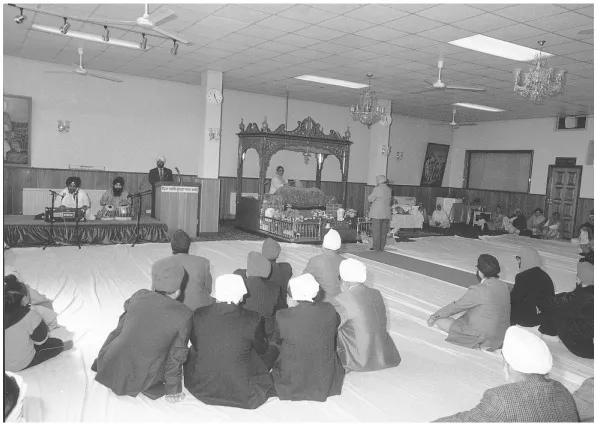
Figure 1.1 This photograph shows the kind of scene you would see if you entered a Sikh place of worship, a gurdwara, almost anywhere in the world.
Look at Figure 1.1 and notice the following:
- the ornate canopy and the posts that support it
- the woman sitting below the canopy, holding a fan (chauri)
- the musicians with their Indian instruments
- a man preparing to bow
- people sitting on the floor, men and women separate; not all the men are wearing turbans, though everyone’s head is covered. (The women are out of picture, on the right.)
From your initial observations you can deduce a number of things about the Sikh religion.
The seated woman may have led you to conclude that women are of some importance in this setting. You would be right. In fact, women and men have equal standing. Either may lead worship or any other religious activity, so long as they have the necessary competence, such as the ability to read the scripture, the Guru Granth Sahib.
The musicians, known as ragis, inform you that Sikh worship attaches importance to music. Not all religions do but it is an integral part of Sikh worship. The instruments provide a clue to the Indian origins of Sikhism; notice that women are among the instrumentalists.
Sikhs bring offerings of money to the gurdwara but, because a shared meal, known as langar, is an essential part of worship, they also bring food. (These offerings cannot be seen clearly in Figure 1.1.)
Everyone sits on the floor to show the equality of all human beings; this included Prince Charles, the Prince of Wales, when he visited a gurdwara in Derby. Respect for the scripture is the main reason why Sikhs sit on the floor in the gurdwara. The scripture alone is given a seat of honour. In its presence every head must be covered as another mark of respect.
Insight
Not all male Sikhs wear a turban. Those who do not, and other visitors, usually tie a handkerchief over the head. No one wears shoes, but stockinged feet are permitted in all but a few major gurdwaras. Every Sikh takes a bath before going to the gurdwara; this is another way of honouring the scripture.
Men and women sit in separate groups on the ground because in Indian society it is not considered modest for them to sit together in conditions that must inevitably result in physical contact, particularly on occasions when the hall is filled to capacity.
In some parts of the Sikh dispersion (that is, in communities outside India) there has been discussion about introducing chairs into the hall where worship takes place. So far this attempt at modernization has been resisted. Most Sikhs are likely to regard it more as a challenge to the unique position of the scripture than a move to bring Sikhism up to date. So strongly do Sikhs feel about this that even those who walk with the aid of crutches are likely to prefer to sit propped against the wall, rather than ask to be allowed to use a chair, though Sikhs are often eager to invite disabled visitors to sit on one at the back of the hall rather than be uncomfortable.
Part of Sikh worship is the langar meal, which will be discussed later. In India this invariably is eaten by Sikhs sitting on the ground. In the West, chairs and tables may be used. Some Western gurdwaras have reverted to the Punjabi custom, but in this case the reason has to do with long-established tradition rather than belief in equality, which is taken for granted.
From what has been written already you will have realized that the Guru Granth Sahib (Adi Granth, the Sikh holy book) has special importance for Sikhs. It is not very clearly visible in the photograph but it is its focal point. The woman is reading the scripture. She is holding a fan of yak hair embedded in silver, a chauri, in her hand and occasionally waves it over the Guru Granth Sahib in a gesture of respect. The canopy, chanani, serves the same purpose. The throne used by the British queen at the state opening of Parliament has a canopy. When she visits an Eastern country, an umbrella may be held over her head, not only for the practical purpose of sheltering her from sun or rain, but in response to her status.
By now you may have realized that the scripture is seated on a throne, rather like one used by princes of Mughal emperors in India in past times. When Sikhs approach the throne, on entering the gurdwara, they bow and kneel in front of it before sitting facing it in the congregation, sangat. The act of worship Sikhs engage in is called diwan, the word used for an audience with a Mughal emperor. The room of the gurdwara in which worship is held is known as the diwan hall.
The equality of Sikhs is further demonstrated through the use of food. At the end of an act of worship, every member of the sangat, whether they be adults, children or visitors who are not Sikhs receive karah parshad. This is made of flour, sugar and ghee, mixed in equal quantities in an iron bowl, and then heated before being carried into the diwan hall, perhaps before the service begins, but certainly before six stanzas of the Anand, a hymn of thanksgiving, are chanted. It is then touched with the point of a kirpan, a short sword which initiated Sikhs wear, to strengthen it symbolically, and given to five initiated Sikhs before being served to the rest of the congregation. Though it is usually received at the end of worship in Britain, in large Indian gurdwaras where worship continues throughout the day, Sikhs may be given it after bowing to the Guru Granth Sahib, or upon leaving its presence.
During diwan, in another room of the gurdwara, some Sikhs will have been preparing food. The community meal, called langar, is another way of affirming the belief of Sikhs in the equality of everyone. Sikhism came to birth in a Hindu society where almost all people ate only with members of their own kinship or occupational group. They believed in ritual pollution, that is that by sharing food with men lower in the social hierarchy, and perhaps any women, especially during menstruation, they would be rendered impure and unable to approach God. The men who preached the message of Sikhism totally rejected this belief and used karah parshad and langar as practical ways of demonstrating this. Anyone may eat with Sikhs, their kitchen is open to all, but those who have reservations or misgivings about human equality will refuse the invitation to eat with them. Sikhs would not interpret it as a dislike of spicy Indian food, but as a refusal to eat with them for some reason. In an attempt to offend no one, the food provided at langar is always vegetarian, usually a simple meal of lentil soup (dahl), vegetables, rice and chappatis.
Sikhs are very fond of telling the story of the Mughal emperor Akbar the Great who made a visit to one of the Sikh leaders, Guru Amar Das. Before being allowed into the Guru’s presence, the emperor was required to sit on the ground and share food with other men and women. ‘Pehle pangat, piche sangat’, first eat together then worship together, is a major tenet of Sikh faith. God is no respecter of persons and those who would wish to meet God cannot hope to do so unless they regard all human beings as God does.
The photograph with which this chapter began could have been taken almost anywhere in the world. However, there are some variations which might be encountered from place to place, though not usually in the act of worship itself.
In the dispersion, chairs and tables are often used for langar. This will be eaten indoors in countries like Britain, whereas in India it is often served outdoors, perhaps on leaf plates with people sitting in rows on the ground. The food served the world over remains Punjabi. The meal is satisfying and enjoyable but is intended to sustain and remove hunger as well as express unity rather than offer five-star sophisticated Indian cuisine. In India, pilgrims of all religions and other travellers often take langar in the gurdwaras that lie on their route, knowing that Sikhs are under obligation to give hospitality to anyone who asks for it. This may include accommodation for the night. Many of the larger gurdwaras have guest rooms where up to three nights’ stay may be provided. After this the traveller should be fully rested and able to continue his journey.
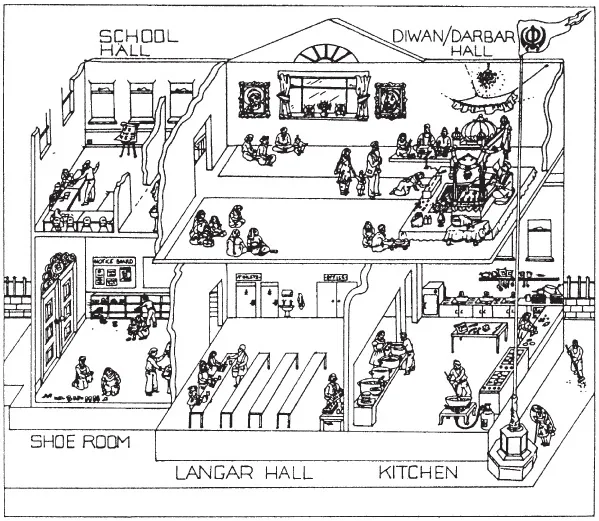
Figure 1.2 Cut-away illustration of a purpose-built gurdwara in one of the countries of the Sikh dispersion.
Members of the sangat provide the food, prepare it, serve it, and do the washing-up afterwards. When a family has a particular event to celebrate they may request the opportunity to express their joy through the privilege of providing langar for the congregation. In India, the extended family will share the work among themselves; elsewhere they may call upon the help of friends.
Because the Sikh scriptures are in Punjabi, and Sikhs have a strong attachment to that region of India even though they may have lived abroad for three or four generations, Punjabi remains the language of worship everywhere. The time is likely to come when Sikhs use the language of the country in which they live for sermons and addresses but it has not arrived yet, and the scriptures will always be recited in the original language in Sikh worship. It is not possible to envisage a translation of the Guru Granth Sahib ever being installed as the focus of worship.
The content and purpose of Sikh worship
We have noted the principal features of the gurdwara and some of the activities that take place there (Figure 1.2 provides a useful visual summary). The main activity is worship, w...
Table of contents
- Cover
- Title
- Copyright
- Dedication
- Acknowledgements
- Contents
- Meet the author
- Only got a minute?
- Only got five minutes?
- 1 Introduction: worship
- 2 The beginnings of Sikhism
- 3 Initiation
- 4 The family
- 5 Sikh names and the naming ceremony
- 6 Marriage (anand karaj)
- 7 Death
- 8 The Sikh Gurus
- 9 Festivals and their meaning
- 10 Ethics
- 11 The Sikh scriptures
- 12 Sikh teachings about God
- 13 Human nature and spiritual liberation
- 14 Sikhism in the modern period
- 15 Sikh attitudes to other religions
- 16 The Sikh dispersion
- Taking it further
- Glossary
- Index
Trusted by 375,005 students
Access to over 1.5 million titles for a fair monthly price.
Study more efficiently using our study tools.
Frequently asked questions
Yes, you can cancel anytime from the Subscription tab in your account settings on the Perlego website. Your subscription will stay active until the end of your current billing period. Learn how to cancel your subscription
No, books cannot be downloaded as external files, such as PDFs, for use outside of Perlego. However, you can download books within the Perlego app for offline reading on mobile or tablet. Learn how to download books offline
Perlego offers two plans: Essential and Complete
- Essential is ideal for learners and professionals who enjoy exploring a wide range of subjects. Access the Essential Library with 800,000+ trusted titles and best-sellers across business, personal growth, and the humanities. Includes unlimited reading time and Standard Read Aloud voice.
- Complete: Perfect for advanced learners and researchers needing full, unrestricted access. Unlock 1.5M+ books across hundreds of subjects, including academic and specialized titles. The Complete Plan also includes advanced features like Premium Read Aloud and Research Assistant.
We are an online textbook subscription service, where you can get access to an entire online library for less than the price of a single book per month. With over 1.5 million books across 990+ topics, we’ve got you covered! Learn about our mission
Look out for the read-aloud symbol on your next book to see if you can listen to it. The read-aloud tool reads text aloud for you, highlighting the text as it is being read. You can pause it, speed it up and slow it down. Learn more about Read Aloud
Yes! You can use the Perlego app on both iOS and Android devices to read anytime, anywhere — even offline. Perfect for commutes or when you’re on the go.
Please note we cannot support devices running on iOS 13 and Android 7 or earlier. Learn more about using the app
Please note we cannot support devices running on iOS 13 and Android 7 or earlier. Learn more about using the app
Yes, you can access Sikhism - An Introduction: Teach Yourself by Owen Cole in PDF and/or ePUB format, as well as other popular books in Theology & Religion & Asian Religions. We have over 1.5 million books available in our catalogue for you to explore.