Do you want to be able to persuade, influence, or empathise with people in any situation? Do you want to be able to click with people instantly? Do you want people to trust you?
This new Teach Yourself Workbook doesn't just tell you what emotional intelligence is. It accompanies you every step of the way, with diagnostic tools, goal-setting charts, practical exercises, and many more features ideal for people who want a more active style of learning. The book starts by helping you identify the behaviours associated with emotional intelligence, and whether you are currently doing them. It then helps you set specific goals to improve on; as you progress through the book, you will be able to keep checking your progress against these goals. Specially created exercises, using the tools of NLP, hypnotherapy and cognitive psychology, will help you to boost your emotional intelligence so that you can reach your potential in any situation.
- 288 pages
- English
- ePUB (mobile friendly)
- Available on iOS & Android
eBook - ePub
The Emotional Intelligence Workbook: Teach Yourself
About this book
Information
Topic
PsychologieSubtopic
Émotions en psychologie | Self-directed learning |

In its broadest meaning, ‘self-directed learning’ describes a process ‘in which individuals take the initiative, with or without the help of others, in diagnosing their learning needs, formulating learning goals, identifying human and material resources for learning, choosing and implementing appropriate learning strategies, and evaluating learning outcomes’. (Knowles, 1975).
WHAT IT IS
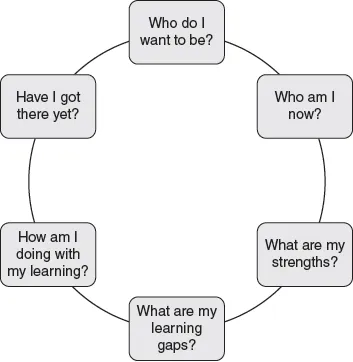
An example of self-directed learning is the undertaking of a targeted programme of study with defined milestones which involve development of a study plan and assessments of progress leading to defined outcomes or goals. The creation of the self-directed study plan often involves diagnostic exercises, usually open questions to cause the learner to reflect on where they are now, and the results of the exercises help shape the plan. The objective is to conclude where the learner wants to be, by when, in terms of improvements to their behaviour, knowledge and skills.
Self-directed learning
Nowadays, the resources and references available to individuals in the home environment are many: examples are integrated internet television provided via cable, satellite or terrestrial television, and unified communications integrating a laptop, PC or tablet with mobile phone applications. Public and academic libraries also remain valuable sources for the learner. Thus, this approach will appeal to those for whom a self-designed, self-directed strategy and programme of learning is attractive.

Acquiring a higher EQ through this developmental process may be different to your education, training and development experiences prior to this.
• Adults learn because they want to learn; adults are not in compulsory education.
• Adults acquire experience through everyday occurrences, both good and bad.
• In organizations, adults will learn whether the company directs it or not; individuals will adapt to progress, survive and compete.
Because of the nature of emotional intelligence, in what way is developing it different? Emotional intelligence is most effectively developed through experiential learning, i.e. learning through experiences of the senses. Experiential learning has more impact since people connect emotionally, often without even knowing or naming what they feel. By engaging in a meaningful experience, something is more likely to shift in our amygdala (see Chapter 2) and this opens us to changing our behavioural patterns.
The most appropriate definition of experiential learning for the purposes of emotional intelligence is ‘education that occurs as a direct participation in the events of life’ (Houle, 1980). Here, learning is sponsored by people themselves, not by some formal educational institution. Learning is achieved through reflection upon everyday experiences; most adults learn this way. This can be reinforced through linguistic communication – talking therapies, sharing learning with others or through coaching and mentoring.
It is critical in self-directed learning to:
• experiment and practise. This way may stretch most adults to become more flexible in using a variety of learning styles to a preferred style (Smith, 2001)
• develop and use relationships as part of your learning and change process
• identify and work with good role models (see later exercise). Reflect with them regarding their own perception and experience of managing personal change in the past
• generate settings where you feel psychologically safe to experiment and practise
• reflect on a...
Table of contents
- Cover
- Title
- Dedication
- Acknowledgement
- Contents
- How to use this workbook
- 1 Self-directed learning
- 2 Taking advantage of your brain design
- 3 Developing your self-awareness
- 4 Developing your self-control
- 5 Developing your self-motivation
- 6 Developing your awareness of others
- 7 Developing your management of others
- 8 Becoming more resilient
- 9 Developing your influencing skills
- 10 Conflict resolution
- 11 Achievement orientation
- 12 Organizational awareness
- 13 Teamwork and collaboration
- References and resources
- Copyright
Trusted by 375,005 students
Access to over 1.5 million titles for a fair monthly price.
Study more efficiently using our study tools.
Frequently asked questions
Yes, you can cancel anytime from the Subscription tab in your account settings on the Perlego website. Your subscription will stay active until the end of your current billing period. Learn how to cancel your subscription
No, books cannot be downloaded as external files, such as PDFs, for use outside of Perlego. However, you can download books within the Perlego app for offline reading on mobile or tablet. Learn how to download books offline
Perlego offers two plans: Essential and Complete
- Essential is ideal for learners and professionals who enjoy exploring a wide range of subjects. Access the Essential Library with 800,000+ trusted titles and best-sellers across business, personal growth, and the humanities. Includes unlimited reading time and Standard Read Aloud voice.
- Complete: Perfect for advanced learners and researchers needing full, unrestricted access. Unlock 1.5M+ books across hundreds of subjects, including academic and specialized titles. The Complete Plan also includes advanced features like Premium Read Aloud and Research Assistant.
We are an online textbook subscription service, where you can get access to an entire online library for less than the price of a single book per month. With over 1.5 million books across 990+ topics, we’ve got you covered! Learn about our mission
Look out for the read-aloud symbol on your next book to see if you can listen to it. The read-aloud tool reads text aloud for you, highlighting the text as it is being read. You can pause it, speed it up and slow it down. Learn more about Read Aloud
Yes! You can use the Perlego app on both iOS and Android devices to read anytime, anywhere — even offline. Perfect for commutes or when you’re on the go.
Please note we cannot support devices running on iOS 13 and Android 7 or earlier. Learn more about using the app
Please note we cannot support devices running on iOS 13 and Android 7 or earlier. Learn more about using the app
Yes, you can access The Emotional Intelligence Workbook: Teach Yourself by Jill Dann,Derek Dann in PDF and/or ePUB format, as well as other popular books in Psychologie & Émotions en psychologie. We have over 1.5 million books available in our catalogue for you to explore.