Teach Yourself - the world's leading learning brand - is relaunched in 2010 as a multi-platform experience that will keep you motivated to achieve your goals. Let our expert author guide you through this brand new edition, with personal insights, tips, energising self-tests and summaries throughout the book. Go online at www.teachyourself.com for tests, extension articles and a vibrant community of like-minded learners. And if you don't have much time, don't worry - every book gives you 1, 5 and 10-minute bites of learning to get you started. - A bestseller, now fully updated with the very latest on body language and non-verbal communication - The only title to give you practical exercises to help you understand your own and other peoples' body language - Unlike other titles, this is not restricted to the workplace but shows you how to understand what other people are saying in every social and domestic situation - Includes the very latest on NLP and how to communicate more effectively through its useWe all use body language. Over 90% of all face-to-face communication is non-verbal, and the silent messages of body language often reveal more than the spoken word in conveying true feelings. These messages are particularly significant in influencing first impressions and the self-image we project to others.
Now updated for the 21st century with the very latest on NLP and other cutting edge research, Teach Yourself Body Language gives you the knowledge and understanding to be able to use and interpret body language more effectively. It includes practical exercises that will enhance your understanding of non-verbal communication, and it also explores the use of body language in personal and professional situations.
All aspects of body language are covered including features of the workplace and features exhibited in an international context.
- 224 pages
- English
- ePUB (mobile friendly)
- Available on iOS & Android
eBook - ePub
Understand Body Language: Teach Yourself
About this book
Information
Subtopic
History & Theory in PsychologyIndex
PsychologyPart one
Body language in everyday life
Before we examine the skills and techniques needed to become a confident body language communicator, it’s important to recognize some of the everyday life situations, or contexts, in which non-verbal communication plays such a significant role. The chapters that follow will evaluate differences in body language recognition and how we can use this knowledge to enhance our personal and working relationships.
1
Cultural differences
In this chapter you will learn:
- about cultural differences in the use of body language
- how taking account of such differences makes you a more effective communicator.
Body language is complex enough when you are dealing with people from your own culture, let alone those from other parts of the world where cultural differences may count for a lot in personal and professional communication. Because things can so easily go wrong as a result of misunderstandings or inadvertent mistakes, it may be useful to consider some of the difficulties to be encountered, and how to avoid them.
The world today is a much smaller place than it was even 50 years ago. Travel is relatively easy, and far cheaper than it used to be. We can go to distant places which were once inaccessible to us because of cost, difficult terrain and political boundaries. We watch television pictures from the other side of the globe beamed to us by satellite, chat online thanks to the power of the internet, and text each other on mobile phones from all over the world, at a fraction of the cost it used to be.
The revolution in communications has made all this possible. As a result, the differences between the peoples of the world are diminishing. We know more about each other now than ever before. We share ideas and copy each other’s fashions and technical innovations – but we don’t always understand how our traditions and customs differ. Just because you can back-pack across China, fly to a conference in Managua, or sleep rough on a Greek holiday beach, doesn’t mean you understand or respect the values and uniqueness of the people and places you visit.
Cultural diversity offers huge opportunities for learning about, and integrating into, each other’s cultures, yet all too often little or no effort is made to do so. Historical factors are partly to blame for this, such as the ‘we’re better than them’ attitudes which still exist as a hangover from the colonial era. But there is no room for this today. Failure to respect the customs, values and traditions of other countries and peoples is a recipe for disaster in a multicultural, inter-dependent world.
Silent language
The anthropologist, Edward Hall, coined the phrase ‘the silent language’ to describe out-of-awareness aspects of communication. People of western European descent, he argued, live in a ‘word world’ and often fail to realize the significance of the ‘language of behaviour’. If we don’t at least try to understand this language, we can only blame ourselves when things go wrong. He gives instances in which inappropriate non-verbal behaviour, coupled with general cultural insensitivity, can cause poor communication, or even cause it to break down altogether. Take the case in which negotiations between American and Greek officials had reached stalemate. Examination revealed that the American habit of being outspoken and forthright was regarded by the Greeks as indicating a lack of finesse, which made them reluctant to negotiate. When the Americans wanted to limit the length of meetings and to reach agreement on general principles first, leaving the details to be sorted out by sub-committees, the Greeks saw this as a device to pull the wool over their eyes. The basic difference between the two negotiating styles was that the Greeks preferred to work out the details in front of all concerned – regardless of how long it took.
In another case, an American attaché, new to a Latin country, tried to arrange a meeting with his ministerial opposite number. All kinds of messages came back that the time was not yet ripe for such a meeting. The American persisted and was eventually granted an appointment. When he arrived, he was asked to wait in an outer office. The time of the appointment came and went. After 15 minutes, he asked the minister’s secretary to make sure the minister knew he was waiting. Time passed. Twenty minutes, 30 minutes, 45 minutes. At this point, he jumped up and told the secretary he had been ‘cooling his heels’ long enough and that he was ‘sick and tired’ of this kind of treatment. What he had failed to grasp is that a 45-minute waiting time in that country was equivalent to a five-minute waiting time in America.
Effective cross-cultural communication is so important in the modern world that breakdowns like these need to be studied for the lessons they can teach us. They also make it increasingly important that people who live and work in countries other than their own should be given training so that they recognize differences in local body language as well as the local spoken language. While quite a lot of research has been carried out on differences in the way various peoples around the world use body language, it has tended to focus on the Americans, the Japanese, the Arabs and some European countries. More needs to be done to include people from other cultures given the far greater mobility afforded by open borders and cheaper travel today.
Eye signals
In research into the use of eye contact, for instance, it has been observed that Greeks look at each other more in public places, whether in direct communication or just observation. In fact, they feel quite upset if other people do not show an equal curiosity in them and feel they are being ignored. On the other hand, Swedes have been found to look at each other less often than other Europeans, but they look for longer.
Arabs are very dependent on eye contact when conversing. They look at each other when listening and when talking, however they interact less successfully with someone whose eyes cannot be seen. The Japanese look at other people very little and tend to focus their eyes on the other person’s neck when conversing. Americans and British, on the other hand, tend to be relatively restrained in their facial expressions, while Italians tend to be much more expressive. The Japanese keep a straight face in public and make more use of smiles when greeting others, particularly in business and formal meetings.
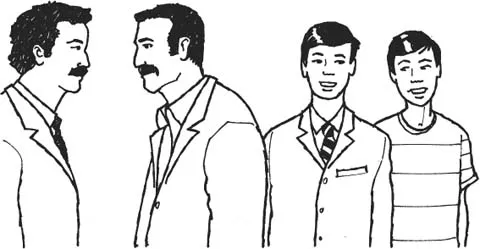
Figure 1.1 Eye contact.
Thoughts and actions
We communicate using gestures and body posture far more than we realize. Gesticulations, facial expressions, head movements, in fact all kinds of actions involving the face, hands and body, take the place of words on many occasions. It’s as if we are dancing to the tune of our thoughts, investing what we say with additional meaning and weight. Sometimes thoughts and feelings make themselves known without us intending them to do so – what we mean by betraying our thoughts.
In many cases actions speak louder than words. How a person stands can indicate how they are feeling about something. We call someone ‘uptight’ when they seem taut and controlling, and ‘defensive’ when they cross their arms and hunch their backs. The Japanese bow when greeting and saying farewells, with persons of lower status bowing lower than those of high status. Germans on the other hand maintain a more upright posture than people from Latin countries. Italians and Arabs stand closer to other people when conversing, whereas Germans stand further apart.
The Japanese use formal gestures to summon others to them, such as extending the arm with palm downwards and fluttering the fingers. To suggest that someone is a liar, they lick a forefinger and stroke an eyebrow. The British are more likely to nod and look downwards, saying nothing, yet signifying their doubt.
In the USA, you can signal that everything is OK by forming a circle with the thumb and index finger and spreading out the rest of the fingers, but in Japan the same gesture means money, in France it means ‘zero’, in Scandinavia and parts of central Europe it is regarded as vulgar, and in some south American countries it has obscene connotations.
In Hindu and Muslim cultures it is customary to use the right hand when preparing and eating food because the left hand is considered unclean due to its use in bodily hygiene. Equally, pointing the soles of your feet towards another person is considered offensive – something that globe-trotting backpackers should note.
Westerners tend to think that a smile always reflects warmth or happiness, yet in some parts of Asia it can also indicate displeasure since overt expression of negative feelings is discouraged. Silence is similarly misinterpreted. Whereas the Japanese are comfortable with silences, particularly during negotiations, Americans and British often find them unnerving. We shall return to this subject in more detail in Chapter 8.
Touch and tone
Latins touch each other more readily in everyday social situations than northern Europeans, while Arab men will frequently hold hands while walking and talking – something which Europeans often misinterpret. The Japanese touch each other very little in public, though they have a tradition of bathing together without any connotation of immodesty. Western women kiss, hug and touch each other socially, while it is frowned upon for Arab women to be touched at all in public.
We often pat children on the head as a sign of affection, but in Muslim countries the head is regarded as the seat of mental and spiritual powers. Accordingly, it should not be touched. In the West we scratch our heads when we are puzzled, while in Japan, the same action is interpreted as showing anger.
Amongst other non-verbal forms of communication tone of voice is particularly important across cultures. Emotions can be gauged from how people speak even if the spoken language is not properly understood. But a word of warning here: Latin languages are often spoken with far greater emphasis than, say, English, and are accompanied by similarly expressive hand and arm movements. To the more reserved northern European this can sound like shouting, or even criticism, when it is simply uninhibited conversation. In other words, it is up to you, the listener, to recognize and appreciate cultural differences in the way we communicate, not to over-react to types of behaviour with which we are unfamiliar. Just because something does not conform to our own notions of acceptability, doesn’t mean that it is wrong.
PERSONAL SPACE
Americans generally prefer more personal space than people in Mediterranean and Latin American cultures, and more than men in Muslim cultures. This is because space is associated with independence and individual rights to privacy. In a recent study, a Brazilian man working as a waiter in an American restaurant found that his habit of casually touching his colleagues when talking resulted in him being rejected. Confused as to why this was happening, he ...
Table of contents
- Cover
- Title
- Copyright
- Contents
- Introduction
- Part one: Body language in everyday life
- Part two: Skills and techniques
- Conclusion
- References and further reading
- Index
Trusted by 375,005 students
Access to over 1.5 million titles for a fair monthly price.
Study more efficiently using our study tools.
Frequently asked questions
Yes, you can cancel anytime from the Subscription tab in your account settings on the Perlego website. Your subscription will stay active until the end of your current billing period. Learn how to cancel your subscription
No, books cannot be downloaded as external files, such as PDFs, for use outside of Perlego. However, you can download books within the Perlego app for offline reading on mobile or tablet. Learn how to download books offline
Perlego offers two plans: Essential and Complete
- Essential is ideal for learners and professionals who enjoy exploring a wide range of subjects. Access the Essential Library with 800,000+ trusted titles and best-sellers across business, personal growth, and the humanities. Includes unlimited reading time and Standard Read Aloud voice.
- Complete: Perfect for advanced learners and researchers needing full, unrestricted access. Unlock 1.5M+ books across hundreds of subjects, including academic and specialized titles. The Complete Plan also includes advanced features like Premium Read Aloud and Research Assistant.
We are an online textbook subscription service, where you can get access to an entire online library for less than the price of a single book per month. With over 1.5 million books across 990+ topics, we’ve got you covered! Learn about our mission
Look out for the read-aloud symbol on your next book to see if you can listen to it. The read-aloud tool reads text aloud for you, highlighting the text as it is being read. You can pause it, speed it up and slow it down. Learn more about Read Aloud
Yes! You can use the Perlego app on both iOS and Android devices to read anytime, anywhere — even offline. Perfect for commutes or when you’re on the go.
Please note we cannot support devices running on iOS 13 and Android 7 or earlier. Learn more about using the app
Please note we cannot support devices running on iOS 13 and Android 7 or earlier. Learn more about using the app
Yes, you can access Understand Body Language: Teach Yourself by Gordon Wainwright in PDF and/or ePUB format, as well as other popular books in Psychology & History & Theory in Psychology. We have over 1.5 million books available in our catalogue for you to explore.