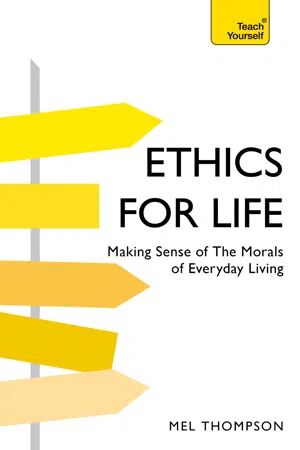
We all face questions on an almost daily basis related to truth and post-truth, particularly in the political sphere, terrorism, globalization, immigration and asylum, social responsibility, media and social-media ethics, and gender and LGBT issues. So how do you navigate this minefield? Ethics for Life is an accessible introduction to all the key theories and thinkers. It shows the relevance of ethical ideas and theories to everyday life, emphasizing the way our view of ourselves and the societies we live in is shaped by our moral values and the arguments they are based on.With contemporary examples and discussion of current debates including terrorism, genetics and the media, Ethics for Life will help you grasp how ethics applies to life today.
- 272 pages
- English
- ePUB (mobile friendly)
- Available on iOS & Android
eBook - ePub
About this book
Information
Topic
PhilosophySubtopic
Ethics & Moral Philosophy1
Free to choose?

In this chapter you will learn:
• To explore how much freedom we need to make sense of morality
• How reductionism challenges moral arguments
• How philosophers have tackled the issue of freedom and determinism
 | Why? |
If you are not responsible for your actions, you should not be blamed or praised for what you do. But what if all our actions are entirely explicable in terms of psychology, genetics, social influences or upbringing? What if our brains are no more than computers responding to stimuli? Without free will morality makes no sense, so how much freedom do we have, and how much does morality require? Are you a free individual or a pre-programmed machine? Or are you both?

What kind of freedom?
Nobody is completely free to do anything that he or she may wish. Freedom is limited in different ways:
• I may decide that I would like to launch myself into the air, spread my arms and fly. I may have dreamed of doing so. I may have a passion for Superman films, and feel certain that in some way it should be possible. But my physical body is, and will always be, incapable of unaided flight. To overcome that limitation, I must resort to technology.
• I may wish to be a famous and highly talented artist, musician or gymnast, but my freedom is again limited. It may not be physically impossible for me to achieve these things, but it requires such a level of experience, training and natural ability, that my chances of achieving what I want are severely restricted.
• I may wish to go to London and parade myself naked before Buckingham Palace. There is no physical limitation to inhibit me, and no great skill required, but I am likely to be arrested if I do so.
• I may want to be the life and soul of a party, but I am shy and introverted and feel inhibited in such social situations.
• I may want to start up a business, but I cannot get the finance I need to do so.
• I may want to come out about my sexuality, but I fear rejection by my family if I do so.
Whether by physical laws, natural abilities, or legal, psychological, economic or social restraints, we are all limited in what we can do. If I am to make a moral choice, I must be free to do, or not to do, the thing in question. It cannot be morally wrong of me not to fly, because I am unable to do so. On the other hand, walking about naked in public could become a moral issue, if it were argued that I would give offence by doing so, because it would be something that I had chosen to do and could have refused to do had I considered it wrong.
Perhaps it’s just as well our freedom is limited. In The Republic (381 BCE) Plato has one of his characters, Glaucon, recount the story of the Ring of Gyges. In it, a shepherd named Gyges finds a magical ring, by means of which he can make himself invisible. Suddenly, he realizes that he can act with impunity. He seduces the queen of Lydia, murders the king and takes the throne. Such freedom haunts all discussions of morality. If we were absolutely free to do whatever we liked, with no chance of being found out or punished, what would we really choose to do? Would it lead to a fair and just world? Or to one in which our selfishness knew no bounds? Do people need to be restrained in order to do the right thing, or can we trust their personal sense of responsibility?
So, to make sense of morality, we also need to make sense of the experience of freedom and choice, whether or not it is an illusion.
 | Key idea for life |
Freedom is a threat, although we generally hate being deprived of it. It requires us to choose and take responsibility. How much easier it would be if we had a comfortable but totally predictable life, with everything fully explained and plotted out. There would always be something or someone else to blame when things didn’t work out as we had hoped. We are challenged, to the extent that we are free.
Consensual?
In relationships, consent opens up the possibility of mutual free expression of desire and fundamentally changes the ethical significance of the resulting sex. But what constitutes ‘consensual sexual activity’? What one person regards as normal, another might object to, whether or not able to voice that objection at the time. Falsely assumed consent can sometimes be blamed on the use of pornography, where consent is cheerfully implied in situations that, in real life, would be ambiguous at best. What about alcohol or drugs? Do these take away responsibility, or imply consent?
During 2017 and 2018 there was a hugely increased awareness of the problems of sexual harassment, particularly in the workplace, and on the part of men who had positions of authority over younger women. But what constitutes consent? Knowing all the facts and having a clear mind to understand and evaluate them and make a decision? But how often, in social situations, can one rely on either of those requirements? It possibly comes down to a question of what one could reasonably expect a person to consent to. But how is one to be educated in that? And does such a broad requirement not make a mockery of the variety of human needs and desires?
In these discussions, there are few easy answers.
Determinism
Science is based on the observation of natural events and their causes, and from the resulting information is able to develop theories by which events may be predicted.
You look up and say ‘I think it is going to rain’. You do not thereby imply that the weather has a personality, and that you guess that it has decided to enjoy a little precipitation. Rather, you make a comment based on the clouds, wind, dampness in the air, and on your observation of similar things leading to rain on previous occasions.
• The falling of rain is determined absolutely by certain atmospheric conditions.
• The fact that you may be inaccurate in predicting those conditions, and therefore the coming of rain, does not detract from the fundamentally determined nature of that event.
• Given certain conditions, it will rain; without them, it will not: the weather is determined. Its absolute prediction is theoretically possible, even if practically difficult.
The prediction of rain is possible because it is recognized that all physical phenomena are causally connected. Everything from the weather to the electrical impulses within human brains can be explained in terms of physical laws.
From the rise of modern science in the seventeenth century to the early part of the twentieth century, it could be said with some certainty that science was mechanistic. The whole world was seen as a machine, knowledge of which would enable mankind to predict and control the action of individual things. Even the process of evolution, as set out by Darwin, had a mechanistic and determinist basis. With the theory of natural selection, we have a clear example of the way in which change is forced forward through the operation of an impersonal law: that only those who survive to adulthood are able to breed, and it is they, rather than others of the species, who pass on their characteristics to future generations.
Although, in the general run of things, science still appears to be largely deterministic, some philosophers have made much of the fact that, at that sub-atomic level, the very act of observing some phenomena causes them to change, so it is not possible to formulate and test out physical laws with quite the crude certainty that prevailed in the nineteenth century. But that does not discredit the general rule that events are determined by pre-existing causes and conditions, and it certainly does not operate at the level at which humans engage with the physical world.
Nevertheless, overall, including the spheres of sociology and psychology (which explore issues that are morally significant) science has ...
Table of contents
- Cover
- Title
- Contents
- Meet the author
- Introduction: What’s the point of ethics?
- 1 Free to choose?
- 2 What do we mean?
- 3 Scepticism and relativism
- 4 Is it natural?
- 5 Looking for results
- 6 The experience of moral choice
- 7 Personal development and virtue
- 8 Law and order
- 9 Fairness and equality
- 10 Religion and moral values
- Some conclusions
- Glossary
Trusted by 375,005 students
Access to over 1.5 million titles for a fair monthly price.
Study more efficiently using our study tools.
Frequently asked questions
Yes, you can cancel anytime from the Subscription tab in your account settings on the Perlego website. Your subscription will stay active until the end of your current billing period. Learn how to cancel your subscription
No, books cannot be downloaded as external files, such as PDFs, for use outside of Perlego. However, you can download books within the Perlego app for offline reading on mobile or tablet. Learn how to download books offline
Perlego offers two plans: Essential and Complete
- Essential is ideal for learners and professionals who enjoy exploring a wide range of subjects. Access the Essential Library with 800,000+ trusted titles and best-sellers across business, personal growth, and the humanities. Includes unlimited reading time and Standard Read Aloud voice.
- Complete: Perfect for advanced learners and researchers needing full, unrestricted access. Unlock 1.5M+ books across hundreds of subjects, including academic and specialized titles. The Complete Plan also includes advanced features like Premium Read Aloud and Research Assistant.
We are an online textbook subscription service, where you can get access to an entire online library for less than the price of a single book per month. With over 1.5 million books across 990+ topics, we’ve got you covered! Learn about our mission
Look out for the read-aloud symbol on your next book to see if you can listen to it. The read-aloud tool reads text aloud for you, highlighting the text as it is being read. You can pause it, speed it up and slow it down. Learn more about Read Aloud
Yes! You can use the Perlego app on both iOS and Android devices to read anytime, anywhere — even offline. Perfect for commutes or when you’re on the go.
Please note we cannot support devices running on iOS 13 and Android 7 or earlier. Learn more about using the app
Please note we cannot support devices running on iOS 13 and Android 7 or earlier. Learn more about using the app
Yes, you can access Ethics for Life by Mel Thompson in PDF and/or ePUB format, as well as other popular books in Philosophy & Ethics & Moral Philosophy. We have over 1.5 million books available in our catalogue for you to explore.