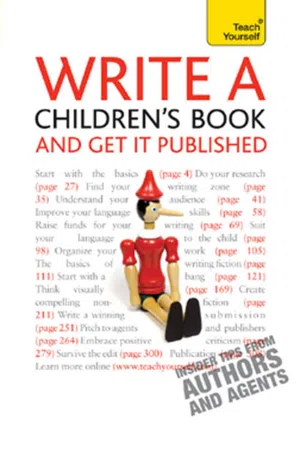
Designed for writers of any children's literature, be it fiction, non-fiction or faction, this popular and successful title has been fully updated and expanded to include the latest developments in the field of children's publishing. You will understand the implications of television and film projects, learn new ways of producing your work, the latest technologies and even how to self-publish, guided by two authors who are highly experienced with the genre.
NOT GOT MUCH TIME?One, five and ten-minute introductions to key principles to get you started.
AUTHOR INSIGHTSLots of instant help with common problems and quick tips for success, based on the authors' many years of experience.
TEST YOURSELFTests in the book and online to keep track of your progress.
EXTEND YOUR KNOWLEDGEExtra online articles at www.teachyourself.com to give you a richer understanding of writing for children.
FIVE THINGS TO REMEMBERQuick refreshers to help you remember the key facts.
TRY THISInnovative exercises illustrate what you've learnt and how to use it.
eBook - ePub
Write A Children's Book - And Get It Published: Teach Yourself
- 250 pages
- English
- ePUB (mobile friendly)
- Available on iOS & Android
eBook - ePub
Write A Children's Book - And Get It Published: Teach Yourself
About this book
Information
Topic
Personal DevelopmentSubtopic
Writing & Presentation Skills1
Writing for children: an easy option?
In this chapter you will learn:
- that writing for children is not an easy option
- that getting your material published is going to be hard work
- some basic guidelines to help increase your chances of getting published.
Once upon a time, someone had a great idea for a story …
Are you that person? Do you have a great idea in your head right now? Then you need to get it out of your head and onto paper or into your computer. If you don’t have a computer or any paper to hand, use your mobile phone, blackberry or whatever other electronic device you currently carry around with you. If you don’t have any of these things, borrow a pen from a stranger and scribble your idea down in the back of this book. Just get it written down – ideas can easily get lost in all the chaos of modern life, and you are going to kick yourself if your great idea goes down the drain because your boss suddenly gave you an insane deadline, or your children need help with their homework or you’re distracted by a bee, or whatever.
Trust us – ideas can come and go really quickly if you don’t pay them enough attention. And the other thing is that once you start recording ideas, they can snowball unexpectedly until suddenly you have a complete plot or storyline figured out. Don’t let anyone get in the way of your great idea. There was a famous poet called Samuel Taylor Coleridge. He woke up after an amazing dream and started writing the dream down – and it turned into the poem Kubla Khan. It was going to be an epic, but 54 lines in, someone turned up at his house and broke his concentration – and the poem was never completed because all the rest of Samuel’s ideas got knocked out of his head by his unexpected guest.
Don’t let that happen to you. Don’t pay any attention to the doorbell or the telephone or a text message until you have the whole of your idea written down.
How to use this book
So, what is it with books anyway? People have been prophesying the death of the printed word for years. ‘In the future there will be no books. Everything will be electronic.’ Well, possibly – but we don’t think so, and it certainly isn’t going to happen any time soon. Handheld readers are additional ways of accessing books and information, not necessarily replacements for the sight, touch and smell of paper. Of course the internet has changed the way people read and research, especially when it comes to factual stuff – but when they’re reading a good story, the majority of people still like the feel of a book in their hands – perhaps especially so for children. And even if books do eventually become ‘ear-pods’ or ‘story-screens’ – someone still needs to write them – and that’s where you come in – and that’s where this book comes in to help you out.
People collect expensive first editions of favourite books and keep them sealed behind glass. Good for them – why not? But books aren’t ornaments – they exist to be handled and stuffed into pockets and bags and to be dropped in the bathwater and mauled around a bit… and to be read. Okay, so maybe we were brought up to treat books with care and reverence and not to scribble on them or fold down the corners or anything like that. Well, you can forget all of that with this book.
Exercise 1
We want you to go and buy a coloured highlighter pen, and we want you to highlight passages or lines in this book that interest you. We want you to turn the corners down and scribble in the margins. We want you to cover it in Post-it® notes. This book is a tool – like a textbook in an ‘open page’ exam. Its only purpose is to help you – treat it mean. Use it!
This book isn’t like one of those writers’ courses you see advertised everywhere – we don’t guarantee that by the final chapter you’ll have recouped your outlay from work you’ve had published. There are no promises like that on offer – but we do believe that by the time you’ve read the book, you’ll have taken on board a whole lot of useful practical advice and know-how that will help you to get published – if you have the talent and the determination to really go for it.
By the way – this book isn’t intended for writers who have already got published work out there; it’s aimed at people who have been quietly and diligently creating stories for their own pleasure, or to amuse their own children, but who don’t know how to turn their work into something that will appeal to a wider audience. Or maybe you’re thinking – ‘Hey, I’d like to try writing a children’s book. I just bet I can do it. But how do I go about it?’ Well, read on – we’re here to help. Or it could be that you’ve been sending your work off to publishers for a while, and you’re getting tired of getting rejection letters back. These days publishers don’t have a lot of time to explain what you’re doing wrong – but we do. Let us show you how you can turn rejections into signed contracts and to books on shelves.
STARTING WITH THE BASICS
We have a bit of a problem at this point. We have no idea how much you already know about writing children’s books and trying to get them published. You may be on the brink of having your first piece of work accepted, or you may never before have even thought of contacting a publisher. We have to work on the basis that you know absolutely nothing, and build up from there, so we hope those of you with a higher level of knowledge will bear with us while we go through the basics.
First off, there is no right or wrong way to write for children, but getting a handle on some of the basic guidelines will increase your chances of being published. Use this book as a study aid and you’ll get to where you need to be far more quickly than by going it alone. At least, that’s the plan, and the fact that we’re working on a fourth reprint right now suggests the plan is working fine. When we originally put this book together, we sent out a whole bunch of questionnaires to authors and publishers and literary agents (we’ll fill you in on what they are later) involved in the world of children’s books. These people were glad and eager to help – even the slowest, longest reply only took ten days to arrive, and a lot of people emailed or wrote back the same day. This made one thing really obvious to us – people in the book business want to help new writers and are happy to share their expertise, as well at to point out the mistakes they made along the way and what worked and didn’t work for them.
When we repeated the process for this new edition, we found things had changed a little. Far fewer people responded. What should we make of this? Maybe agents and editors and authors are busier now, and don’t have the time to fill out questionnaires. Maybe the world has grown harsher and more callous over the past decade? Whatever is going on, it’s as well for you to be aware that, in the words of one publisher we spoke with: ‘The children’s market is brutal right now …’ But brutal or not, we hope you stay with us – the world needs writers and storytellers.
The responses we got to our questionnaires covered the whole range of human emotions and experience – from laugh-out-loud hilarious (but eye-poppingly unprintable) to grim and grisly and horribly sobering. You’ll spot these handy first-hand insights scattered throughout the book. We hope you’ll find them as useful as we did. Here’s one to be getting on with:
Insight
Write something every day. Anything. Even if it’s utter garbage. Just write.
Myth-busting
First the harsh news: if you thought writing for children was an easy option, forget it. It’s probably more difficult to write the text of a 400-word picture book for the very young and get it published than it is to sell a 100,000-word novel for adults. These days it’s hard for any new author to get their foot in the door, and the children’s market is certainly no exception. Why so? Well here are a few of the reasons. Large book store chains will usually have a central buying policy which means they tend to buy books that will show a quick profit in all of their stores – meaning books already earmarked as bestsellers by known authors. Books by established authors or known celebrity ‘names’ will be given large marketing budgets, get all the publicity and go straight to the top of the buying list. As chains of book stores merge and are bought up, this just gets worse. Supermarkets and similar outlets are also in the book-selling game – ‘stacking ’em high and selling ’em cheap’ and not always at a profit – which is good if you are a recognized bestselling author, but it does unknown writers no favours at all. It’s called ‘catch-22’: if no one knows who you are, how do you get publishers to pay you any attention? If your book is not advertised and broadcast to the book trade – how will buyers find out about it? ‘Come back when you’re better known and we’ll do business together’ is all very well – but how do you get better known? No experience could mean no publishing deal – but without getting anything published, how do you learn the trade, and how do you get your foot in the door? Read on, and we’ll show you the best way of maximizing your chances.
MYTH 1: WRITING FOR CHILDREN IS EASIER THAN WRITING FOR ADULTS
At lot of people – even those who should know better – think that writing for children is going to be easier than writing for adults.
They’ve got that wrong.
Even famous authors of books for the over-16s have found that they can’t make a go of writing for a younger readership. An author needs special and specific skills if they’re going to crack the children’s market.
When you write for adults, there are no real limits on the language you can use. You can also be as oblique and complex as you like in your plotting and presentation. You can write in whatever style takes your fancy, and write about pretty much anything you can think of, and you can still find publishers who will give your work a chance.
Not so in the children’s market. You’re going to have to come to terms with a whole heap of important new issues and concerns. Consider this for a start: what age children are you aiming your story at? Toddlers who are just starting to learn the alphabet? Five-year-olds who want an adult to read to them while they look at lots of brightly coloured pictures? Eight-year-old boys with the attention span of a fruit fly? Twelve-year-old girls who hang out in gangs in the Mall and are desperate to be 16? Soul-searching Goth teens who want to fall in love with a cute-but-dangerous vampire? Each of these target audiences will have different language skills and each will expect different things from storytellers. When you decide whom you want to write for, you then have to find yourself a publisher who works in that zone. And there will be fewer of these than in the world of grown-up literature.
By the way, if UK readers are wondering why we don’t just say ‘the adult market’ when we’re talking about books for the over-16s – it’s because in some countries the ‘adult market’ means erotica and porn.
If you want to crack the children’s market, you’re going to need a few elements working for you right from the start. You’re going to need inspiration and luck. You’re going to need persistence and adaptability. Then you’re going to need to grow a thick skin to deal with all the harsh criticism you’re going to encounter. You also have to want to write, and yet to have fun at the same time.
Think about this: in the children’s market a great idea, badly written, has more chance of being picked up by a publisher than a weak idea written wonderfully well. This is because a publisher may latch onto an outstanding concept, as they know that the bad writing can be put right when it gets edited. The same publisher may be impressed by the technical expertise of wonderful writing, but if the story being told does not grab them, the book will not be taken on. In other words, there is no place in children’s writing for the abstract, abstruse or overly complicated; the job of a children’s writer is to tell a story – simply and entertainingly.
But is this an easy option? Of course it isn’t, although plenty of people both outside and inside the business still don’t get how hard and demanding it is.
Here’s part of an actual letter from an editor who usually works on adult-interest books, in response to the submission of a children’s short story by a well known author:
It would do you some good to make heavier demands of your art and yourself. Although you have a gift of writing both poems and fiction for children, and there is no reason why you shouldn’t continue to cultivate it, I do worry that you may be clinging to those habits as a form of security.
In other words, stop dabbling in ‘easy option’ kids’ books and get out in the real world. Tell that to the people who have created all the unforgettab...
Table of contents
- Cover
- Title
- Copyright
- Acknowledgements
- Contents
- Meet the authors
- Only got a minute?
- Only got five minutes?
- Only got ten minutes?
- Foreword
- 1 Writing for children: an easy option?
- 2 A professional approach
- 3 Getting started: the tools of the trade
- 4 What to write and who to write for
- 5 The basics of writing fiction
- 6 Illustrations and picture books
- 7 Markets for fiction
- 8 Non-fiction books
- 9 Presentation and submission
- 10 Dealing with rejection
- 11 Acceptance
- 12 Publication day – and afterwards
- Taking it further
- Index
Trusted by 375,005 students
Access to over 1.5 million titles for a fair monthly price.
Study more efficiently using our study tools.
Frequently asked questions
Yes, you can cancel anytime from the Subscription tab in your account settings on the Perlego website. Your subscription will stay active until the end of your current billing period. Learn how to cancel your subscription
No, books cannot be downloaded as external files, such as PDFs, for use outside of Perlego. However, you can download books within the Perlego app for offline reading on mobile or tablet. Learn how to download books offline
Perlego offers two plans: Essential and Complete
- Essential is ideal for learners and professionals who enjoy exploring a wide range of subjects. Access the Essential Library with 800,000+ trusted titles and best-sellers across business, personal growth, and the humanities. Includes unlimited reading time and Standard Read Aloud voice.
- Complete: Perfect for advanced learners and researchers needing full, unrestricted access. Unlock 1.5M+ books across hundreds of subjects, including academic and specialized titles. The Complete Plan also includes advanced features like Premium Read Aloud and Research Assistant.
We are an online textbook subscription service, where you can get access to an entire online library for less than the price of a single book per month. With over 1.5 million books across 990+ topics, we’ve got you covered! Learn about our mission
Look out for the read-aloud symbol on your next book to see if you can listen to it. The read-aloud tool reads text aloud for you, highlighting the text as it is being read. You can pause it, speed it up and slow it down. Learn more about Read Aloud
Yes! You can use the Perlego app on both iOS and Android devices to read anytime, anywhere — even offline. Perfect for commutes or when you’re on the go.
Please note we cannot support devices running on iOS 13 and Android 7 or earlier. Learn more about using the app
Please note we cannot support devices running on iOS 13 and Android 7 or earlier. Learn more about using the app
Yes, you can access Write A Children's Book - And Get It Published: Teach Yourself by Lesley Pollinger,Allen Frewin Jone in PDF and/or ePUB format, as well as other popular books in Personal Development & Writing & Presentation Skills. We have over 1.5 million books available in our catalogue for you to explore.