LEARN HOW TO WRITE CONVINCING AND COMPELLING DIALOGUE. Commissioning editors say good dialogue is one of the first things that make a book stand out from the crowd - and similarly, that clunky direct speech is one of the first things that will send a book straight from the slushpile to the rejections bin.But while many other aspects of writing are pored over in intense detail, there have been very few books on the art of writing successful dialogue. In this practical guide for aspiring writers of all levels, Irving Weinman, himself a published writer and well-known creative writing tutor, uses case studies to help you explore how to write good dialogue, and gives you a range of fun and challenging exercises that will help you to write great dialogue. ABOUT THE SERIES
The Teach Yourself Creative Writing series helps aspiring authors tell their story. Covering a range of genres from science fiction and romantic novels, to illustrated children's books and comedy, this series is packed with advice, exercises and tips for unlocking creativity and improving your writing. And because we know how daunting the blank page can be, we set up the Just Write online community at tyjustwrite, for budding authors and successful writers to connect and share.
eBook - ePub
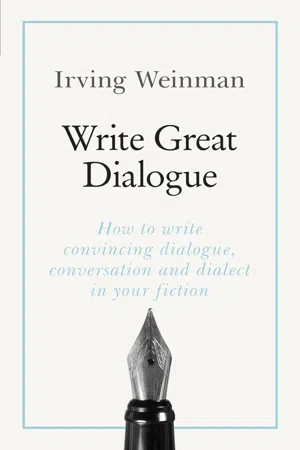
Write Great Dialogue
How to write convincing dialogue, conversation and dialect in your fiction
- 192 pages
- English
- ePUB (mobile friendly)
- Available on iOS & Android
eBook - ePub
Write Great Dialogue
How to write convincing dialogue, conversation and dialect in your fiction
About this book
Information
1
An overview of dialogue

In this chapter you will learn:
• The basics of dialogue: what it is and how it functions
• How dialogue relates to other elements of fiction such as character and plot
• The various forms in which dialogue may occur
• Ways of moving into and out of dialogue
• About less frequent types of dialogue.
What is dialogue in fiction?
Dialogue in fiction is the written representation of speech between two or more people. Dialogue in real life is the speech between two or more people, what they say to each other. Because most real-life conversation is full of pauses, broken thoughts, repetitions and non-verbal sounds like ‘uhm,’ erm’, and ‘ahh’ while thinking, writers would be crazy to put actual real-life dialogue into fiction. It would either bore readers or irritate them so much they’d stop reading.
 | Key idea |
The trick or the craft or the art of writing good dialogue involves an imitation (‘the written representation’) of conversation that:
• keeps the story going
• reveals the characters
• is believable
• interests the readers.
These are the four characteristics of good dialogue.

 | Write |
In my ‘Short, important introduction’ I promised that my best advice on ‘how to write’ is to write. Take no more than ten minutes to write one page (300 words) of dialogue between two characters. They don’t know each other; they’re meeting for the first time, and it’s the opening of a piece of fiction. (Look briefly at the list of four characteristics of good dialogue above and then forget them and start writing. That’s right, don’t think about writing – just write!)
Another reason that conversation in fiction can’t be exactly like conversation in life is that in life people often speak at the same time. Even if a writer made two parallel columns of speech to indicate simultaneous speech, it wouldn’t work. The eye reads linearly. Though you can hear several words at once and make some sense of them, you simply can’t read two things at once.
What does dialogue do?
One useful way to think about fiction is that it presents itself in two different ways: through narration and through action (also called scene). Contemporary readers and writers often refer to narration as the ‘telling’ element and to action or scene as the ‘showing’ element of fiction.
 | Focus point |
Dialogue is action – an important part of how fiction ‘shows’ rather than ‘tells’.
Much of human interaction occurs through speech. Even when the interaction is primarily physical – working, fighting, making love – it is typically accompanied by speech. Showing brings life and drama to fiction. Dialogue is a major element of showing. Here’s how it works:
Case study: The start of the novel Auto da Fé by Elias Canetti
‘What are you doing here, my little man?’
‘Nothing.’
‘Then why are you standing here?’
‘Just because.’
‘Can you read?’
‘Oh, yes!’
‘How old are you?’
‘Nine and a bit.’
‘Which would you prefer, a piece of chocolate or a book?’
‘A book.’
‘Indeed? Splendid! So that’s your reason for standing here?’
‘Yes.’
‘Why didn’t you say so before?’
‘Father scolds me.’
‘Oh. And who is your father?’
‘Franz Metzger.’
‘Would you like to travel to a foreign country?’
‘Yes. To India. They have tigers there.’
‘And where else?’
‘To China. They’ve got a huge wall there.’
‘You’d like to scramble over it, wouldn’t you?’
‘It’s much too thick and too high. Nobody can get over it. That’s why they built it.’
‘What a lot you know! You must have read a great deal already?’
‘Yes. I read all the time. Father takes my books away. I’d like to go to a Chinese school. They have forty thousand letters in their alphabet. You couldn’t get them all into one book.’
‘That’s only what you think.’
***
If we check this against the four characteristics of good dialogue, we find first that, as the opening of a novel, it gets the story going. Beginnings give the reader some sense of the who, where and when (character, setting, time) of the story. This is sometimes called the ‘opening exposition’. Here, there’s an adult – a man, we think – and a child. The man strikes up the conversation. The boy, at first reluctant, responds to the question about reading. From then on, the questions and answers form a seemingly logical, natural sequence. In other words, it becomes a conversation. It’s obviously taking place outside, and there’s even a clue that it occurs in front of a bookshop (‘A book?’ … ‘So that’s your reason for standing here?’) The German name, Franz Metzger, could indicate national location. And this sense of place, of a street, indicates it’s taking place not ‘once upon a time’ but in a relatively modern, historical time.
Second, this dialogue begins to reveal character. It tells us that the boy is at first wary of the man and his questions, and then that he likes reading enough to respond to a question about reading, and that he has a father who disapproves of his interest in reading (partly explaining the boy’s initial silence). As for the man, his motives for starting up the conversation may be innocent or sinister, but he clearly approves of the boy liking to read, and his delight in the boy’s knowledge of China and Chinese indicates his own knowledge and interests.
The dialogue is definitely not an everyday conversation between an adult and child in a street, but it is made believable – the third characteristic of good dialogue – in several ways. There is the boy’s typical reluctance to strike up conversation with an apparent stranger (he’s doing ‘Nothing’ standing here; he’s here ‘Just because’). The dialogue also allows for the sense of natural digression common to real speech: the boy first speaks of wanting to go to India because ‘They have tigers there’ before speaking about China.
Fourth and finally, the dialogue interests us by moving so quickly from ‘Nothing’ and ‘Just because’ to a nine-year-old’s discussion of ‘forty thousand letters’ in the Chinese alphabet. And the boy’s mistake about the impossibility of books based on such an alphabet is amusing because it’s so logical. In fact, the more we think of this conversation, the stranger it is. Thi...
Table of contents
- Cover
- Title
- Contents
- About the Author
- Acknowledgements
- Short, important introduction
- 1 An overview of dialogue
- 2 Character in dialogue
- 3 Narrative in dialogue
- 4 Dialogue in narrative
- 5 Versions of dialogue
- 6 Direct and indirect speech and transitions
- 7 Approximating the impossible: interrupted and multiple speech and the crowd scene
- 8 Dialogue in foreign languages; accents and dialect
- 9 The further reaches of dialogue
- 10 The art of not listening; learning from listening
- References
- Copyright
Trusted by 375,005 students
Access to over 1.5 million titles for a fair monthly price.
Study more efficiently using our study tools.
Frequently asked questions
Yes, you can cancel anytime from the Subscription tab in your account settings on the Perlego website. Your subscription will stay active until the end of your current billing period. Learn how to cancel your subscription
No, books cannot be downloaded as external files, such as PDFs, for use outside of Perlego. However, you can download books within the Perlego app for offline reading on mobile or tablet. Learn how to download books offline
Perlego offers two plans: Essential and Complete
- Essential is ideal for learners and professionals who enjoy exploring a wide range of subjects. Access the Essential Library with 800,000+ trusted titles and best-sellers across business, personal growth, and the humanities. Includes unlimited reading time and Standard Read Aloud voice.
- Complete: Perfect for advanced learners and researchers needing full, unrestricted access. Unlock 1.5M+ books across hundreds of subjects, including academic and specialized titles. The Complete Plan also includes advanced features like Premium Read Aloud and Research Assistant.
We are an online textbook subscription service, where you can get access to an entire online library for less than the price of a single book per month. With over 1.5 million books across 990+ topics, we’ve got you covered! Learn about our mission
Look out for the read-aloud symbol on your next book to see if you can listen to it. The read-aloud tool reads text aloud for you, highlighting the text as it is being read. You can pause it, speed it up and slow it down. Learn more about Read Aloud
Yes! You can use the Perlego app on both iOS and Android devices to read anytime, anywhere — even offline. Perfect for commutes or when you’re on the go.
Please note we cannot support devices running on iOS 13 and Android 7 or earlier. Learn more about using the app
Please note we cannot support devices running on iOS 13 and Android 7 or earlier. Learn more about using the app
Yes, you can access Write Great Dialogue by Irving Weinman in PDF and/or ePUB format, as well as other popular books in Languages & Linguistics & Creative Writing. We have over 1.5 million books available in our catalogue for you to explore.