LEARN HOW TO LIFT YOUR CREATIVE WRITING BY EMPLOYING A GOOD WRITING STYLE. Do you want to write more effectively, correctly and in a manner which is appropriate for this brave new world of text speak and blogging?Whether you are a professional writer, or writing for your profession, a journalist, non-fiction writer, or simply a would-be blogger, you will find essential guidance and the latest style rules in this book.It contains firstly a detailed breakdown of both the rules of grammar, punctuation and spelling and, secondly, a guide to making your work readable, structured and well-paced. Unlike any other style guide, it also sets out the new and evolving rules for 21st century writing such as blogging, chatrooms, and even PowerPoint presentations. ABOUT THE SERIES
The Teach Yourself Creative Writing series helps aspiring authors tell their story. Covering a range of genres from science fiction and romantic novels, to illustrated children's books and comedy, this series is packed with advice, exercises and tips for unlocking creativity and improving your writing. And because we know how daunting the blank page can be, we set up the Just Write online community at tyjustwrite, for budding authors and successful writers to connect and share.
eBook - ePub
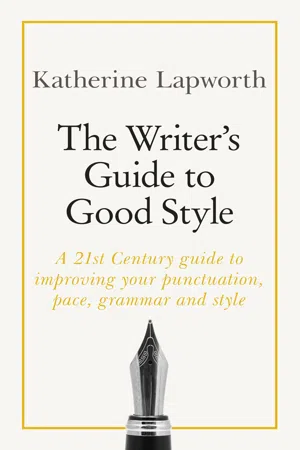
The Writer's Guide to Good Style
A 21st Century guide to improving your punctuation, pace, grammar and style
- 240 pages
- English
- ePUB (mobile friendly)
- Available on iOS & Android
eBook - ePub
The Writer's Guide to Good Style
A 21st Century guide to improving your punctuation, pace, grammar and style
About this book
Information
1
Introduction and grammar

In this chapter you will learn about:
• nouns, pronouns and adjectives
• verbs, tenses and adverbs
• conjunctions, prepositions and determiners
• subjects and objects.
A good style should show no sign of effort. What is written should seem a happy accident.
Somerset Maugham

Introduction
You don’t need to be a published author to call yourself a writer these days. We are all writers; it’s almost impossible not to write. From emails to texts, writing a ‘thank you’ letter or a job application, we communicate with each other by writing.
Style is the way in which writers use language to express themselves. For some writers, their style is exceptional, able to move us with the way they use their words. The rest of us are just hoping to write a clear, intelligible style of English to get by in our daily lives.
As with most things in life, usage and fashion change how we do things. Writing styles are no different; English is a living language that changes and adapts all the time. Within those shifting patterns and trends, there are rules and guidelines that help keep the language under control so that we can communicate successfully with each other. These are the rules of grammar and punctuation. If you don’t know how grammar and punctuation work, you appear ignorant to others. Though it may seem unfair, people judge us by the way we write and speak as much as how we look and sound or the clothes we wear or the house we live in.
In this book, we will look at the different types of writing we need to do in our daily lives. We will cover areas where people often struggle with rules and usage and we will discuss ways in which we can become better writers.
 | Key idea |
Charlotte Bronte’s school report of 1825 said ‘She knows nothing of grammar’ and remarked that she could only write ‘indifferently’.
Important note
The eagle-eyed among you will notice that some of the style suggestions mentioned here are not actually reflected in this book and that is because the publisher, John Murray Learning, has its own particular house style when it comes to producing Teach Yourself books. One is not ‘more correct’ than the other; they are the preferred way of doing something. Just as one person might have short hair and another chooses to leave theirs long, most publishers, publications and companies have an individual house style that gives them their identity and sets them slightly apart from one another.
Grammar – a short history
It is difficult to avoid mentioning Latin when discussing grammar. In Medieval times, educated people wrote in Latin and, in those days, ‘grammar’ meant the study of Latin. Nowadays, grammar is the study of language in general in which there is a set of standards or a system of rules that we follow to show that we can speak and write correctly.
Books on English grammar and style guides have been produced since the 1500s but it wasn’t until the eighteenth century that the rules governing English grammar became really restrictive. A Short Introduction to English Grammar was one of the most influential books in Britain, written by an Oxford academic, Robert Lowth, in 1762. Unfortunately, a lot of those rules were taken from Latin. As a written ‘dead’ language (rather than a living, spoken one), Latin had lots of established rules that never changed and which gave order and precision. And it worked well – for Latin. It was quite a different matter with English, a living language. Many of the difficulties that people subsequently have had with learning (and understanding) the rules of grammar have occured because the union of the English language (with its Germanic base) with the concepts of Latin and Greek grammar did not always work well together.
This was not a problem while the vast majority of the population did not read or write. But when schooling became compulsory in the second half of the nineteenth century, all children had to learn grammar.
| Key idea |
The following is a poem written for Victorian schoolchildren.
The Nine Articles of Speech
Three little words we often see,
Determiners, like a, an and the.
A noun’s the name of anything,
As school or garden, hoop or string.
An adjective tells the kind of noun,
As great, small, pretty, white or brown.
Instead of nouns the pronouns stand,
John’s head, his...
Table of contents
- Cover
- Title
- Contents
- About this book
- In one minute
- 1 Introduction and grammar
- 2 Punctuation
- 3 Appearance and presentation
- 4 Writing for an audience
- 5 What to avoid
- 6 Business writing
- 7 Letter writing
- 8 Writing on the internet
- 9 Improve your writing
- Appendix
- Taking it further
- Copyright
Trusted by 375,005 students
Access to over 1.5 million titles for a fair monthly price.
Study more efficiently using our study tools.
Frequently asked questions
Yes, you can cancel anytime from the Subscription tab in your account settings on the Perlego website. Your subscription will stay active until the end of your current billing period. Learn how to cancel your subscription
No, books cannot be downloaded as external files, such as PDFs, for use outside of Perlego. However, you can download books within the Perlego app for offline reading on mobile or tablet. Learn how to download books offline
Perlego offers two plans: Essential and Complete
- Essential is ideal for learners and professionals who enjoy exploring a wide range of subjects. Access the Essential Library with 800,000+ trusted titles and best-sellers across business, personal growth, and the humanities. Includes unlimited reading time and Standard Read Aloud voice.
- Complete: Perfect for advanced learners and researchers needing full, unrestricted access. Unlock 1.5M+ books across hundreds of subjects, including academic and specialized titles. The Complete Plan also includes advanced features like Premium Read Aloud and Research Assistant.
We are an online textbook subscription service, where you can get access to an entire online library for less than the price of a single book per month. With over 1.5 million books across 990+ topics, we’ve got you covered! Learn about our mission
Look out for the read-aloud symbol on your next book to see if you can listen to it. The read-aloud tool reads text aloud for you, highlighting the text as it is being read. You can pause it, speed it up and slow it down. Learn more about Read Aloud
Yes! You can use the Perlego app on both iOS and Android devices to read anytime, anywhere — even offline. Perfect for commutes or when you’re on the go.
Please note we cannot support devices running on iOS 13 and Android 7 or earlier. Learn more about using the app
Please note we cannot support devices running on iOS 13 and Android 7 or earlier. Learn more about using the app
Yes, you can access The Writer's Guide to Good Style by Katherine Lapworth in PDF and/or ePUB format, as well as other popular books in Languages & Linguistics & Creative Writing. We have over 1.5 million books available in our catalogue for you to explore.