Real world examples and practical techniques for functional programming in C# without the jargon and theory.
In Functional Programming in C#, Second Edition you will learn how to:
Use higher-order functions to reduce duplication and do more with less code
Use pure functions to write code that is easy to test and optimize
Write pleasant APIs that accurately describe your program's behavior
Use dedicated types to handle nullability, system errors, and validation rules predictably and elegantly
Write composable code without the overhead of an IoC container
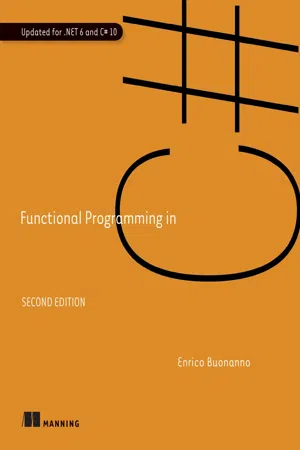
Functional Programming in C# has helped thousands of developers apply functional thinking to C# code. Its practical examples and spot-on treatment of FP concepts makes it the perfect guide for proficient C# programmers. This second edition is fully revised to cover new functional-inspired features in the most recent releases of C#, including tuples, async streams, pattern matching, and records. Each chapter is packed with awesome perspectives and epiphany moments on how functional programming can change the way you code.
About the technology
Turbocharge your C# code. Good functional techniques will improve concurrency, state management, event handling, and maintainability of your software. This book gives you practical answers to why, how, and where to add functional programing into your C# coding practice.
About the book
Functional Programming in C#, Second Edition teaches functional thinking for real-world problems. It reviews the C# language features that allow you to program functionally and through many practical examples shows the power of function composition, data-driven programming, and immutable data structures. All code examples work with .NET 6 and C# 10.
What's inside
Higher-order functions reduce duplication and do more with less code
Code based on pure functions is easy to test and optimize
Write pleasant APIs that accurately describe your program’s behavior
Write a Web API in a functional style
Monadic composition with LINQ
About the reader
For intermediate C# programmers.
About the author
Enrico Buonanno studied Computer Science at Columbia University and has over 15 years of experience as a developer, architect, and trainer.
Table of Contents
PART 1 GETTING STARTED
1 Introducing functional programming
2 Thinking in functions
3 Why function purity matters
PART 2 CORE TECHNIQUES
4 Designing function signatures and types
5 Modeling the possible absence of data
6 Patterns in functional programming
7 Designing programs with function composition
PART 3 FUNCTIONAL DESIGNS
8 Functional error handling
9 Structuring an application with functions
10 Working effectively with multi-argument functions
11 Representing state and change
12 A short introduction to functional data structures
13 Event sourcing: A functional approach to persistence
PART 4 ADVANCED TECHNIQUES
14 Lazy computations, continuations, and the beauty of monadic composition
15 Stateful programs and stateful computations
16 Working with asynchronous computations
17 Traversable and stacked monads
18 Data streams and the Reactive Extensions
19 An introduction to message-passing concurrency
- 448 pages
- English
- ePUB (mobile friendly)
- Available on iOS & Android
eBook - ePub
Functional Programming in C#, Second Edition
About this book
Information
Topic
InformaticaSubtopic
Programmazione MicrosoftTable of contents
- inside front cover
- Praise for the first edition
- Functional Programming in C#
- Copyright
- contents
- front matter
- Part 1. Getting started
- 1 Introducing functional programming
- 2 Thinking in functions
- 3 Why function purity matters
- Part 2. Core techniques
- 4 Designing function signatures and types
- 5 Modeling the possible absence of data
- 6 Patterns in functional programming
- 7 Designing programs with function composition
- Part 3. Functional designs
- 8 Functional error handling
- 9 Structuring an application with functions
- 10 Working effectively with multi-argument functions
- 11 Representing state and change
- 12 A short introduction to functional data structures
- 13 Event sourcing: A functional approach to persistence
- Part 4. Advanced techniques
- 14 Lazy computations, continuations, and the beauty of monadic composition
- 15 Stateful programs and stateful computations
- 16 Working with asynchronous computations
- 17 Traversable and stacked monads
- 18 Data streams and the Reactive Extensions
- 19 An introduction to message-passing concurrency
- Appendix A. Working with previous version of C#
- Epilogue. What next?
- index
Trusted by 375,005 students
Access to over 1.5 million titles for a fair monthly price.
Study more efficiently using our study tools.
Frequently asked questions
Yes, you can cancel anytime from the Subscription tab in your account settings on the Perlego website. Your subscription will stay active until the end of your current billing period. Learn how to cancel your subscription
No, books cannot be downloaded as external files, such as PDFs, for use outside of Perlego. However, you can download books within the Perlego app for offline reading on mobile or tablet. Learn how to download books offline
Perlego offers two plans: Essential and Complete
- Essential is ideal for learners and professionals who enjoy exploring a wide range of subjects. Access the Essential Library with 800,000+ trusted titles and best-sellers across business, personal growth, and the humanities. Includes unlimited reading time and Standard Read Aloud voice.
- Complete: Perfect for advanced learners and researchers needing full, unrestricted access. Unlock 1.5M+ books across hundreds of subjects, including academic and specialized titles. The Complete Plan also includes advanced features like Premium Read Aloud and Research Assistant.
We are an online textbook subscription service, where you can get access to an entire online library for less than the price of a single book per month. With over 1.5 million books across 990+ topics, we’ve got you covered! Learn about our mission
Look out for the read-aloud symbol on your next book to see if you can listen to it. The read-aloud tool reads text aloud for you, highlighting the text as it is being read. You can pause it, speed it up and slow it down. Learn more about Read Aloud
Yes! You can use the Perlego app on both iOS and Android devices to read anytime, anywhere — even offline. Perfect for commutes or when you’re on the go.
Please note we cannot support devices running on iOS 13 and Android 7 or earlier. Learn more about using the app
Please note we cannot support devices running on iOS 13 and Android 7 or earlier. Learn more about using the app
Yes, you can access Functional Programming in C#, Second Edition by Enrico Buonanno in PDF and/or ePUB format, as well as other popular books in Informatica & Programmazione Microsoft. We have over 1.5 million books available in our catalogue for you to explore.