Online dating has become a widespread feature of modern social life. In less than two decades, seeking partners through commercial intermediaries went from being a marginal and stigmatized practice to being a common activity. How can we explain this rapid change and what does it tell us about the changing nature of love and sexuality?
In contrast to those who praise online dating as a democratization of love and those who condemn it as a commodification of intimacy, this book tells a different story about how and why online dating became big. The key to understanding the growing prevalence of digital dating lies in what Marie Bergström calls "the privatization of intimacy." Online dating takes courtship from the public to the private sphere and makes it a domestic and individual practice. Unlike courtship in traditional settings such as school, work, and gatherings of family and friends, online dating makes a clear distinction between social and sexual sociability and renders dating much more discrete. Apparently banal, this privatizing feature is fundamental for understanding both the success and the nature of digital matchmaking. Bergström also sheds light on the persisting inequalities of intimate life, showing that online dating is neither free nor fair: it has its winners and losers and it differs significantly according to gender, age and social class.
Drawing on a wide range of empirical material, this book challenges what we think we know about online dating and gives us a new understanding of who, why, and how people go online to seek sex and love.
There are thousands of marriageable men and women of all ages capable of making each other happy, who never have a chance of meeting… Therefore, the desirability of having some organ through which ladies and gentlemen aspiring to marriage can be honorably brought into communication is too obvious to need a demonstration.
The Matrimonial News and Special Advertiser, October 1877
Our mission is to create new connections and bring the world closer together and help people meet others they otherwise wouldn’t have met.
Tinder, February 2017
Today’s dating sites and apps were born with the internet, but they can trace their distant origins to personal advertisements and forms of marriage brokerage that developed in the nineteenth century on both sides of the Atlantic. These early forms of commercial matchmaking have survived until today, but were supplemented in the 1980s by digital dating services such as the bulletin board systems (BBSs) in North America and the Minitel in France. Each of these services is a child of its time. They bear the mark of the sexual norms and matrimonial system they operated in, but also those of the economic and technical environment of their time. The spread is often tied to technological innovations, beginning with industrial printing, which made classified advertising popular, then moving on to early digital technologies, which spurred “computer dating” and the first online dating networks, and finally to the World Wide Web and mobile technology, with the websites and apps familiar to us today.
Many similarities can be found between these different types of dating services. The companies that operated in earlier forms of matchmaking were often the first to invest in new markets, hence features from older services have been passed on and adapted to new platforms. The filiation is noticeable not only in the production but also in the reception of dating services, as arguments directed against them can be found from time to time. The contemporary view that online dating has commodified intimate relations echoes a nineteenth-century outcry against matrimonial agencies and personal ads for turning marriage into a market. On the basis of work carried out by European and American historians and through an analysis of press archives, this chapter traces the origins of online dating. It shows that many features of these platforms and many debates around them, all considered radically new, are curiously similar to those features and debates found in their ancestors, sometimes 150 years old.
Marriage brokerage and personal ads
One of the first attested marriage advertisements was published in 1692 in the Athenian Mercury, an early British periodical (Cocks, 2015). Such advertisements were to remain rare until the second half of the nineteenth century, when “spouse wanted” ads became a staple of some newspapers in the English-speaking world, particularly the popular dailies of London and New York. Cheaper newspapers of mass circulation flourished as a result of the industrialization of publishing and population growth in urban centers. The dailies – typically, tabloids known as “the penny press” – were financed largely through advertising, which included classifieds. The personal columns soon began running matrimonial ads. The New York Herald, the largest daily newspaper in the United States at the time, published its first marriage ads in 1855 and was followed by the New York Times in 1860 (Epstein, 2010).
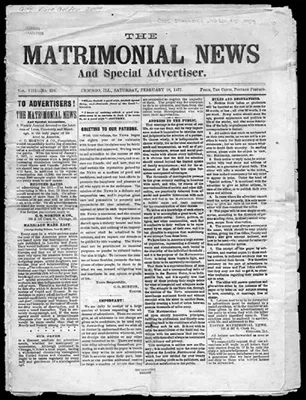
Similar advertisements flourished at the same time in London but, as historian Harry G. Cooks points out, “respectable papers like the Times or Morning Chronicle refused to carry matrimonial ads, thereby encouraging the development of a specialist press devoted solely to publishing them” (Cocks, 2015, p. 22). In Great Britain as in France, these “matrimonial papers” were closely linked to marriage brokerage, which spread around Europe in the nineteenth century (see Figure 1.1). Primarily the matrimonial agencies offered their services to a bourgeois clientele, taking commission on the dowry in cases of successful matches, but the papers (feuilles d’annonces in French) allowed them to reach a broader and more socially diverse public (Gaillard, 2017).
Figure 1.1. Front page of The Matrimonial News and Special Advertiser (February, 1877)
While the development of newspaper publishing provided the material possibility to circulate classified advertisements, the impetus for mediatized matchmaking came from the social transformations of the nineteenth century. Industrialization and urbanization saw young people move away from their original environment and sever their ties to family- and neighborhood-based social networks, where they would traditionally find a spouse (Cocks, 2013, 2015). Matchmaking services allowed access to new potential partners, especially for those without the right social connections (Gaillard, 2020). However, the personal ads were also very much a product of the nineteenth century matrimonial system. In her doctoral research on French marriage brokerage and personal ads, Claire-Lise Gaillard stresses that, at the end of the nineteenth century, social status, possessions, properties, and dowry were more commonly mentioned in advertisements than the search for love and affection. Marriage was not simply a personal matter but a family concern. It is worth noticing that, at that time, almost a third of the ads published in France were written by parents on the lookout for a spouse for their daughters. Finding a suitable “match” was of utter importance, and the desired social attributes were therefore clearly articulated (Gaillard, 2020).
Contemporaries did not see the emergence of this new business in a favourable light. While ads and agencies were shaped by traditional matrimonial norms, they also clashed with codes of romantic love that had grown strong during the century – for instance that of “companionate marriage,” the ideal that “marriage should be based on the true love and mutual affection of marital partners rather than on family ties and parental negotiations” (Phegley, 2013, p. 130). The new matchmaking services came under attack on both sides of the Atlantic as newspapers, novels, and plays either mocked their vulgarity or condemned their negative impact, in terms not unlike those directed today against dating sites and apps. In fact the two most lively debates of the nineteenth century are strikingly similar to how online dating is framed today.
The appearance of matrimonial advertisements and agencies was first caught in a nineteenth-century debate about falling marriage rates. Contemporary observers raised concerns about the growing number of unmarried persons, which affected how the new matchmaking services were perceived. A common understanding was that in modern society young men and women were having increasing difficulty in finding a spouse, and therefore turned to professional intermediaries. The publishers of matrimonial ads often drew on this idea: when addressing their readers, they evoked the growing prevalence of singles and promoted their services as a solution to the problem.
Among the serious causes of the shortage of marriages, we do not hesitate to point out the difficulties and embarrassment experienced by most people, of either sex, who wish to marry – not only to seek, but also to find, meet, and get to know their one and only. […] In this frenzied century – with so many varied pleasures, constant labors, and important business of multiple sorts that must be dealt with at the same time, at full steam – many men whose position requires that they marry promptly enjoy neither the time nor the circumstances to seek and find a wife. (La Gazette du Mariage, July 15, 1882)
The publishers of matrimonial ads often stressed the difficulties of meeting someone in a “frenzied” society characterized by the intensification of economic and social life and by a perceived acceleration of time. Young people were thought to be too busy or simply inapt to find a spouse, and marriage was consequently considered to be in crisis (Epstein, 2010; Cocks, 2013). Interestingly, this was actually not the case at all. At the end of the nineteenth century marriage rates were not falling in Europe but were rather stable over time, or even increasing (Hajnal, 1953). What was taken for a fact was in reality a false assumption, spurred by fears that marriage could be in decline (Cocks, 2013).
Today we witness a similar phenomenon. When explaining the popularity of online dating, journalists, bloggers, and essayists almost systematically refer to the rising rates of singlehood. People are perceived as having difficulties, not only with encountering potential partners, but also with committing to stable relationships. Ironically, from this point of view, our hyperconnected world, in which communication is undoubtedly faster and more effortless than ever before, has made interaction and relationship building more complicated than they were in the past. But, once again, empirical data tend to invalidate this pervasive idea. It is ...
Table of contents
Cover
Table of Contents
Dedication
Title Page
Copyright Page
Acknowledgments
Figures
Sources
Introduction
Part I The Privatization of Dating
1 The History of Matchmaking
2 Dating Technicians
3 The Keys to Success
4 Time for Sex and Love
Part II Unequal before the Laws of Love
5 Class at First Sight
6 The Age of Singles
7 Digital Double Standards
Conclusion: Private Matters
Bibliography
End User License Agreement
Trusted by 375,005 students
Access to over 1.5 million titles for a fair monthly price.
Study more efficiently using our study tools.
Frequently asked questions
Yes, you can cancel anytime from the Subscription tab in your account settings on the Perlego website. Your subscription will stay active until the end of your current billing period. Learn how to cancel your subscription
No, books cannot be downloaded as external files, such as PDFs, for use outside of Perlego. However, you can download books within the Perlego app for offline reading on mobile or tablet. Learn how to download books offline
Perlego offers two plans: Essential and Complete
Essential is ideal for learners and professionals who enjoy exploring a wide range of subjects. Access the Essential Library with 800,000+ trusted titles and best-sellers across business, personal growth, and the humanities. Includes unlimited reading time and Standard Read Aloud voice.
Complete: Perfect for advanced learners and researchers needing full, unrestricted access. Unlock 1.5M+ books across hundreds of subjects, including academic and specialized titles. The Complete Plan also includes advanced features like Premium Read Aloud and Research Assistant.
Both plans are available with monthly, semester, or annual billing cycles.
We are an online textbook subscription service, where you can get access to an entire online library for less than the price of a single book per month. With over 1.5 million books across 990+ topics, we’ve got you covered! Learn about our mission
Look out for the read-aloud symbol on your next book to see if you can listen to it. The read-aloud tool reads text aloud for you, highlighting the text as it is being read. You can pause it, speed it up and slow it down. Learn more about Read Aloud
Yes! You can use the Perlego app on both iOS and Android devices to read anytime, anywhere — even offline. Perfect for commutes or when you’re on the go. Please note we cannot support devices running on iOS 13 and Android 7 or earlier. Learn more about using the app
Yes, you can access The New Laws of Love by Marie Bergström in PDF and/or ePUB format, as well as other popular books in Social Sciences & Media Studies. We have over 1.5 million books available in our catalogue for you to explore.