This handbook provides an authoritative and comprehensive overview of African population dynamics, variations, causes and consequences, demonstrating the real-world applications of research in policies and programmes.
African demography has come of age. Over 50 years, the discipline has grown exponentially in the number of training and research institutions, specialist experts and academic output, all with an aim of addressing the enormous demographic challenges faced by the continent. The book draws on old and emerging analytical tools to explore the relationships between population dynamics and social, economic, cultural and political environments from African perspectives. Key topics include fertility, sexual behaviours, healthcare, ageing, mortality, migration, displacement, the causes and consequences of demographic changes and teaching and research developments in African demography.
The Routledge Handbook of African Demography will be an essential resource for students and researchers of African demography, sociology, development and cultural studies.
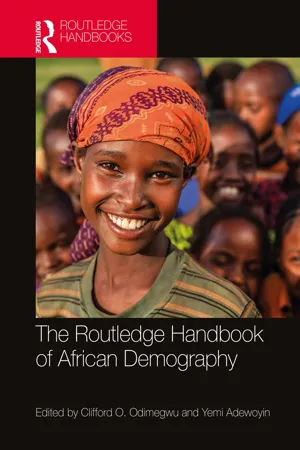
eBook - ePub
The Routledge Handbook of African Demography
- 888 pages
- English
- ePUB (mobile friendly)
- Available on iOS & Android
eBook - ePub
The Routledge Handbook of African Demography
About this book
Information
PART 1 Introductory chapters
1 INTRODUCTION
DOI: 10.4324/9780429287213-2
Introduction
The world’s population is set to reach 9.7 billion by 2050, with over 50% of growth occurring in sub-Saharan Africa (SSA). Interestingly, the world has experienced tremendous demographic changes evident in declines in fertility and mortality – both of which have been associated with rapid economic growth in many developed countries (Lee & Mason, 2010). Sub-Saharan Africa alike has witnessed some slow-paced changes in its demographic profile consisting of changes in the patterns of fertility, mortality, and migration. Compared with the experience of other world regions, sub-Saharan Africa stands out not only in terms of fertility levels and its indices such as the onset of marriage and childbearing, longer birth intervals, persistence of high ideal family size, and low level of contraceptive use but also with regard to mortality and migration (Bongaarts & Casterline, 2013; A. C. Ezeh, Mberu, & Emina, 2009; Hertrich, 2017; Timaeus & Moultrie, 2008).
While declines in fertility levels have been slow paced in many sub-Saharan African countries, the fertility level is still substantially higher in Africa than elsewhere (Bongaarts & Casterline, 2013). The level of fertility in sub-Saharan Africa is about 5.1 births per woman, a level much lower now than expected (Bongaarts & Casterline, 2013), with wide variations among the regions. For example, the total fertility level in Southern Africa is lower and about half the fertility level of other regions (Gerland, Biddlecom, & Kantorová, 2017). Even across countries, there are wide variations, ranging from less than two births per woman in Mauritius to about eight births per woman in the republic of Niger (Gerland et al., 2017).
Multiple factors have contributed to the observed patterns in fertility decline. For example, the increased use of modern...
Table of contents
- Cover Page
- Half Title Page
- Title Page
- Copyright Page
- Dedication Page
- Table of Contents Page
- List of Figures Page
- List of Tables Page
- List of Contributors Page
- Foreword Page
- Preface Page
- Acknowledgements Page
- PART 1 Introductory chapters
- PART 2 Demographic training and research
- PART 3 Marriage, fertility and SRH
- PART 4 Gender in African demography
- PART 5 Environment, health and demography
- PART 6 Migration
- PART 7 Demographic dividend
- PART 8 Ageing
- PART 9 Mortality
- PART 10 Concluding matters
- Index
Trusted by 375,005 students
Access to over 1.5 million titles for a fair monthly price.
Study more efficiently using our study tools.
Frequently asked questions
Yes, you can cancel anytime from the Subscription tab in your account settings on the Perlego website. Your subscription will stay active until the end of your current billing period. Learn how to cancel your subscription
No, books cannot be downloaded as external files, such as PDFs, for use outside of Perlego. However, you can download books within the Perlego app for offline reading on mobile or tablet. Learn how to download books offline
Perlego offers two plans: Essential and Complete
- Essential is ideal for learners and professionals who enjoy exploring a wide range of subjects. Access the Essential Library with 800,000+ trusted titles and best-sellers across business, personal growth, and the humanities. Includes unlimited reading time and Standard Read Aloud voice.
- Complete: Perfect for advanced learners and researchers needing full, unrestricted access. Unlock 1.5M+ books across hundreds of subjects, including academic and specialized titles. The Complete Plan also includes advanced features like Premium Read Aloud and Research Assistant.
We are an online textbook subscription service, where you can get access to an entire online library for less than the price of a single book per month. With over 1.5 million books across 990+ topics, we’ve got you covered! Learn about our mission
Look out for the read-aloud symbol on your next book to see if you can listen to it. The read-aloud tool reads text aloud for you, highlighting the text as it is being read. You can pause it, speed it up and slow it down. Learn more about Read Aloud
Yes! You can use the Perlego app on both iOS and Android devices to read anytime, anywhere — even offline. Perfect for commutes or when you’re on the go.
Please note we cannot support devices running on iOS 13 and Android 7 or earlier. Learn more about using the app
Please note we cannot support devices running on iOS 13 and Android 7 or earlier. Learn more about using the app
Yes, you can access The Routledge Handbook of African Demography by Clifford O. Odimegwu, Yemi Adewoyin, Clifford O. Odimegwu,Yemi Adewoyin in PDF and/or ePUB format, as well as other popular books in Social Sciences & Demography. We have over 1.5 million books available in our catalogue for you to explore.