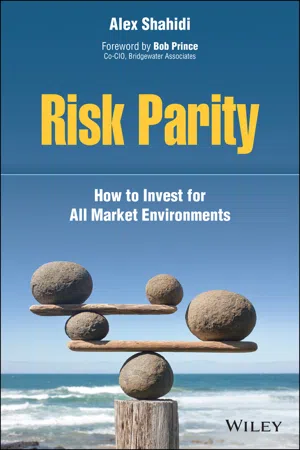
Target high returns and greater consistency with this insightful guide from a leading investor
The market volatility exacerbated by the COVID-19 pandemic has led many to question their exposure to risk in their own portfolios. But what should one do about it?
In Risk Parity: How to Invest for All Market Environments, accomplished investment consultant Alex Shahidi delivers a powerful approach to portfolio management that reduces the potential for significant capital loss while maintaining an attractive expected return.
The book focuses on allocating capital amongst four diverse asset classes: equities, commodities, Treasury bonds, and Treasury Inflation Protected Securities. You'll learn about:
The nature of risk and why traditional approaches to risk management unnecessarily give up potential returns or inadequately protect against catastrophic market events
Why proper risk management is more important now than ever
How to efficiently implement a risk parity approach
Perfect for both individual and professional investors, Risk Parity is a must-have resource for anyone seeking to increase consistency in their portfolio by building a truly balanced asset allocation.
Ray Dalio, Bob Prince and their team at Bridgewater pioneered most of the concepts presented in this book about 30 years ago and have been successfully refining and implementing the strategy ever since. Our risk parity mix uses the same overall framework as Bridgewater's, although the specific asset classes and allocation represent a simplified version. Our approach also differs slightly as it is designed for a wide range of investors, many of whom are subject to paying taxes, as opposed to being tailored for the largest tax‐exempt institutions in the world. This also represents our best thinking as of this writing. As previously stated, we hope to continue to evolve our understanding and make improvements in future iterations.
RISK PARITY IS ALL ABOUT BALANCE
The ultimate goal of a risk parity portfolio is to earn attractive equity‐like returns while taking less risk than equities. Both objectives are important. We want good absolute returns (competitive with equities) over the long run since that is the main purpose behind investing capital. Controlling risk is also paramount because losses are painful and can be difficult to recover from, both mathematically and emotionally. A portfolio that achieves attractive returns while minimizing risk can be constructed with a well‐balanced allocation that invests in public market securities, which will be the focus here.
The operative term is balance. Webster's dictionary defines balance as a “state in which different things have an equal or proper amount of importance.” Ideally, we should seek balance in all aspects of life. From the most basic level, we hope to equally distribute our weight so we can stand upright without falling. We should probably also strive to maintain a balanced diet or appropriate work‐life balance. Many of us have discovered that excessive and prolonged imbalance in these areas often ends in a painful outcome that forces us back toward better balance.
Within the context of an investment portfolio, balance has a comparable connotation and is similarly important. In a portfolio, balance means giving similar importance, or weight, to asset classes that behave differently from each other. A balanced portfolio has some assets that perform well when others perform poorly. As a result, the portfolio is not overly exposed or vulnerable to a particular market or economic outcome. Instead, no matter what happens, the portfolio is reasonably well protected. This is what it means to have a “well‐diversified” portfolio. A diversified portfolio is one that minimizes risk for a given level of return. Said differently, the objective is to take risk efficiently so that we don't take unnecessary risk when a similar return can be earned through a smoother path that experiences less frequent and less severe drawdowns.
A Smoother Path
Starting from a high‐level conceptual framework, a smoother path can be attained by investing across a wide range of return streams that are different from one another. By different, I mean that while they all go up over time, their ups and downs generally do not coincide. As a result, a total portfolio that is made up of these fluctuating constituents should exhibit less variability over time than any single one of them. This is the core insight of Modern Portfolio Theory, which posits that a portfolio made up of diverse components can exhibit less risk for a given level of return than a less diversified mix. The bold line in Figure 1.1 illustrates the conceptual idea of a smoother path – one that takes less risk to earn a similar return.
If we strive to grow the portfolio from Point A to Point B, allocating across multiple assets that all end at Point B but proceed through different paths yields a less bumpy ride for the total portfolio. A good metaphor for this framework is an automobile engine. The engine is made up of a diverse mix of parts: pistons, cylinders, chains, spark plugs, crankshafts, valves, and so on. Each component is necessary and functions very differently from the other parts. Each has a pre‐defined role to ensure smooth operation for the whole. If you were to view the inside of a properly designed and constructed engine block, you would observe chaos as various pieces would be operating in different directions and at a varying pace. Yet, the finely tuned machine purrs along smoothly when viewed from the outside. I believe we can build portfolios using a similar construct.
Figure 1.1 Building a Smoother Path
Ray famously referred to this investment approach as “the holy grail.” If investors are able to identify 10 good, uncorrelated investments and split their portfolio roughly equally among them, then they could enjoy attractive returns with low risk. The concept is supported by the notion that when one investment is doing well, another may be underperforming, and they can balance each other out to yield a return closer to the average of the two. Including more uncorrelated return streams would drastically reduce the total risk of the portfolio.
The simple math is extremely compelling. A portfolio of a single risky asset with an 8% expected return and 15% volatility (standard deviation) has about a 30% chance of losing money in a single year. If we have five assets that offer the same returns and risk but are uncorrelated with one another and we allocate equally across the five, then the risk of the total portfolio is less than half of the one‐asset portfolio, and the odds of losing money in a single year significantly lower. Risk decreases even further as we go from five uncorrelated assets to 10, although there are diminishing returns to diversification beyond a certain point. The math is provided in Table 1.1.
Table 1.1 Portfolios of High Returning, Uncorrelated Investments
1‐Asset Portfolio
5‐Asset Portfolio
10‐Asset Portfolio
Return
8%
8%
8%
Risk (volatility)
15%
7%
5%
Odds of losing money in one year
30%
12%
5%
Same Return and Less Risk –>
As Figure 1.1 and Table 1.1 illustrate, a similar return can be mathematically achieved with less risk if lowly correlated, high‐returning assets are utilized to construct a portfolio.
Finding 5 to 10 uncorrelated investments with attractive returns can be difficult, particularly in liquid public markets (which is the scope of this study). However, the point of this exercise is to demonstrate the power of diversification and the simple approach that we follow to construct a portfolio with expected returns competitive with equities with less risk. Clearly, implementing the conceptual framework can be challenging, which is why I have devoted an entire book to the subject. We now dive one step deeper into the risk parity framework by describing where returns come from, defining risk, and explaining why a traditional portfolio is poorly balanced.
THE SOURCE OF RETURNS
Investors have a choice when deciding how to allocate their portfolio. The safest bet is to leave all the money in cash and earn a guaranteed rate of return. The return is based on the prevailing interest rate at the time. You can think of the rate offered by a bank in a savings account or in insured certificates of deposit (CDs) as examples. Money market funds are also considered very low risk investments that provide interest payments without risk of principal. The Federal Reserve of the United States effectively sets the rate of cash. Over time, cash rates have fluctuated as the economic environment has shifted. In the early 1980s, cash yields were over 10% and as of this writing in 2021, they are closer to 0%.
Investors who seek higher returns than cash, have the option to take greater risk (which will be defined next) with their assets. In order to be enticed to purchase investments with safe cash, various asset classes should offer a return premium over cash. In other words, unless you expected to earn a reasonable excess return above cash over time by taking risk, you would not take the risk. This “risk premium” can be observed by measuring the long‐term performance difference between risky investments and cash. For example, since 1926 the stock market has outpaced cash by about 5% per annum.
In general, asset classes that are riskier have delivered greater excess returns than those that are less risky. This should make sense since investors should pay attention to the level of compensation for a certain level of risk. Why would I take a lot of risk to earn just a little more return? As a result, historical asset‐class returns and risk are somewhat proportional: those with greater risk offer higher expected returns than those with less risk.
My ultimate goal in this book is to walk through an efficient way to capture the risk premiums available in various asset classes. That is, we wish to identify the best way to seek better returns than cash by investing in a diverse set of asset classes while minimizing risk. In fact, we seek returns much better than cash and want to be thoughtful about how to achieve this objective without taking undue risk.
It is important to note that there is no attempt to predict what the future economic environment may look like or which asset classes will be the best performers over the next market cycle. We want to be, by and large, indifferent to what environment transpires next and how it may shift through time. We are trying to identify a thoughtful, neutral portfolio that can stand the test of time through a passive long‐term allocation without the need for tactical decision‐making. In fact, the design of this balanced allocation assumes that the future twists and turns of the markets are inherently difficult to anticipate in advance. This is why it makes sense to maintain a well‐diversified portfolio at all times.
WHAT IS RISK?
The rate of return of an investment is a relatively straightforward notion to u...
Table of contents
Cover
Table of Contents
Praise for Risk Parity
Title Page
Copyright
Dedication
Foreword
Preface
Acknowledgments
About the Author
Introduction
CHAPTER ONE: What Is Risk Parity?
CHAPTER TWO: Two Steps to Build a Well‐Balanced Portfolio
CHAPTER THIRTEEN: When Does Risk Parity Underperform?
CHAPTER FOURTEEN: FAQs
CHAPTER FIFTEEN: Conclusion
Index
End User License Agreement
Trusted by 375,005 students
Access to over 1.5 million titles for a fair monthly price.
Study more efficiently using our study tools.
Frequently asked questions
Yes, you can cancel anytime from the Subscription tab in your account settings on the Perlego website. Your subscription will stay active until the end of your current billing period. Learn how to cancel your subscription
No, books cannot be downloaded as external files, such as PDFs, for use outside of Perlego. However, you can download books within the Perlego app for offline reading on mobile or tablet. Learn how to download books offline
Perlego offers two plans: Essential and Complete
Essential is ideal for learners and professionals who enjoy exploring a wide range of subjects. Access the Essential Library with 800,000+ trusted titles and best-sellers across business, personal growth, and the humanities. Includes unlimited reading time and Standard Read Aloud voice.
Complete: Perfect for advanced learners and researchers needing full, unrestricted access. Unlock 1.5M+ books across hundreds of subjects, including academic and specialized titles. The Complete Plan also includes advanced features like Premium Read Aloud and Research Assistant.
Both plans are available with monthly, semester, or annual billing cycles.
We are an online textbook subscription service, where you can get access to an entire online library for less than the price of a single book per month. With over 1.5 million books across 990+ topics, we’ve got you covered! Learn about our mission
Look out for the read-aloud symbol on your next book to see if you can listen to it. The read-aloud tool reads text aloud for you, highlighting the text as it is being read. You can pause it, speed it up and slow it down. Learn more about Read Aloud
Yes! You can use the Perlego app on both iOS and Android devices to read anytime, anywhere — even offline. Perfect for commutes or when you’re on the go. Please note we cannot support devices running on iOS 13 and Android 7 or earlier. Learn more about using the app
Yes, you can access Risk Parity by Alex Shahidi in PDF and/or ePUB format, as well as other popular books in Business & Investments & Securities. We have over 1.5 million books available in our catalogue for you to explore.