Using insights drawn from the experiences of professional linguists working in a range of domains, this book is an essential resource to help you recognize the value and relevance of your skills and training as a linguist in the job market. No matter where you are in your career – just starting a first job or reflecting back on 30 years – this book provides an interpretive frame for catalyzing momentum around what comes next.
Encouraging you to approach your career with agency and curiosity, Anna Marie Trester details the myriad ways that linguists can contribute meaningfully to the world of work. Exploring the connections between linguistics as a field of study and a way of thinking, she details the ways in which the powerful observational and analytical skills and abilities cultivated by a background in linguistics can be employed in a diverse range of professional workspaces. With activities, exercises, and a review of career literature, Employing Linguistics helps you seek and create opportunities as you choose what challenges to focus on next.
eBook - ePub
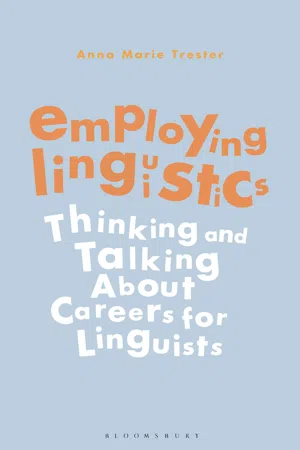
Employing Linguistics
Thinking and Talking About Careers for Linguists
- 208 pages
- English
- ePUB (mobile friendly)
- Available on iOS & Android
eBook - ePub
About this book
Information
1 Reckoning with Your Intentions
I invoke the idea of “reckoning” in this chapter because the stories comprising it showcase three powerful linguists in career-defining moments, moments where they take decisive action to show what they are made of. These stories show what they stand for and how they think and work like linguists. And note an important distinction that I draw here, one that I maintain throughout the book. I contend that once you have been trained in our ways of seeing, your linguistics training shapes how you frame problems and how you approach your work, such that you work like a linguist, even if you are not working as a linguist. I choose to focus on what the linguist DOES rather than whether or not this person IS a linguist (a line of inquiry that I have found to be counterproductive in discussions about career).
By focusing in on a moment from their professional lives, I hope to invite you—the reader—to reflect a bit on some of the moments (career-defining or ordinary), which showcase how you work like a linguist, whether or not you are currently working as one.
We’ll begin with Charlotte Linde, focusing in on the moment when NASA Ames reached out to ask: “Do you think you might have something to say about small group decision-making in the cockpit?” A moment where she felt the fear and did it anyway.
Charlotte’s career encompasses more than thirty years of wide-ranging career adventure and a breadth of applications from ethnographies with insurance agencies, Silicon Valley, and Buddhist communities, to multiple engagements with NASA, including her now famous research on pilot and air-traffic-controller communication. Her engagement with both academic and applied research in many domains of work exemplifies important career lessons for those at any stage of their career journey. As Charlotte put it: “Go out there and do stuff. One thing will lead to another.”
In telling her story, I seek to inspire those of you considering what it might mean to say “yes” to an opportunity that might be in front of you at present, or to one that you are thinking about creating. Or perhaps you are in a period of reflection, and you might want to think about those to which you have said “yes” or “no” in the past in terms of how they have shaped your trajectory, and whether you might currently be in a moment of reorientation. As you listen to Charlotte’s story, think about your own whys, including why you do what you do, and why you do things the way you do them.
Charlotte Linde
“Go Out and Do Stuff, One Thing Will Lead to Another”
When she got that first call from NASA, Charlotte had no experience with communication in the cockpit. And the stakes were so high! But she trusted her training, and she trusted that the research process would illuminate useful insights and she said “yes.” I have long been inspired by Charlotte’s careful, thoughtful, and densely intricate work, dating back I suppose to my first reading her book Life Stories as a graduate student. I reached out back then with a note thanking her for this excellent work, describing how it was helping me with some project that I was working on. That began a conversation that has continued for years, and now, Charlotte presents me with an opportunity to take her advice—to go for it. Despite feeling a bit intimidated, I’ll take a whack at telling her powerful career story because I trust the process that I have developed for the storytelling in this book, starting (if unconventionally) with the here and now.
Charlotte is currently doing research focused on exemplars—people who get held up by communities as examples for how to be—as part of a larger project exploring the social construction of wisdom in various organizations. This research draws from three of her own long-term projects: (1) an ethnography with a major American insurance company, as described in her book Working the Past; (2) a Buddhist meditation community where she has been practicing and teaching meditation for forty-plus years; and (3) Silicon Valley, drawing from her many years of living and working in this region including thirteen years as an entrepreneur. Having recently put up all her publications (going back to 1975) on ResearchGate, she is looking to invite conversational partners to explore these concepts, as happened recently when a professor at a Lutheran seminary reached out to ask if she would be willing to come talk at an annual meeting of their current students and alumni. He had read Working the Past and saw the connections to narrative and institutional remembering, and was delighted to learn of her interest in the ways that members of organizations come to be recognized as “people who get counted as wise within an institutional context.”
Charlotte describes her expertise as that of understanding: “The ways in which institutions use narrative to remember their identity and history, and to induct new members into these ongoing stories.” Reflecting on the experience of being the first woman to go speak to that particular seminary, she remarked that they saw many parallels and asked her great questions, which ultimately she concluded was unsurprising because as she realized, “these people are in the same business as I am!”
In her recent past, Charlotte worked in Knowledge Management at NASA—but this was in fact her second engagement with the National Aeronautics and Space Administration. The more recent stint started in 1999, and comprised completely different work and was a totally different “way in” than the first time (more on that one soon). Over the years, she participated on teams helping NASA design and build spacecraft, to develop collaborations with industry, and to manage the systems that organized information, knowledge, and learned wisdom including drafting requirements and conducting evaluations and trainings. As she describes it: “Such institutional narrations can be viewed as knowledge management in its natural habitat: hardly noticed, ubiquitous, and effective.”
The title she used for her business card “Socio-Rocket Scientist” is my favorite job title ever, but it gives little sense for her responsibilities within the Information Sciences and Technology division at NASA Ames Research Center. Broadly speaking, she observed and advised about the practices by which NASA “remembers” or in other words how they “preserve and use representations of the past to guide present and future actions.” When I describe her work to linguistics students, I tell them that her job was to chase down, organize, and preserve stories at the organization. As a linguist, she uniquely recognizes the wisdom these stories contain and the tremendous value of keeping this knowledge available and accessible to current and future employees.
Knowledge management strikes me as a great way to describe our potential as linguists to bring insight to any industry. Any linguist—no matter her theoretical orientation—will have been trained to abstract away from interaction to see the role of language in the production of knowledge as it is unfolding. Additionally, experience in managing and organizing insights will have been a part of any research project she conducts. This is just one example of how a linguist will work like a linguist in just about any context.
There’s no doubt that Charlotte’s breadth and depth of research experience made her highly sought-after when the opportunity presented itself for her to bring this expertise to NASA Ames in 1999. By that point, she had published widely in academic journals, she had worked as a Senior Research Scientist and Chief Narrative Officer at the Institute for Research on Learning, and she had run her own business, Semantic Structures, for thirteen years. But no doubt, those who were considering her candidacy would have also been interested to know that she had worked for NASA previously. So let’s end this telling of Charlotte’s career story by considering the moment in which it began.
When the first opportunity to work with NASA presented itself, Robin Lakoff—Charlotte’s colleague at the University of California at Berkeley—had been contacted by the university’s public relations department to ask about interesting research currently happening in linguistics. She told them, “Well, Charlotte is working on the Watergate tapes.” They asked for a press release. Charlotte had to research the genre in order to create one, but she made a press release describing her work, and then had the “crazy good fortune” (her words) to have the story released not only during a relatively slow news week, but also at just about the same time that the David Frost interview with Richard Nixon was being run. She got picked up by the San Francisco Chronicle and her piece ran above the masthead—page one, above the fold. In other words, her work was featured very prominently in a major national publication. Someone from NASA Ames saw the piece, saw the potential for collaboration, and reached out.
When the call came, Charlotte was—as she puts it—completely terrified. The work was about communication in the cockpit and the stakes were very high. Lives are at stake in this context, and she wanted her research to be useful, but as she had never done research into interactions in the cockpit, she had absolutely no idea what she would find and thus no way of having certainty that what she was going to do for them was going to be useful. “What if I’m wrong?” she considered. The task, as she understood it in that moment, was to not be afraid of being afraid. She was already an experienced meditator at that time, and I can see the seeds of a mindfulness practice in helping her to see the fear and see through it at the same time. She found a way to trust her training and the research process, reassuring herself by reminding herself: “I’m an interesting person. They have interesting data. Probably I’ll be able to come up with something interesting.”
So what did the research reveal? Ultimately, the analysis came to focus on “mitigation,” a linguistic feature which Linde and her research team defined as “a linguistic indication of indirectness and tentativeness in speech.” The broad pattern that the data illuminated was that speech of subordinates is mor...
Table of contents
- Cover
- Half-title Page
- Series Page
- Title Page
- Contents
- List of Figures
- Preface: From Nebulous to Nebulae
- Acknowledgments
- Introduction: Charting the Stars
- 1 Reckoning with Your Intentions
- 2 BRIGHTEN While You Work
- 3 HOW Linguists BRIGHTEN
- 4 Decide to BRIGHTEN Here and Now
- 5 BRIGHTEN Around the World
- 6 Navigate Your Career with WHY
- Conclusion: Ending in the Middle
- Appendices
- Notes
- References
- Index
- Copyright Page
Trusted by 375,005 students
Access to over 1.5 million titles for a fair monthly price.
Study more efficiently using our study tools.
Frequently asked questions
Yes, you can cancel anytime from the Subscription tab in your account settings on the Perlego website. Your subscription will stay active until the end of your current billing period. Learn how to cancel your subscription
No, books cannot be downloaded as external files, such as PDFs, for use outside of Perlego. However, you can download books within the Perlego app for offline reading on mobile or tablet. Learn how to download books offline
Perlego offers two plans: Essential and Complete
- Essential is ideal for learners and professionals who enjoy exploring a wide range of subjects. Access the Essential Library with 800,000+ trusted titles and best-sellers across business, personal growth, and the humanities. Includes unlimited reading time and Standard Read Aloud voice.
- Complete: Perfect for advanced learners and researchers needing full, unrestricted access. Unlock 1.5M+ books across hundreds of subjects, including academic and specialized titles. The Complete Plan also includes advanced features like Premium Read Aloud and Research Assistant.
We are an online textbook subscription service, where you can get access to an entire online library for less than the price of a single book per month. With over 1.5 million books across 990+ topics, we’ve got you covered! Learn about our mission
Look out for the read-aloud symbol on your next book to see if you can listen to it. The read-aloud tool reads text aloud for you, highlighting the text as it is being read. You can pause it, speed it up and slow it down. Learn more about Read Aloud
Yes! You can use the Perlego app on both iOS and Android devices to read anytime, anywhere — even offline. Perfect for commutes or when you’re on the go.
Please note we cannot support devices running on iOS 13 and Android 7 or earlier. Learn more about using the app
Please note we cannot support devices running on iOS 13 and Android 7 or earlier. Learn more about using the app
Yes, you can access Employing Linguistics by Anna Marie Trester in PDF and/or ePUB format, as well as other popular books in Languages & Linguistics & Careers. We have over 1.5 million books available in our catalogue for you to explore.