eBook - ePub
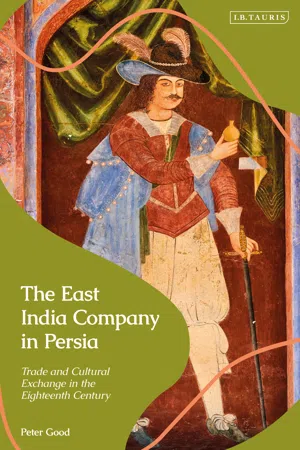
The East India Company in Persia
Trade and Cultural Exchange in the Eighteenth Century
- 224 pages
- English
- ePUB (mobile friendly)
- Available on iOS & Android
eBook - ePub
About this book
In 1747, the city of Kerman in Persia burned amidst chaos, destruction and death perpetrated by the city's own overlord, Nader Shah. After the violent overthrow of the Safavid dynasty in 1722 and subsequent foreign invasions from all sides, Persia had been in constant turmoil. One well-appointed house that belonged to the East India Company had been saved from destruction by the ingenuity of a Company servant, Danvers Graves, and his knowledge of the Company's privileges in Persia. This book explores the lived experience of the Company and its trade in Persia and how it interacted with power structures and the local environment in a time of great upheaval in Persian history. Using East India Company records and other sources, it charts the role of the Navy and commercial fleet in the Gulf, trade agreements, and the experience of Company staff, British and non-British living in and navigating conditions in 18th-century Persia. By examining the social, commercial and diplomatic history of this relationship, this book creates a new paradigm for the study of Early Modern interactions in the Indian Ocean.
Information
1 Life in the Company’s Persian factory
Histories of the East India Company tend to overlook the harsh conditions and social difficulties experienced by the Company’s servants. However, there is a wealth of detail available through the factory’s records which concern the lived experience of the Company’s servants, whether it takes the form of descriptions of the town of Bandar Abbas and the factory or accounts of personal disagreements. The importance of these facets of human experience has yet to be fully integrated into the history of the Company or other institutions. The factory was a small community, composed of a variety of different ethnicities including Hindu and Muslim Indians, Eurasians, Persians, Arabs, Armenians and Englishmen.1 Despite being largely administrative and official in scope, the letters and consultations written for the Gulf Factory also contain very interesting insights into the personal lives of the men serving in the Company’s factory. These include not only their commercial transactions and business but also the process by which their wills were executed and their estates disbursed, their marriages, liaisons and disagreements. By studying these issues in the small Company community in Persia, it is possible to build up an appreciation of the attitudes and perceptions concerning sexuality, interracial marriage and legal jurisdiction in the wider ‘Company-State’ growing in India and beyond. As Stern has argued successfully, the Company modelled its cities in India on an idealised vision of successful plantations or colonies.2 This was all well and good where the Company was founding new settlements or had reasonably unfettered control over the territory in question, but this simply could not be the case in a place like Bandar Abbas where neither of these were true. This chapter will therefore consider some of the challenges faced by the Persian factories and the efforts made both centrally and locally to overcome them.
Bandar Abbas never comes out as the ideal place to find oneself in the service of the Company.
A sailors adage of the time had it that ‘only an inch of deal stands between Gombroon and Hell’. ‘You cannot get excited about Gombroon’, wrote James Douglas, the Bombay Historian.3
This small but significant corner of the Indian Ocean’s trade, then, was not the destination many of the young men in the Company’s service would have hoped to be posted to. It had a significant saving grace in being a major point of transhipment, giving greater opportunities for the transaction of private trade, should one survive. Indeed, the descriptions of the town and its environs were far from complimentary, even when one takes into account contemporary views of Bombay, Madras and Calcutta.4 Despite this, the Company felt it worthwhile and necessary to deploy resources and personnel to keep a presence in the town in order to maintain its ongoing business in Persia.
Willem Floor has described the Gulf region as ‘hot, humid and unpleasant … while winters were mild, although at times cold enough to require warm clothes’.5 Floor also notes the miniscule average rainfall and limited arable zone in the port’s hinterland which was available and suitable to support the local population. The monsoon winds which were so integral to the importance of the Gulf as a centre of trade and exchange, while providing some relief from the oppressive weather, equally held their own dangers. Often these winds blew up into gales which rendered many of the ports and roadsteads on both the north and south littorals unsafe as docks and berths, especially for the small local boats used for ferrying goods to shore from ocean-going ships. The lack of any shelter for either ocean-going ships or local boats made the basic task of bringing cargo ashore hazardous at best due to the unpredictable strength of the prevailing winds.
Bandar Abbas, which lies on the northern coast, has the double advantages of being one of the safer, more sheltered ports in the area and had access to sources of fresh water. The port faced southward towards the islands of Qeshm and Hormuz, the two linchpins of trade and shipping in that part of the Gulf, which also sheltered the town from the worst of the wind from the mouth of Gulf to the Southeast. Qeshm offered a rare source of fresh water, an anchorage at Basaidu, at its north-western extremity and a beach at Laft suitable for the vital task of careening, the process of beaching a ship deliberately to clean the hull. (This is now likely part of the Hara Protected Area of mangrove forests.) Hormuz, though much reduced in importance after 1622, still retained a garrison and fortress equipped with heavy artillery to protect the entrance to the sheltered anchorages between the mainland, Qeshm, Hormuz and Larak, though trade now flowed directly onto the mainland through Bandar Abbas. The presence of Europeans at Bandar Abbas was a mark of the transition in importance from the island of Hormuz to the mainland port city, as the European Companies represented a major export market for Persian goods. In addition to its favourable geographical location, other positive factors, according to Cornelis le Bruyn, a Dutch traveller and artist, included that Bandar Abbas was blessed with an abundance of gamberi, a variety of prawns or crayfish, plenty of date palms which, in addition to fruit, provided a staple building material. Le Bruyn also described the architectural features of badgir, a wind catcher providing a natural cooling system for houses and public buildings.6 In order to avoid the hottest parts of the day, local people were in the habit of taking a siesta in the heat of the afternoon, then carrying on their business in the relative cool of the evening.7
Prior to departing Bandar Abbas, Le Bruyn took note of the large European graveyard ‘filled with lofty tombs and covered domes’.8 He stated that the reader should not be surprised by the great number of graves blaming ‘unhealthy air’, ‘excessive heats’ and ‘burning fevers, which are there more common than in any other place, and frequently prove fatal in the space of twenty-four hours’.9 Le Bruyn’s account supports other reports concerning Bandar Abbas, characterising the port and its environs as deadly due to heat and disease, this before even mentioning the equally unhealthy winter damp, or the ‘unwholesome’ water. Whether it was Winter or Summer, Bandar Abbas and the wider Gulf appeared to have something unpleasant to offer merchants and travellers. Throughout the records of the East India Company in Persia there are instances where the Company’s servants complained about the heat and bad water, as well as the infrequent but heavy rains which made any work impossible, the high winds that threatened to destroy ships while tearing apart the small local craft used to shuttle goods between the sea-going ships in the road and the port itself. If all of this were not enough, there is a record of a plague of locusts in 1738 and an earthquake in 1747.10 Bandar Abbas’ punishing environment ranked above the Company’s other factories in terms of dangers, worse even than the infamous Bencoolen in Sumatra, a port built on a fetid disease-ridden swamp, or the tiny, mid-Atlantic island of St. Helena. Both of these other settlements were renowned for high rates of mortality and emotional hardships rarely falling short of misery. Appreciating these physical difficulties and the anxieties which accompanied them makes it easier to understand how particular events unfolded, or gives fresh insight into individuals and their decisions.
In the descriptions of the port and town at Bandar Abbas, one of the recurrent themes is the ever-present reality of disease. Bandar Abbas had a deserved reputation as regards its lethal effects upon the health of those whose misfortune it was to be posted there. Tim Blanning describes the relationship between the people of seventeenth- and eighteenth-century Europe and disease: ‘When mourners gathered around an English graveside to hear the clergyman intoning the words of the Book of Common Prayer of 1662 “in the midst of life we are in death” – they knew it to be true.’11 In Europe, the average life expectancy fluctuated between thirty years of age to the mid-forties, depending on factors such as social class, region and wealth. In the service of the East India Company in Bombay, most young men could expect to live only three years from their arrival in Asia.12 Given that the Company tended to only employ servants who were at least eighteen, this gave an unenviable life expectancy of just twenty-one. The situation in Bandar Abbas is shown to have been yet more stark when one considers that men would return to Bombay in order to recover their health.13 A damning indictment if ever there was one. This is particularly remarkable given contemporary accounts of Bombay’s climate, with its ‘raines and pestilence’ was preferable, indeed a relief, from the conditions on the Gulf Coast.14
The considerable problems and tensions that sickness and death caused to the Factory’s residents are most starkly seen after an outbreak of plague that swept across the Garmsirat in July 1723 not long after the Afghan invasion of Persia. This plague, which is noted as having presented as a ‘bilious fever’, killed all the Company’s servants within two weeks – John Larkin, the surgeon, Edmund Wright, John Frost and Styleman Gostlin, leaving Henry Fowler and John Hill to execute the wills of the deceased and run the factory.15 Neither of these remaining men were covenanted servants of the Company and were described in a later letter as ‘young men of little experience with no dependency on us so that we cannot give them any orders’.16 Along with the Company’s covenanted servants, the factory’s garrison was also left leaderless, the Ensign, Sergeant and Corporal all succumbing to the same sickness. The fever struck quickly, with none of the sufferers surviving longer than twelve days after the first report of symptoms.
The human tragedy of so many deaths in a very small community and in such a short time must have been shocking and goes some way to explain why shortly afterwards, Henry Fowler ordered the bombardment of the town after the murder of two of the Company’s guards who had insulted some locals while drunk. Fowler failed to come to amicable terms with the Shahbandar, Mirza Zahed Ali, instead ordering the Britannia to attack the town, resulting in the factory being put to siege.17 Fowler’s decision, after an official investigation, caused him to be recalled to Bombay to answer for it and for the large cost to the Company in gifts given to placate the Persians, after the timely arrival of Robert Newlin.18 Newlin’s tenure as Agent was to prove short lived, as he succumbed to the same illness as his predecessors within weeks of his arrival. The extreme fragility of life in the Persian Factory is quite evident from this, not to mention that Persia had just been invaded by the Afghans and the Company’s more senior servants were all under siege in Isfahan, unable to influence events. The direct attack on the city ordered by Fowler seems to be proof of a snap of temper on his part, caused by the stress of his situation, his youth and potential fear of both the plague and unidentified local threats, rather than a rational decision. It is important, therefore, to consider how specific conditions experienced at Bandar Abbas, the death, disease, temperature, led to a distinct psychological impact upon those experiencing it, leading to extreme emotional outbreaks of rage, madness or irrational hostility. Such a behavioural break could have far-reaching effects upon the Company’s relationship with both local authorities and the Persian government and the Company’s servant’s relationships with one another. In the case of Fowler, grief, illness, heat, maybe a little drunkenness led to a significant political incident with the Persians, which was only reconciled with significant financial cost.
Securing supplies of fresh water was a constant source of anxiety for Europeans and non-Europeans alike. The inhabitants of the Gulf region and Iranian plateau had since ancient times devised various ways to mitigate this, including the building and maintenance of underground channels, wells and cisterns for year-round supply and storage. However, this in turn could cause other issues, the most notable of which was the proliferation of bacteria and parasites in untreated, stagnant water used both for personal and agricultural purpos...
Table of contents
- Cover
- Half-title Page
- Title Page
- Contents
- Acknowledgements
- Author’s Notes
- Prologue
- Introduction: Historiographical Essay
- 1 Life in the Company’s Persian factory
- 2 Governance, information management, reporting, communication and control
- 3 Trade’s increase: The Company’s commerce in Persia
- 4 A navy for hire: The continuing maritime operations of the East India Company in the Persian Gulf 1727–43
- 5 Brokers, Khwajas and country Christians: The Company’s employment of non-Europeans in Persia
- Conclusion
- Notes
- Bibliography
- Index
- Copyright Page
Trusted by 375,005 students
Access to over 1.5 million titles for a fair monthly price.
Study more efficiently using our study tools.
Frequently asked questions
Yes, you can cancel anytime from the Subscription tab in your account settings on the Perlego website. Your subscription will stay active until the end of your current billing period. Learn how to cancel your subscription
No, books cannot be downloaded as external files, such as PDFs, for use outside of Perlego. However, you can download books within the Perlego app for offline reading on mobile or tablet. Learn how to download books offline
Perlego offers two plans: Essential and Complete
- Essential is ideal for learners and professionals who enjoy exploring a wide range of subjects. Access the Essential Library with 800,000+ trusted titles and best-sellers across business, personal growth, and the humanities. Includes unlimited reading time and Standard Read Aloud voice.
- Complete: Perfect for advanced learners and researchers needing full, unrestricted access. Unlock 1.5M+ books across hundreds of subjects, including academic and specialized titles. The Complete Plan also includes advanced features like Premium Read Aloud and Research Assistant.
We are an online textbook subscription service, where you can get access to an entire online library for less than the price of a single book per month. With over 1.5 million books across 990+ topics, we’ve got you covered! Learn about our mission
Look out for the read-aloud symbol on your next book to see if you can listen to it. The read-aloud tool reads text aloud for you, highlighting the text as it is being read. You can pause it, speed it up and slow it down. Learn more about Read Aloud
Yes! You can use the Perlego app on both iOS and Android devices to read anytime, anywhere — even offline. Perfect for commutes or when you’re on the go.
Please note we cannot support devices running on iOS 13 and Android 7 or earlier. Learn more about using the app
Please note we cannot support devices running on iOS 13 and Android 7 or earlier. Learn more about using the app
Yes, you can access The East India Company in Persia by Peter Good in PDF and/or ePUB format, as well as other popular books in History & Early Modern History. We have over 1.5 million books available in our catalogue for you to explore.