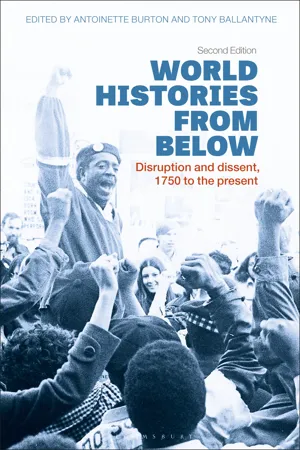
History has traditionally privileged elites and their accomplishments. World Histories from Below provides an antidote, placing 'ordinary' people and subordinated subjects at the heart of the themes it explores. Arguing that disruption and dissent are overlooked agents of historical change, it takes a global view of topics including political revolution, religious conversion, labour struggles and body politics. This 2nd edition includes two additional chapters on indigenous peoples, migration and environmental histories from below. With an updated preface, this enhanced text also includes additional images and case studies to grapple with themes that have more recently come to the fore, such as populism and the environment. Offering a study of these themes from 1750 to the present day, World Histories from Below refocuses our entire approach to teaching world history.
eBook - ePub
World Histories from Below
Disruption and Dissent, 1750 to the Present
- 312 pages
- English
- ePUB (mobile friendly)
- Available on iOS & Android
eBook - ePub
World Histories from Below
Disruption and Dissent, 1750 to the Present
About this book
Information
1
Modern Political Revolutions:
Connecting Grassroots Political Dissent and Global Historical Transformations1
In the fall of 2014, the streets of Hong Kong filled with protesters. The movement that came to be called Occupy Central had originated in 2012, around the same time as Occupy Wall Street and other Occupy movements aiming to reclaim urban spaces associated with the interests of global capitalism. But the Occupy Central movement took on a particular urgency in July 2014 when the government of the People’s Republic of China issued a white paper asserting its authority to restrict political autonomy in Hong Kong. Protesters set up tent cities in the business and government district known as Central, and in the working-class neighborhood of Mong-kok. In those encampments, protesters attempted to imagine a utopian future for Hong Kong.
Protesters came from virtually every walk of life. They wrote slogans, which they posted on walls, sometimes using Post-It notes (a tactical novelty), sometimes using big character posters (a more familiar protest tradition). They established lending libraries. Carpenters built makeshift desks so that students, an important presence in the movement, could study while they participated in the encampments. They showed solidarity with other protest movements across the globe, for example by raising their arms in the “Don’t shoot!” stance popularized by recent protests against the police killing of Michael Brown in Ferguson, Missouri. The movement was firmly rooted in local political conditions, but the protestors’ ideas and their repertoires drew on and fed into transnational flows. This essay will examine connections linking local and grassroots revolutionary movements with global flows of people, ideas, and repertoires of collective action throughout the modern era.
Our analysis begins in the eighteenth century; the revolutions associated with Western political modernity surely involved such global flows. Even contemporaries recognized that the events of the French Revolution held ramifications beyond French borders. For example, the Swiss-born journalist Jacques Mallet du Pan observed in 1793 that “the revolution, being cosmopolitan, so to speak, ceases to belong exclusively to the French.”2 Based on observations like this one, R. R. Palmer placed the French Revolution in transatlantic history in his path-breaking study, The Age of the Democratic Revolution: A Political History of Europe and America, 1760–1800, published in two volumes in 1959 and 1964. He argued that the French Revolution had to be understood as part of a series of political and intellectual transformations occurring on both sides of the Atlantic. Although Palmer’s study focused mostly on the activities of political elites, he was nevertheless aware of grassroots forms of activism in far-flung corners of the transatlantic world. “A Negro at Buenos Aires,” he noted, for example, “testified that Frenchmen in the city were plotting to liberate slaves in an uprising against the Spanish crown. In the High Andes, at the old silver town of Potosi … the governor was horrified to discover men who toasted liberty and drank to France.”3 Still, Palmer ignored the Haitian Revolution, not to mention earlier uprisings elsewhere in the Atlantic world.
With the publication in 1962 of The Age of Revolution: 1789–1848, Eric Hobsbawm took the history of these revolutions in further new directions. Based on ideas first suggested by Karl Marx, Hobsbawm’s “dual revolution” thesis explored specific connections between political rebellion in Europe and the economic dislocations that accompanied early industrial capitalism. Moreover, Hobsbawm also anticipated later developments in global history by suggesting connections between revolutionary ideas and events in Europe and contemporaneous or subsequent revolutions elsewhere in the world—not just in the Americas, but beyond. Still, as David Armitage and Sanjay Subrahmanyam note in their introduction to The Age of Revolutions in Global Context, c. 1760–1840 (2010), even Hobsbawm, for all of his expansive thinking, now appears, like Palmer, “strikingly Eurotropic, if not quite Eurocentric.” Only recently has the turn toward global history encouraged the exploration of provocative comparisons and previously invisible connections that are moving us closer to “viewing the Age of Revolutions as a … global phenomenon.”4
Starting with a global re-framing of “the age of revolutions,” this essay will focus on select revolutionary moments from the mid-eighteenth century to the early twenty-first that hold particular significance in terms of global dynamics. We presume a broad working definition of “revolution,” keeping in mind the difficulties entailed by both the changing meanings of the word and concept as understood and used by contemporaries over this long period and by the varying resonances of the term in different historiographies.5
Drawing on the work of Charles Tilly, we include under the term “revolutions” a continuum of political movements and processes that result in “forcible transfers of power over states” and “a forcible break in sovereignty.” We are mainly concerned with what Tilly terms “great revolutions” such as the Chinese or the Russian Revolution—that is, transfers of power that involve deep social rifts in the polity and substantial power transfers among contending groups in society, rather than more limited and “top-down” events such as military coups or civil wars that did not challenge political institutions or the nature of political legitimacy per se.6 In particular, given the nature of this volume, we will emphasize revolutions that involved notable political challenges “from below”—calls for a new relationship between “the people” and their rulers—although the political visions behind revolutions, the definitions of peoplehood in whose name they were carried out, and forms of revolutionary activity varied widely. We will investigate the operation and flow of specific “repertoires” of grassroots collective action; akin to theatrical performance, these repertoires of collective protest are the set of actions based on “available scripts within which [participants in political contention] innovate.”7 Repertoires include such actions as burning a landlord’s castle, posting demands, carrying a banner on a march, or occupying a symbolic space. Finally, we will not limit ourselves to successful revolutions; we will also include cases where revolutionary situations did not result directly in regime change, such as the Taiping Rebellion in China or the 1848–49 revolts in Europe.
Placing political revolutions in global-historical context involves two somewhat distinct analytic projects. The first involves identifying roughly simultaneous but localized revolutionary activities in different regions of the globe and investigating global-scale processes (such as market development or imperialism or war) that might have fed into these spatially distant activities. The second involves tracking specific global flows—of ideas, people, and political practices—that have connected grassroots movements with one another across the globe and across time. Although the point here is to locate modern political revolutions in global history, it is nevertheless important to keep in mind the local historical particularities of individual revolutionary situations as well as the global dynamics through which we are re-framing them.
Global 1789
The transatlantic flows of individuals, ideas, and tactics that fed into late eighteenth-century revolutions were complicated and multi-directional. The political principles at play in the American Revolution crisscrossed the Atlantic. Historians have long been aware of the role of the movements of Europeans and Americans of European descent in constructing transatlantic revolutionary discourses.8 For example, the Declaration of the Rights of Man and Citizen passed by the revolutionary French National Assembly in August of 1789 resembled the American Bill of Rights approved by the US Congress in September of the same year. The Marquis de Lafayette, who played a prominent role in both revolutions, wrote an influential draft for the Assembly committee charged with coming up with the Declaration. He consulted with Thomas Jefferson during the process of writing it. In a July 9, 1789 letter to Thomas Jefferson, Lafayette asked for Jefferson’s “observations” on “[his] bill of rights” before presenting it to the National Assembly.9 The writing of documents such as constitutions and petitions became a staple tactic of subsequent revolutions in the Atlantic world and beyond, as were practices involving the election of representatives to revolutionary assemblies.
Transnational intellectual and political connections at the grassroots have played a less visible role in historical narratives. According to Peter Linebaugh and Marcus Rediker, sailors and slaves who met and talked onboard ships and in port cities helped to construct a grassroots “revolutionary Atlantic” beginning in the mid-seventeenth century. Jane Landers has reconstructed the political activities of “Atlantic creoles”—men of African descent, some of them former slaves—who traveled widely through the southern Atlantic and Caribbean world, spreading political messages as they did so. Juan Bautista Whitten, for example, was born in West Africa in the late 1750s and taken slave there; his “remarkable career … spanned the course of the American, French, Haitian, and Latin American revolutions as well as the eventual abolition of the Atlantic slave trade.”10
The Revolution in the French Caribbean colony of Saint-Domingue (later renamed Haiti) is perhaps the best illustration of elite and grassroots connections that crossed the Atlantic. In the year before the outbreak of the French Revolution, the Society of the Friends of Blacks began meeting in Paris as part of an international effort to eliminate the slave trade. The roster of its members included leading intellectuals and politicians; its president, the Marquis de Condorcet, would later play an important role in the revolutionary National Assembly. The Society’s agenda grew out of concerns over slaveholding in colonies like Saint-Domingue. The vast majority of the population of the colony’s half-million residents (about 90 percent) were enslaved people of African origin. The remaining 10 percent were either whites or free people of color (gens de couleur). Each of these groups was positioned differently in terms of French colonial rule, and so the political upheavals in Paris presented each with different opportunities and strategies.
Those upheavals, of course, had much to do with internal conditions in the metropole. The fiscal problems faced by the French state in the late 1780s (which led King Louis XVI to call a meeting of the Estates General for the first time in over 150 years) were rooted in France’s inegalitarian social structure and taxation system. But the situation was exacerbated by the huge state debt contracted primarily as a result of military and naval expenditures occasioned by colonial rivalries between France and England in the Americas and in South Asia. In terms of global processes, it is clear that French colonial ambitions and activities played a significant role in setting up a revolutionary situation, and thus in launching the events that would soon bring down the monarchy. Moreover, inequalities specific to colonial arenas were on the agenda.
Global 1789: Events in France
The process of electing delegates to the Estates General brought people in the metropole and the colonies together in the midst of a widening food crisis that evoked mobilization and political experimentation from below. The early years of the revolution saw the invention of new forms of political action and the re-purposing of old ones. Under the surveillance of Parisian popular crowds, the Estates General was transformed into a new entity—a “National Assembly”—that would soon challenge royal sovereignty. The Assembly in turn would face challenges as it took up questions of citizenship involving various and competing claims by groups of elites, peasants, workers, and women in the metropole, and also by slave-owners, people of color, and enslaved people in the colonies.
Assemblies of people in the streets of Paris and elsewhere, many wearing the red bonnets (understood to be a symbol of slave emancipation in ancient Rome) and cockades manifesting support for the Revolution, took on symbolic and sometimes actual power. They occupied public sp...
Table of contents
- Cover
- Halftitle Page
- Title Page
- Dedication Page
- Contents
- List of Illustrations
- Notes on Contributors
- Preface
- Keywords: “World History,” “Below,” and “Dissent and Disruption”
- 1 Modern Political Revolutions: Connecting Grassroots Political Dissent and Global Historical Transformations
- 2 International and Global Anti-Colonial Movements
- 3 Insurgent Citizenships: Armed Rebellions and Everyday Acts of Resistance in the Global South
- 4 Indigeneity, Movement, and Disrupting the Global Nineteenth Century
- 5 Body Politics, Sexualities, and the “Modern Family” in Global History
- 6 The Persistence of the Gods: Religion in the Modern World
- 7 Global Mobilities
- 8 The Anthropocene from Below
- 9 The Anthropocene’s “Belows”: Nature and Power in Global History
- Index
- Imprint
Trusted by 375,005 students
Access to over 1.5 million titles for a fair monthly price.
Study more efficiently using our study tools.
Frequently asked questions
Yes, you can cancel anytime from the Subscription tab in your account settings on the Perlego website. Your subscription will stay active until the end of your current billing period. Learn how to cancel your subscription
No, books cannot be downloaded as external files, such as PDFs, for use outside of Perlego. However, you can download books within the Perlego app for offline reading on mobile or tablet. Learn how to download books offline
Perlego offers two plans: Essential and Complete
- Essential is ideal for learners and professionals who enjoy exploring a wide range of subjects. Access the Essential Library with 800,000+ trusted titles and best-sellers across business, personal growth, and the humanities. Includes unlimited reading time and Standard Read Aloud voice.
- Complete: Perfect for advanced learners and researchers needing full, unrestricted access. Unlock 1.5M+ books across hundreds of subjects, including academic and specialized titles. The Complete Plan also includes advanced features like Premium Read Aloud and Research Assistant.
We are an online textbook subscription service, where you can get access to an entire online library for less than the price of a single book per month. With over 1.5 million books across 990+ topics, we’ve got you covered! Learn about our mission
Look out for the read-aloud symbol on your next book to see if you can listen to it. The read-aloud tool reads text aloud for you, highlighting the text as it is being read. You can pause it, speed it up and slow it down. Learn more about Read Aloud
Yes! You can use the Perlego app on both iOS and Android devices to read anytime, anywhere — even offline. Perfect for commutes or when you’re on the go.
Please note we cannot support devices running on iOS 13 and Android 7 or earlier. Learn more about using the app
Please note we cannot support devices running on iOS 13 and Android 7 or earlier. Learn more about using the app
Yes, you can access World Histories from Below by Antoinette Burton, Tony Ballantyne in PDF and/or ePUB format, as well as other popular books in History & Modern History. We have over 1.5 million books available in our catalogue for you to explore.