Uncovering the theoretical and creative interconnections between posthumanism and philosophies of immanence, this volume explores the influence of the philosophy of immanence on posthuman theory; the varied reworkings of immanence for the nonhuman turn; and the new pathways for critical thinking created by the combination of these monumental discourses.
With the philosophy of Gilles Deleuze and Félix Guattari serving as a vibrant node of immanence, this volume maps a multiplicity of pathways from Deleuze, Guattari and their theoretical allies – including Spinoza and Nietzsche – to posthuman thought. As positions that insist, respectively, on the equal yet distinct powers of mind and body (immanence) and the urgent need to dismantle human privilege and exceptionality (posthumanism), each chapter reveals concepts for rethinking established notions of being, thought, experience, and life.
The authors here take examples from a range of different media, including literature and contemporary cinema, featuring films such as Enthiran/The Robot (India, 2010) and CHAPPiE (USA/Mexico, 2015), and new developments in technology and theory. In doing so, they investigate Deleuzian and Guattarian posthumanism from a variety of political and ethical frameworks and perspectives, from afro-pessimism to feminist thought, disability studies, biopolitics, and social justice.
Countering the dualisms of Cartesian philosophy and flattening the hierarchies imposed by Humanism, From Deleuze and Guattari to Posthumanism launches vital interrogations of established knowledge and sparks the critical reflection necessary for life in the posthuman era.
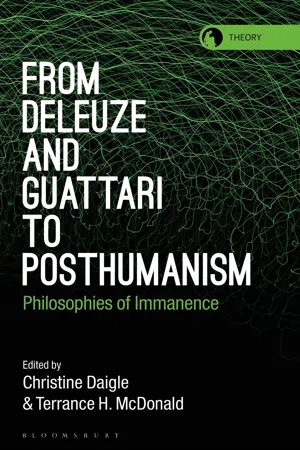
eBook - ePub
From Deleuze and Guattari to Posthumanism
Philosophies of Immanence
- 304 pages
- English
- ePUB (mobile friendly)
- Available on iOS & Android
eBook - ePub
From Deleuze and Guattari to Posthumanism
Philosophies of Immanence
About this book
Information
Part One
Philosophical genealogies – From Deleuze and Guattari to posthumanism
1
Posthuman neo-materialisms and affirmation
Rosi Braidotti
Introduction
The outline of this chapter is as follows: I take as beginning assumptions, first, the twofold empirical-transcendental equation demonstrated by Deleuze and Guattari, namely that thinking is not the prerogative of humans or any other bound entity. Second, that the specific mode of thought promoted by philosophy is about the creation of new concepts. All along – nomadically speaking – I will uphold the conviction that both Deleuze and Guattari, as profoundly anti-humanist and post-anthropocentric thinkers, offer a significant new approach to the discussions on naturalism, the environment, ecological justice and the posthuman. And as the ever-shifting horizon for the thought processes dramatized within these pages, I will defend the ethics of affirmation and the politics of radical immanence. The working definition I have adopted in my rhizomatic, multidirectional argument is that the posthuman – and its multiple posthumanisms – are not substantive concepts, but rather navigational tools or conceptual personae. With this specific framing of the question of the posthuman in mind, let me then proceed to explore the steps of the argument, in a nomadic manner that offers the rigour of consistency, not the comfort of linearity.
The posthuman as conceptual persona
Posthuman thought in contemporary scholarship is a convergence phenomenon unfolding at the intersection between posthumanism on the one hand and post-anthropocentrism on the other. The former proposes the philosophical critique of the Western Humanist ideal of ‘Man’ as the allegedly universal measure of all things on the one hand, whereas the latter rests on the rejection of species hierarchy and human exceptionalism. They are equally powerful discourses, but they refer to different theoretical and philosophical genealogies and engender different political stances, which encompass both forms of empowerment and, in many ways, new modes of entrapment. Their convergence in what I call posthuman critical thought is producing a chain of theoretical, social and political effects that is more than the sum of its parts and points to a qualitative leap in new conceptual directions.1
The force of this convergence is enhanced contextually by the urgency of the Anthropocene condition, which, read in the light of Guattari’s three ecologies,2 becomes an environmental, socio-economical, as well as affective and psychical phenomenon of unprecedented proportions. The combination of fast technological advances on the one hand and the exacerbation of economic and social inequalities on the other, make for a multifaceted and conflict-ridden posthuman landscape.3
I understand the task of philosophy as both critical and creative. The critical side is operationalized through cartographies of the power relations at work in the production of discourses and social practices, with special emphasis on their effects upon subject-formation.4 Cartographies are theoretically infused navigational tools across the complexities of the material and discursive complexities of the present. The posthuman is at present my preferred navigational tool and conceptual persona, following from the previous sequence that included the feminist philosopher and the nomadic subject.
I combine the cartographic approach with the feminist politics of locations, based on the notions of embodiment and lived experience, which I take as the original historical and theoretical manifestation of embodied and embedded immanence and of corporeal or sensible empiricism. Politics of locations emphasize the situated and accountable nature of knowledge.5 Feminist epistemology includes, next to a sharp critical dimension, creative efforts aimed at the expression of new alternatives.6 The encounter of feminist epistemology and Deleuze, in the framework of vital neo-materialism,7 results in renewed emphasis on immanence and, therefore, the rejection not only of dualism but also of transcendental universalism.
My nomadic philosophy of immanence is rooted in feminist theory, but it flows nomadically in many other directions. Two main implications follow from this, and they are symbiotically intertwined: one about the function of cartographies and the other about the importance of subjectivity. Cartographies as embodied and embedded relational practices become both methods and political strategies. They produce theoretical and political accounts of one’s multiple – and potentially contradictory – locations in terms of space (geophysical or eco-sophical dimension) and time (both Chronos and Aion, that is to say: historical memory and genealogical dimension). As relational objects produced and circulated in multiple networks of connection, cartographies become dialogical objects of exchange. The speed of their itineraries and the intensity of their discursive production compose the different planes of an ‘assemblage’,8 that is to say a transindividual form of subjectivity. This assemblage – which includes non-human factors as well as technological mediation – composes a plane of immanence, that is to say, a space of relational encounter9 or the composition of a community that was virtual until it gets materialized, embodied and embedded, as a ‘people’. This nomadic transversal entity is bonded by what Genevieve Lloyd calls a ‘collaborative morality’,10 which is to say, an ethics of affirmation (more on this later).
Subjectivity, therefore, is not linked to bound individuals – Deleuze and Guattari rejected liberal individualism. Nor is it ‘collectivized’ within a dialectical scheme that posits one entity, like class, or a multitude,11 as the transcendent category that drives the progress of world history. Nomadic subjectivity rather gets actualized transversally, in between nature/technology; male/female; black/white; local/global; present/past – in assemblages that flow across and displace the binaries. These in between states are processes of becoming that defy the logic of the excluded middle. Although they allow an analytic function to the negative, they reject negativity and aim at the production of joyful or affirmative values and projects.12 A new alliance of critique with creation is put to the task of actualizing alternatives to the dominant vision of the subject, resisting the hegemony of reason and the pull of transcendentalism.
A neo-materialist posthuman philosophy, which assumes that all matter is one; that it is intelligent and self-organizing (auto-poietic); that takes ‘living matter’ as zoe-centred process,13 which is geophysical but also psychic and interacts with the technosphere; that resists over-coding by the profit principle, which is the axiomatic of advanced capitalism – results in proposing an affirmative composition of transversal subjectivities (i.e. assemblages). Subjectivity can then be redefined as a praxis, not a concept – it produces an expanded self, whose relational capacities are multifold and open to non-anthropomorphic elements. Zoe-centred egalitarianism, the non-human, the vital force of Life is the transversal entity that allows us to think across previously segregated species, categories and domains. Neo-materialist immanence requires ethical accountability for the sustainability of these assemblages or transversal compositions.14
The question of the posthuman in Deleuze
A consensus has emerged in recent Deleuze scholarship that Deleuze’s philosophy is firmly inscribed in the Continental tradition of anti-humanism, going back to Nietzsche and beyond.15 Deleuze’s theoretical and personal relationship to Foucault is, in this respect, a crucial knot and one that I cannot untie here. But I do wish to foreground the critical distance that Deleuze takes both from the claims of European humanism and the (often rhetorical) celebrations of the human that ensue from it.
This distance is both conceptual and affective, as things often are in Deleuze’s philosophical universe. European humanism is taken to task in view of the philosophical institutions it has created and supported. They are true mechanisms of capture of the singular and collective intelligence, instruments of intimidation and conformism that enforce the replication of the obvious, albeit in shrinking institutional spaces. At the affective level, far from displaying any anthropocentric arrogance or boastful self-satisfaction, Deleuze – the most ascetic of twentieth-century French philosophers – openly professes a kind of shame about being human. The sense of shame encompasses macro historical events, such as the Holocaust – think of the pages Deleuze dedicates to Primo Levi – colonialism and despotic power. It also extends, however, to daily micro-instances:
we can feel shame at being human in utterly trivial situations, too: in the face of too great a vulgarization of thinking, in the face of TV entertainment, of a ministerial speech, of ‘jolly people’ gossiping. This is one of the most powerful incentives towards philosophy, and it’s what makes all philosophy political.16
This deep-seated sense of shame about being human is not a form of self-hatred and nihilism, but exactly the contrary. As critical self-reflection, it lays the conditions of a possibility for overcoming negative passions and compose a life where generosity, ontological relationality and openness to human and non-human others, provide the ethical compass. The crucial point is the transcendence of negativity, which in this case means the transformation of shame as a negative state, from contempt and resentment (or Lack, ontological insecurity, original sin, structural guilt and perennial debt, as stipulated in the Hegelian-Lacanian model), into a becoming-minoritarian of the subject, aimed at the affirmation of other ways of being human. The ethical moment consists in the production of affirmative affects and generative relations, composing assemblages that can actualize virtual relations and projects. Shame about some of the face...
Table of contents
- Cover
- Half-Title
- Series
- Title
- Contents
- List of contributors
- Acknowledgements
- Introduction: Posthumanisms through Deleuze and Guattari
- Part One Philosophical genealogies – From Deleuze and Guattari to posthumanism
- Part Two From Deleuze and Guattari to posthuman aesthetics
- Part Three The politics of Deleuze, Guattari and posthumanism
- Index
- Copyright
Trusted by 375,005 students
Access to over 1.5 million titles for a fair monthly price.
Study more efficiently using our study tools.
Frequently asked questions
Yes, you can cancel anytime from the Subscription tab in your account settings on the Perlego website. Your subscription will stay active until the end of your current billing period. Learn how to cancel your subscription
No, books cannot be downloaded as external files, such as PDFs, for use outside of Perlego. However, you can download books within the Perlego app for offline reading on mobile or tablet. Learn how to download books offline
Perlego offers two plans: Essential and Complete
- Essential is ideal for learners and professionals who enjoy exploring a wide range of subjects. Access the Essential Library with 800,000+ trusted titles and best-sellers across business, personal growth, and the humanities. Includes unlimited reading time and Standard Read Aloud voice.
- Complete: Perfect for advanced learners and researchers needing full, unrestricted access. Unlock 1.5M+ books across hundreds of subjects, including academic and specialized titles. The Complete Plan also includes advanced features like Premium Read Aloud and Research Assistant.
We are an online textbook subscription service, where you can get access to an entire online library for less than the price of a single book per month. With over 1.5 million books across 990+ topics, we’ve got you covered! Learn about our mission
Look out for the read-aloud symbol on your next book to see if you can listen to it. The read-aloud tool reads text aloud for you, highlighting the text as it is being read. You can pause it, speed it up and slow it down. Learn more about Read Aloud
Yes! You can use the Perlego app on both iOS and Android devices to read anytime, anywhere — even offline. Perfect for commutes or when you’re on the go.
Please note we cannot support devices running on iOS 13 and Android 7 or earlier. Learn more about using the app
Please note we cannot support devices running on iOS 13 and Android 7 or earlier. Learn more about using the app
Yes, you can access From Deleuze and Guattari to Posthumanism by Christine Daigle, Terrance H. McDonald, Christine Daigle,Terrance H. McDonald in PDF and/or ePUB format, as well as other popular books in Philosophy & Critical Theory. We have over 1.5 million books available in our catalogue for you to explore.