Despite the boycott Hamas was subjected to since its victory in the 2006 parliamentary elections, it has become a significant player on the international stage. It boasts a territory identifiable by its borders, internationally recognized cease-fire lines and effective authority over a population.
This book, a study in international relations, shows how Hamas willingly mobilizes Palestinian internal issues to establish its legitimacy on a global scale, and at the same time, uses its relations with non-Palestinian players to compete against its political rivals on the Palestinian national stage. Leila Seurat reveals that Hamas's foreign and internal policy are strongly intertwined and centred mainly on Hamas's quest for recognition. The book then is a comprehensive diplomatic history of Palestine, focused on the political orientations of Hamas towards both Israel and other countries. Its coverage spans the movement's victory in 2006 up until more recent momentous events, including, Hamas' response to Trump's 'deal of the century' and Israel's announcement of the annexation of the Jordan Valley, as well as the proclamation of normalization accords between Israel and the United Arab Emirates and the impact of Covid19. The book is based on Leila Seurat's extensive fieldwork and interviews with Hamas's leading officials across the West Bank, Gaza, Damascus, Geneva and Beirut in addition to recent video-conferences planned by various NGOs and attended by West Bank, Gaza and Diaspora Palestinians.
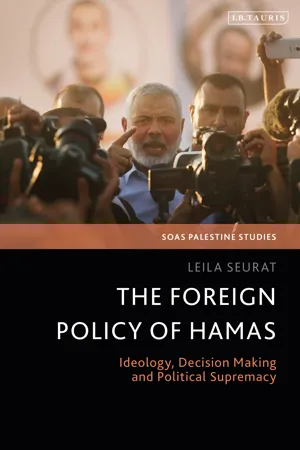
eBook - ePub
The Foreign Policy of Hamas
Ideology, Decision Making and Political Supremacy
- 312 pages
- English
- ePUB (mobile friendly)
- Available on iOS & Android
eBook - ePub
The Foreign Policy of Hamas
Ideology, Decision Making and Political Supremacy
About this book
Information
Part I
General orientations of Hamas foreign policy
Chapter 1
Hamas and Israel
Conciliation and confrontation
Hamas has conducted an apparently contradictory policy that at times advocates conciliation, at others armed struggle. As an attempt to end the series of confrontations opposing it to Israel, it opened, as from June 2007, negotiations under the patronage of Egypt, which led to the signing of a hudna (truce) in June 2008.
Six months later, in the wake of its numerous incursions in the Gaza Strip, Israel broke the truce and triggered a grand scale military offensive in December 2008–January 2009. The only result of this assault, which Israel refers to as ‘Cast lead’, was a unilateral Israeli cease-fire.
The year 2011 saw a new sequence of intense interactions between Israel and Hamas. In October, the Islamist movement freed the IDF Israeli private Gilad Shalit, who had been abducted in June 2006. In March and August 2011, the Izz al-Din al-Qassam Brigades fired a series of rockets towards Israel. Two Israeli offensives were then carried out on the Gaza Strip: one in November 2012, ‘Pillar of Defence’, and one in summer 2014, ‘Protective Edge’.
The period that followed the summer 2014 offensive heralded a substantial change in relations between Israel and Hamas. Large-scale recurrent military assaults against the Gaza Strip turned into increasingly routine violent confrontations between the two sides, interwoven with the dynamics of the Great March of Return launched on 30 March 2018.
The election victory’s impact: ‘One hand builds, the other resists’
Subjecting the exercise of power to the imperative of resistance
The January 2006 elections, won by Hamas (to its own surprise), placed it in an unexpected situation. The refusal of Fatah to form a national unity government led Hamas to constitute the Palestinian government on its own. The movement then considered that, far from abandoning the armed struggle, its entry into the Palestinian Authority’s institutions would, quite the opposite, allow it to protect the ‘resistance and permanently bury the agreements signed between the PLO and Israel’ in 1993 and 1994.1
The dilemma between resistance and the exercising of power had been clearly exposed before this time.2 The election programme, which was the foundation for Hamas’ parliamentary election campaign, had led to the writing of two texts dealing with the issue of resistance, each almost contradicting the other. The manifesto published in the newspaper Minbar al-Islâh,3 on 8 January 2006, stated that the Palestinian people, still in a state of national struggle, had the right to regain their rights by all means, including armed resistance. In contrast, its draft programme for a coalition government originating from the central committee for the preparation of elections had erased the notion of armed struggle, highlighting other means for the preservation of the Palestinian people’s rights.4
This dilemma was exposed in exemplary fashion on two occasions: during the 2006 election victory and the kidnapping of Israeli soldier Gilad Shalit. On 27 March 2006, during his inaugural speech in parliament, Ismail Haniyeh mentioned the necessity of founding a Palestinian state within the 1967 borders; he detailed that his government would ‘work according to the articles of the Basic Law amended in March 2003’.5 This reference to Fundamental Law is significant, in that it appeared in the framework of the Oslo agreements. On the legal level, Hamas was therefore to conform to parameters put in place by the ‘peace talks’.
Gilad Shalit’s abduction on 25 June 2006, captured jointly by Hamas’ armed branch, the Popular Resistance Committees and the Salafi group Jaysh al-Islâm, meant the definitive collapse of the truce concluded in March 2005.6 During an exclusive interview with al-Jazeera through Tamer al-Mashal documentary programme ‘What Is Hidden Is Greater’, Marwan Issa, deputy chief of the al-Qassam Brigades, provides details on the manner this operation was prepared, as well as on how it unfolded.7 The crisis that followed translated into a campaign of destruction of Palestinian institutions and the arrest of MPs and ministers. In July 2006, an Israeli foray in the Gaza Strip provoked the death of the family of Abou Sulmiyya, one of the leaders of Hamas: this was followed in August by an air raid on the al-Shuaja’iyya neighbourhood.
In the wake of this victory, the movement’s leaders called for the adoption of a new strategy in which the exercise of power would be subjected to the imperative of resistance. ‘How to do things in order to act in an environment where the exercising of power goes against the imperative of resistance? It is a new experiment, that of allying power to resistance, and this is why we must do all we can to carry out this double objective. This situation is provisional, it is not strategic,’ Abu Marzouk declared.8
The National Conciliation Document of the Prisoners
Three days after Gilad Shalit’s abduction, Hamas signed, together with other Palestinian factions, the Prisoners’ Document, also called the National Conciliation Document (Wathîqat al-Wifâq al-watani). This text implicitly recognized the validity of the June 1967 borders and agreed on limiting resistance to the land occupied in 1967.9 Since 2005 Hamas had ceased its suicide attacks inside the 1948 territories: this was the period when the movement was preparing its participation in the Palestinian political system. Hamas spokesman Yahya Musa declared: ‘Hamas has moved onto a new stage that requires the cessation of martyrdom operations (istishhâd), which took place in an exceptional period, that of the Intifada. They have now been brought to an end, for reasons related to circumstances and to our beliefs.’10
Just like in the case of the Cairo Agreement of March 2005, the Prisoners’ Document transferred to the PLO the file of negotiations with the occupying power. Hamas thereby accepted that the president of the Palestinian Authority carry out direct negotiations with Israel.
However, most of Hamas’ leaders tried to minimize the importance of these pragmatic declarations; they were seen as a tactical manoeuvre by the movement, and they did not diminish by any means the validity and legitimacy of its historical strategy. It is possible to notice here a wavering between two fluctuating approaches (mawâqif moutazabziba). This policy would be contrary to that of Fatah, for whom the building of a Palestinian state on the 1967 borders constitutes the ultimate goal:
For us, the struggle has not ended, and this is why the building of a Palestinian state on the 1967 borders remains a tactical goal. For Fatah, the conflict is over; this is why for them it is a strategic aim. We do not believe in a two-state solution. Fatah believes in the two-state solution; this is why they have recognized Israel.11
Certain clauses of the Prisoners’ Document restrict the range of the decision to transfer the negotiation file to the PLO. In the case where an agreement between Mahmoud Abbas and the State of Israel is found, it would obligatorily need to be submitted to the vote of the Legislative Council, where Hamas has a majority. These agreements should, in a later phase, be validated via a popular referendum.12 Although the movement did show that it was ready to collaborate with Fatah, it thus maintained a more than circumspect stance as regards a policy of peace with Israel at any cost.
The issue of the file’s transfer would moreover be the subject of loud disagreements between the two parties during the formation of a national unity government in March 2007. While Fatah insisted on the (Hamas dominated) government’s obligation to accept that the PLO be the only decision-maker, Hamas considered that any agreement with Israel necessarily had to be validated by the Legislative Council beforehand.
The Mecca Agreement of February 2007
In 2006, all attempts to form a national unity government failed. During this period, bloody episodes between Hamas and Fatah followed one another, until the signing of the Mecca Agreement in February 2007, which permitted breaking the deadlock and paving the way for this national unity government.
Through this reconciliation, Hamas was endorsing the validity of already-existing agreements between Israel and the PLO.13 The roots of this acceptance in the framework of the Oslo agreement go back to the period that followed parliamentary elections, when many Hamas leaders had advocated ‘respect’ of agreements that would not be detrimental to the rights of the Palestinian people. An increasing number of voices in the movement were being heard, asking for recognition of the validity of these agreements, although there was no unanimity on this stand, since others were, indeed, considering that victory in elections provided the possibility of denouncing these accords. The president of the Legislative Council Aziz Dweik had, for instance, declared that the National Assembly would review the Israeli–Palestinian agreements, and that Hamas would only accept those that were in the interest of its people.14
Four days after Hamas’ victory, Khaled Mesh’al had declared: ‘Hamas will take into consideration all established agreements and all realistically and pragmatically voted laws to preserve the rights of its people, but we will take only what is convenient for us; and we shall reject what goes against our interests. We will not pay the price of peace.’15
The vice-president of the Political Bureau Moussa Abu Marzouk soon followed in these footsteps and announced that he would take Oslo into account with ‘appropriate realism’, because from a juridical viewpoint, one must take due note of agreements ratified by an established political regime.16 He added that although Hamas had entered the contest of parliamentary elections, it had done so ‘on the basis of these agreements’, despite their diminished weight.17
Though attachment to the juridical framework of Oslo preceded the Mecca Agreement, it was really reconciliation in the Saudi holy city in March 2007 that was proof of a break with the previous government. On this occasion, Ismail Haniyeh’s speech made clear the change in his stance concerning international and Arab resolutions. The agreement’s fourth article sugge...
Table of contents
- Cover
- Half-Title
- Series
- Title
- Copyright
- Contents
- Foreword
- Acknowledgements
- INTRODUCTION
- Part 1 GENERAL ORIENTATIONS OF HAMAS FOREIGN POLICY
- Part 2 THE VARIOUS INTERESTS AT THE BASIS OF THE FOREIGN POLICY OF HAMAS
- Part III PLACE AND FUNCTION OF IDEOLOGY IN THE FOREIGN POLICY OF HAMAS
- Part IV THE IMPACT OF DECISION MAKING ON HAMAS FOREIGN POLICY
- Postscript
- Biographies
- Chronology
- Bibliography
- Index
Trusted by 375,005 students
Access to over 1.5 million titles for a fair monthly price.
Study more efficiently using our study tools.
Frequently asked questions
Yes, you can cancel anytime from the Subscription tab in your account settings on the Perlego website. Your subscription will stay active until the end of your current billing period. Learn how to cancel your subscription
No, books cannot be downloaded as external files, such as PDFs, for use outside of Perlego. However, you can download books within the Perlego app for offline reading on mobile or tablet. Learn how to download books offline
Perlego offers two plans: Essential and Complete
- Essential is ideal for learners and professionals who enjoy exploring a wide range of subjects. Access the Essential Library with 800,000+ trusted titles and best-sellers across business, personal growth, and the humanities. Includes unlimited reading time and Standard Read Aloud voice.
- Complete: Perfect for advanced learners and researchers needing full, unrestricted access. Unlock 1.5M+ books across hundreds of subjects, including academic and specialized titles. The Complete Plan also includes advanced features like Premium Read Aloud and Research Assistant.
We are an online textbook subscription service, where you can get access to an entire online library for less than the price of a single book per month. With over 1.5 million books across 990+ topics, we’ve got you covered! Learn about our mission
Look out for the read-aloud symbol on your next book to see if you can listen to it. The read-aloud tool reads text aloud for you, highlighting the text as it is being read. You can pause it, speed it up and slow it down. Learn more about Read Aloud
Yes! You can use the Perlego app on both iOS and Android devices to read anytime, anywhere — even offline. Perfect for commutes or when you’re on the go.
Please note we cannot support devices running on iOS 13 and Android 7 or earlier. Learn more about using the app
Please note we cannot support devices running on iOS 13 and Android 7 or earlier. Learn more about using the app
Yes, you can access The Foreign Policy of Hamas by Leila Seurat, Martin Makinson in PDF and/or ePUB format, as well as other popular books in History & Middle Eastern History. We have over 1.5 million books available in our catalogue for you to explore.