![]()
CHAPTER 1
Making the Case for Social-Emotional Learning
Social-emotional learning (SEL) has been receiving more and more attention recently in the educational sphere, both from practitioners and researchers. SEL has been called the “missing piece” of education; the information and strategies we’ll discuss throughout this book will allow you to complete the puzzle to providing exceptional learning experiences to your students.
KEY CONCEPTS
•What is social-emotional learning (SEL)?
•Why is it so important in our classroom today?
•How can SEL help you and your students?
•What are some strategies for integrating SEL to develop a more positive classroom culture?
•What are some misconceptions about SEL?
•How can we increase our students’ SEL?
INTRODUCTION
Across the country, momentum is building for schools and districts to help students develop the social, emotional, and academic skills that evidence shows are needed for success both in school and in life. There’s a deepening recognition that skills such as responsibility, problem solving, empathy, self-regulation, self-control, and persistence all form a solid foundation for academic achievement and personal growth. The Every Student Succeeds Act (ESSA), 2015, recognizes social-emotional education as a vital factor in helping students develop critical life skills that go well beyond academics.
Furthermore, emotions are of paramount importance for cognition: “We feel, therefore we learn” (Immordino-Yang & Damasio, 2007, p. 3). When there is damage to the emotional networks of the brain, even simple decisions can become challenging (Damasio, 1994). For educators who have dozens of students in their classrooms each day, it can feel overwhelming to support the range of students’ emotional needs in addition to their diverse learning needs. Educators may feel inadequately prepared and need tools to support emotional learning.
There is also the time factor to consider. Teachers have concerns that there is not enough time to address the emotional needs of their students in addition to the cognitive content that must be covered in the curriculum. One teacher I spoke with said, “I cannot take time each day to talk about how each student feels.” This is the challenge that many teachers experience daily.
However, while it is important to recognize that dilemma, educators cannot ignore the critical role of emotions in the classroom and their impact on learning. We must ask, What would it take to weave social and emotional learning into the daily routine and fabric of our nation’s schools? For both adults and children, emotions drive our attention and are essential for cognitive skills such as memory and executive functioning. Emotions even influence basic perception (Zadra & Clore, 2011). If we are not addressing emotions in our classrooms, then we are not addressing how students learn.
The strategies shared in this book provide educators with engaging strategies that are research based and do not require a lot of time to implement. Using these classroom-tested techniques, teachers can design environments and lessons to support emotions for learning. These strategies are inclusive in nature and can be proactively integrated into the learning environment so that any student can access them, whether a student is just having a “bad day” or they have greater emotional or learning challenges.
What Is Social-Emotional Learning?
SEL has been defined in a number of ways (see Humphrey et al., 2020). In general, it focuses on a set of social, emotional, behavioral, and character skills that support success in school, the workplace, relationships, and the community. According to CASEL (Collaborative for Academic, Social and Emotional Learning,
Social and emotional learning (SEL) is an integral part of education and human development. SEL is the process through which all young people and adults acquire and apply the knowledge, skills and attitudes to develop healthy identities, manage emotions and achieve personal and collective goals, feel and show empathy for others, establish and maintain supportive relationships, and make responsible and caring decisions. (CASEL, 2015)
Joan Duffell, executive director of the Committee for Children, summarizes the definition this way: “These are the skills that allow children to calm themselves when angry, make friends, resolve conflicts respectfully, and make ethical and safe choices” (Elias et al., 2017, p. 64).
On a broader scale, SEL includes recognizing and understanding emotions, strategies for managing emotions, developing the ability to recognize and understand emotions in others, and strategies for responding to the emotions of others. SEL also includes explicitly teaching and practicing strategies to develop emotional resiliency—the ability to bounce back after adversity. For years, many of us in education have assumed that impulse control, self-discipline, and sound decision making were taught in the home, that they are innate skills, or that teachers just do not have time to bother with them. Fortunately, educators are realizing that those assumptions were incorrect. Now, we look to schools to integrate these traits into the curriculum.
What Does the Research Say?
The concept of SEL and its importance in education have evolved over the years. In 1997, Elias et al. suggested that SEL comprises a set of competencies, which Durlak et al. (2011) further described as the ability to
•Recognize and manage emotions
•Set and achieve positive goals
•Appreciate the perspectives of others
•Establish and maintain positive relationships
•Make responsible decisions
•Handle interpersonal situations constructively (p. 406)
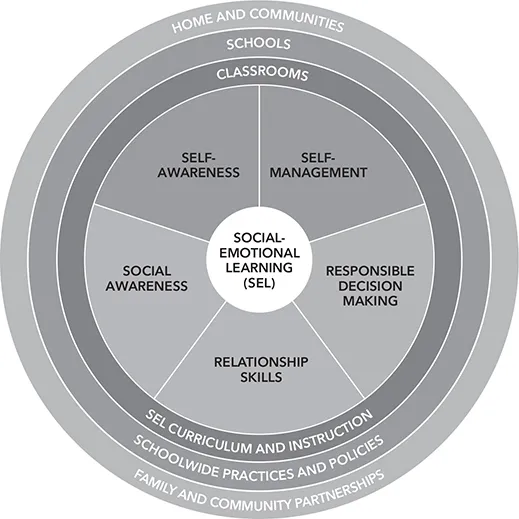
A few years later, the Collaborative for Academic, Social, and Emotional Learning (CASEL, 2005) identified five interrelated cognitive, affective, and behavioral competencies (see Figure 1.1):
1.Self-awareness—the capacity to reflect on one’s own feelings, values, and behaviors
2.Social awareness—the ability to view situations from another perspective, respect the social and cultural norms of others, and celebrate diversity
3.Relationship skills—the ability to initiate and sustain positive connections with peers, teachers, families, and other groups
4.Self-management—the set of skills that includes self-motivation, goal setting, personal organization, self-discipline, impulse control, and use of strategies for coping with stress
5.Responsible decision making—the ability to make choices that consider the well-being of oneself and others
Figure 1.1. CASEL’s five interrelated cognitive, affective, and behavioral competencies. (Source: ©2021 CASEL. All Rights Reserved. https://casel.org/sel-framework/)
Furthermore, the Wallace Foundation model (Jones et al., 2018) identified three domains of SEL:
1.Cognitive regulation—attention control, inhibitory control, working memory and planning, and cognitive flexibility
2.Emotional processes—emotion knowledge and expression, emotion and behavior regulation, and empathy or perspective-taking
3.Interpersonal skills—understanding social cues, conflict resolution, and prosocial behavior
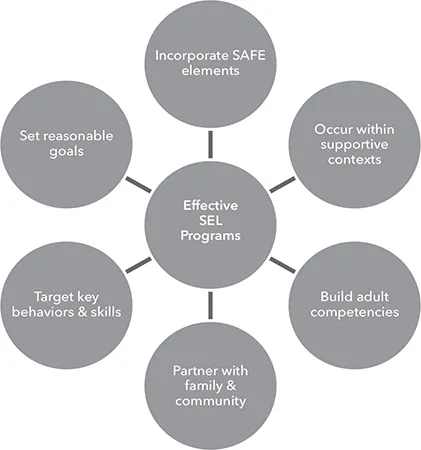
From their extensive study of effective SEL practices, Navigating SEL from the Inside Out (Jones et al., 2017), the Wallace Foundation identified key features that are essential for implementing effective SEL programs (see Figure 1.2):
•Set reasonable goals
•Incorporate SAFE elements
•Occur within supportive contexts
•Build adult competencies
•Partner with family and community
•Target key behaviors and skills
Figure 1.2. Key features of effective SEL programs. (From Jones, Brush, Bailey, Brion-Meisels, McIntyre, Kahn, Nelson, & Stickle. [2017]. Navigating social and emotional learning from the inside out [p. 22]. The Wallace Foundation; reprinted with permission.)
Additionally, in an article titled “What Is Social Emotional Learning?” educator Samantha Cleaver (2013) reminds us that SEL is more than just classroom management and the development of social skills. In a school or classroom where SEL is purposefully included from the first day of class, it becomes an integral part of the day’s lesson; it is not just an afterthought or an “add-on.” The basic principles of SEL are merged into the curriculum so that they are continually...