- 112 pages
- English
- ePUB (mobile friendly)
- Available on iOS & Android
eBook - ePub
About this book
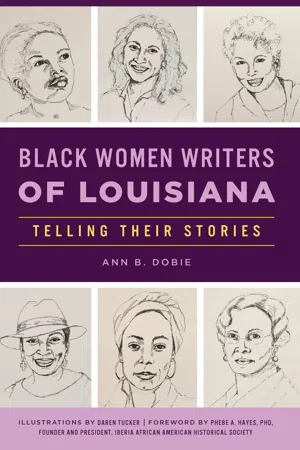
Louisiana has been home, by birth or adoption, to numerous literary greats. But among that talent, there's an under-celebrated cohort: Black women. Due to lack of education and opportunity, their record is fairly brief, but over the past century they have been responsible for a flowering of literature that portrays the Black experience through poetry, fiction, plays, essays and journalism. The writers profiled here have not gone wholly unrecognized though--far from it. Some have been honored with prestigious awards and have found a readership large enough to put them at the forefront of the national literary scene. Beginning with Alice Ruth Dunbar Nelson--a fiery activist, columnist and storyteller in the late nineteenth century--the work extends to Fatima Shaik, named 2021 Louisiana Writer of the Year. Join Ann B. Dobie on this celebration of Louisiana literary talent.
Trusted by 375,005 students
Access to over 1.5 million titles for a fair monthly price.
Study more efficiently using our study tools.
Information
Topic
HistoriaSubtopic
Biografías literariasPINKIE GORDON LANE
A QUIET PIONEER
Indeed, her voice is so quiet at times that in the militant 1960s,
hers was not accepted as “African American poetry.”
—Carolyn M. Jones
Pinkie Gordon Lane is the quintessential trailblazer. Her list of “firsts” is long and impressive. She was the first African American woman to complete a PhD at Louisiana State University. She was the first woman to serve as chair of the English Department at Southern University. Appointed by Governor Buddy Roemer, she became Louisiana’s first African American poet laureate. And that’s just for starters.
Trailblazing was not easy. Born in Philadelphia, Pennsylvania, in 1923 as the only surviving child of William Alexander Gordon and Inez Addie West Gordon, Pinkie Gordon Lane grew up in times troubled by racial strife and the Great Depression. Struggling to provide their daughter with an education, her parents managed to see her through the prestigious Philadelphia High School for Girls. After graduation, however, there was no money for college, and she took a job in a sewing factory. After the death of both parents, Lane won a four-year scholarship to Spelman College in Atlanta, Georgia. It was there that she met her husband, Ulysses “Pete” Simpson. Her degree in English and art from Spelman, where she graduated with honors, was followed later by a master’s degree in English from Atlanta University and the PhD from LSU.
In the interim between degrees, Lane became an educator, a career she was to develop for decades to come. She taught high school students in Georgia and Florida for six years, returning to Atlanta in 1955 to continue her own education. The next year, she accepted a position at Leland College in Baker, Louisiana, where she taught until she moved to join the English Department faculty at Southern University in 1959. Her early years there combined teaching, motherhood and a cross-town commute to LSU to work on her PhD. That experience is recalled in a poem from Wind Thoughts titled “While Working towards the PhD Degree”:
Telephone unanswered, parties unserved,
Husband languishing, flat, unnerved;
Friendships neglected, kisses left cold,
Laughter—too much, too sudden, too bold.
Tears—much too quickly, as quickly forgot,
A child loved and wanted, but with prudence ungot
Dust on the table, a kitten unmilked.
Love but indulged, flowing loosely like silk.
Ethereally lost in the cold world of print,
A drunken desire, incontinent,
Ideas my only reality,
A slave in pursuit of that damned Ph.D.
With the PhD and time, Lane became department chair of English, and her husband taught in the Department of Education. When he died of lung and liver cancer in 1970, Lane continued to develop as a scholar, poet and single mother at Southern, where she spent the rest of her career. Her devotion to art and beauty, despite the disappointments and banalities of life, never wavered, as reflected in “On Being Head of the English Department”:
I will look with detachment
On the signing of contracts
the ordering of books,
and the making of schedules—
will sing hymns of praise
to the negative, when
it is necessary to survive.
And if the morning
light freezes in the east,
a dawn-covered eye
will tell me I am cold
to your pleas, but never whore
to the spirit. I will
write poems in the blue-frosted lake.
If I disdain poetasters,
announcers, and the gods
of mediocrity, knowing
that they too insist on living,
it is because I hand you
the bread and the knife
but never the music and the art
of my existence.
You will not swallow me or absorb me:
I have grown too lean for that.
I am selfish, I am cruel.
I am love.
In addition to her teaching, Lane planned to write short stories. That is, she planned to work with fiction until 1962, when, on the recommendation of a friend, she found A Street in Bronzeville by Gwendolyn Brooks. Reading a book of poetry by a Black woman was a life-changing experience, causing Lane to turn to poetry as her genre of choice. That a single book could cause such a transformative experience might seem surprising today, but it must be remembered that Black studies courses were in their infancy in the early ’60s, and scholarship surrounding Black artists was rare, making such a discovery a powerful one.
Nevertheless, it was not until 1972 that Lane published Wind Thoughts, her first book of poetry. It was well received but did not get the notice that her second book, The Mystic Female, elicited in 1978. A year after its publication, Gwendolyn Brooks nominated it for the Pulitzer Prize. It was followed by three more books of poetry: I Never Scream (1985), Girl at the Window (1991) and Elegy for Etheridge (2000).
Lane’s poetry entered the world at a tumultuous time for writers and readers. With the struggle for civil rights in full swing, much of the art and letters produced by Black artists of the time was full of anger and venom. Lane’s was not. Instead, her voice was quiet. Notably, she titled her third book of poetry I Never Scream. The contrast between her work and that of other Black writers was not missed, resulting in criticism from colleagues and members of the Black Arts Movement for not falling in line with what they deemed to be authentic Black poetry. It was not Black enough for them; that is, it lacked the relevant Black themes they felt with such urgency. Carolyn M. Jones described Lane’s work as follows: “Indeed, her voice is so quiet at times that in the militant 1960s, hers was not accepted as ‘African American poetry.’” Kelly Harris says that Margaret Ambrose, a friend and colleague at Southern, explained, “Pinkie didn’t want to be known as a Black poet, but simply as a poet. It was important to her that she write about her racial experiences and beyond it. She wanted to reach a universal audience, and her poems did reach across racial lines at the time.” Jones reports that Dudley Randall of Broadside Press finally called Lane’s work “another kind of Black poetry, balancing intimacy with emotion with interpretive distance.”
In a 1990 interview with Danella P. Hero for Louisiana Literature, Lane recalled confiding in the poet, editor and activist Margaret Danner about the criticism: “I am getting a lot of rejection from these people who say I should be writing about Black issues and ‘throw your Molotov cocktail at whitey’ and all this kind of thing, but that’s not the kind of poetry I write. [Danner] said, ‘You go right on being yourself. We all have to develop our own audience.’ I needed to hear that” (quoted in 64 Parishes). And apparently, Lane took the advice to heart, as she continued to produce poems that were true to herself and her style.
“A Quiet Poem,” from I Never Scream: New and Selected Poems (1985), explains her stance:
This is a quiet poem.
Black people don’t write
many quiet poems
because what we feel
is not a quiet hurt.
And a not quiet hurt
does not call for muted tones.
But I will write a poem
about this evening
full of the sounds
of small animals, some fluttering
in thick leaves, a smear
of color here and there—
about the whispers of darkness
a gray wilderness of light
descending, touching
breathing.
I will write a quiet poem
immersed in shadows
and mauve colors
and spots of white
fading into deep tones
of blue.
This is a quiet evening
full of hushed singing
and light that has no
ends, no breaking
of the planes, or brambles
thrusting out.
Lane’s contribution to the cause of Black artists was in no way lacking, however. It was, in fact, deeply significant. When Melvin Butler, founder of the Southern University Black Poetry Festival, died suddenly, Lane, along with Charles Rowell, founder of the well-known literary journal Callaloo, assumed the job of coordinating the festival. Under their leadership, it became a means for Black artists—writers, as well as those working in jazz, visual arts and theater—to both celebrate their culture and sharpen their skills. It gave them a way to find their own...
Table of contents
- Front Cover
- Half Page
- Title Page
- Copyright
- Contents
- Foreword, by Phebe A. Hayes, PhD
- Preface
- Acknowledgements
- Alice Ruth Moore Dunbar-Nelson: A Woman Before Her Time
- Sybil Kein: Preserving Créolité
- Pinkie Gordon Lane: A Quiet Pioneer
- Brenda Marie Osbey: Capturing a Culture in Poetry
- Mona Lisa Saloy: Folklorist and Poet
- Elizabeth Brown-Guillory: Scholar, Teacher, Playwright
- Olympia Vernon: Waiting on a Consensus
- Malaika Favorite: Artist and Poet
- Fatima Shaik: A Writer of Many Genres
- Jesmyn Ward: Telling Stories About the People She Loves
- Ladee Hubbard: Introducing the Ribkins
- Sarah Broom: A New Voice Is Heard
- Quoted Sources
- About the Author
Frequently asked questions
Yes, you can cancel anytime from the Subscription tab in your account settings on the Perlego website. Your subscription will stay active until the end of your current billing period. Learn how to cancel your subscription
No, books cannot be downloaded as external files, such as PDFs, for use outside of Perlego. However, you can download books within the Perlego app for offline reading on mobile or tablet. Learn how to download books offline
Perlego offers two plans: Essential and Complete
- Essential is ideal for learners and professionals who enjoy exploring a wide range of subjects. Access the Essential Library with 800,000+ trusted titles and best-sellers across business, personal growth, and the humanities. Includes unlimited reading time and Standard Read Aloud voice.
- Complete: Perfect for advanced learners and researchers needing full, unrestricted access. Unlock 1.5M+ books across hundreds of subjects, including academic and specialized titles. The Complete Plan also includes advanced features like Premium Read Aloud and Research Assistant.
We are an online textbook subscription service, where you can get access to an entire online library for less than the price of a single book per month. With over 1.5 million books across 990+ topics, we’ve got you covered! Learn about our mission
Look out for the read-aloud symbol on your next book to see if you can listen to it. The read-aloud tool reads text aloud for you, highlighting the text as it is being read. You can pause it, speed it up and slow it down. Learn more about Read Aloud
Yes! You can use the Perlego app on both iOS and Android devices to read anytime, anywhere — even offline. Perfect for commutes or when you’re on the go.
Please note we cannot support devices running on iOS 13 and Android 7 or earlier. Learn more about using the app
Please note we cannot support devices running on iOS 13 and Android 7 or earlier. Learn more about using the app
Yes, you can access Black Women Writers of Louisiana by Ann B. Dobie,Daren Tucker in PDF and/or ePUB format, as well as other popular books in Historia & Biografías literarias. We have over 1.5 million books available in our catalogue for you to explore.