Smart Buildings Digitalization
eBook - ePub

Smart Buildings Digitalization

Case Studies on Data Centers and Automation

  1. 313 pages
  2. English
  3. ePUB (mobile friendly)
  4. Available on iOS & Android
eBook - ePub

Smart Buildings Digitalization

Case Studies on Data Centers and Automation

About this book

This book explains the concept of data centers, including data collection, public parking systems, smart metering, and sanitizer dispensers. Electric urban transport systems and effective electric distribution in smart cities are discussed as well. The extensive role of power electronics in smart building applications, such as electric vehicles, rooftop terracing, and renewable energy integration, is included. Case studies on automation in smart homes and commercial and official buildings are elaborated. This book describes the complete implication of smart buildings via industrial, commercial, and community platforms.

FEATURES


  • Systematically defines energy-efficient buildings employing power consumption optimization techniques with the inclusion of renewable energy sources


  • Covers data centers and cybersecurity with excellent data storage features for smart buildings


  • Includes systematic and detailed strategies for building air-conditioning and lighting


  • Details smart building security propulsion

This book is aimed at graduate students, researchers, and professionals in building systems engineering, architectural engineering, and electrical engineering.
Frequently asked questions

Yes, you can cancel anytime from the Subscription tab in your account settings on the Perlego website. Your subscription will stay active until the end of your current billing period. Learn how to cancel your subscription.
No, books cannot be downloaded as external files, such as PDFs, for use outside of Perlego. However, you can download books within the Perlego app for offline reading on mobile or tablet. Learn more here.
Perlego offers two plans: Essential and Complete
  • Essential is ideal for learners and professionals who enjoy exploring a wide range of subjects. Access the Essential Library with 800,000+ trusted titles and best-sellers across business, personal growth, and the humanities. Includes unlimited reading time and Standard Read Aloud voice.
  • Complete: Perfect for advanced learners and researchers needing full, unrestricted access. Unlock 1.4M+ books across hundreds of subjects, including academic and specialized titles. The Complete Plan also includes advanced features like Premium Read Aloud and Research Assistant.
Both plans are available with monthly, semester, or annual billing cycles.
We are an online textbook subscription service, where you can get access to an entire online library for less than the price of a single book per month. With over 1 million books across 1000+ topics, we’ve got you covered! Learn more here.
Look out for the read-aloud symbol on your next book to see if you can listen to it. The read-aloud tool reads text aloud for you, highlighting the text as it is being read. You can pause it, speed it up and slow it down. Learn more here.
Yes! You can use the Perlego app on both iOS or Android devices to read anytime, anywhere — even offline. Perfect for commutes or when you’re on the go.
Please note we cannot support devices running on iOS 13 and Android 7 or earlier. Learn more about using the app.
Yes, you can access Smart Buildings Digitalization by O.V. Gnana Swathika, K. Karthikeyan, Sanjeevikumar Padmanaban, O.V. Gnana Swathika,K. Karthikeyan,Sanjeevikumar Padmanaban in PDF and/or ePUB format, as well as other popular books in Informatica & Reti di computer. We have over one million books available in our catalogue for you to explore.

Information

Publisher
CRC Press
Year
2022
Print ISBN
9781032146423
eBook ISBN
9781000537932
Edition
1

1 Nonlinear Controller for Electric Vehicles in Smart Buildings

Kanimozhi G and O.V. Gnana Swathika
Vellore Institute of Technology
Xiao-Zhi Gao
University of Eastern Finland
DOI: 10.1201/9781003240853-1

Contents

  1. 1.1 Introduction
  2. 1.2 Converter Analysis and Dynamic Modeling
  3. 1.3 PFC Based on Conventional ACM Control
  4. 1.4 Differential Flatness-Based Controller for AC/DC Converter
  5. 1.5 Design Considerations
  6. 1.6 Controller Realization through Simulation
  7. 1.7 Conclusion
  8. References

1.1 Introduction

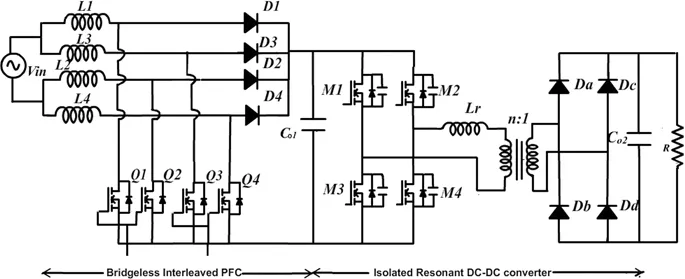
Many electric car charging solutions today are as easy as a car-to-grid link, with nothing else in between to tell either building managers or grid operators who charge when and how much electricity. But as electric cars become more popular, the need for building managers to be able to communicate with AC car chargers will grow as companies and residents try to juggle energy demands. Plug-in electric vehicle (EV) power conditioning system consists of an AC/DC boost rectifier accompanied by an independent DC/DC converter to charge a high-voltage battery bank. The front-end converter has PFC controller stage and the charger stage; the PFC stage is to enhance the input current quality received from the power supply and the charger stage is designed to energize the battery bank. Figure 1.1 shows the proposed charger for an EV. For the front-end PFC stage, boost converters with interleaving concept are generally used. In this paper, bridgeless interleaved (BLIL) boost AC/DC [1, 2, 3 and 4] converter is preferred. The main advantages of BLIL boost converter over conventional interleaved topology are increased converter’s efficiency, increased reliability of the system by device paralleling, increased output voltage ripple frequency, decreased voltage and current stresses in the power semiconductor devices, decreased input current ripple, reduced passive components, and EMI filter size. The current ripple at the input side is reduced by interleaving [5], and to ensure it, the gating pulses to the switches are given with a phase shift of 180°. Here, four-channel interleaving inductors are used to reduce the input current ripple, inductor size, and output current ripple.
shows the charger architecture with the front-end converter followed by isolated DC-DC converter. The output of the second-stage DC-DC converter is connected to a resistive load. Bridgeless interleaved PFC boost converter topology is chosen for the first stage, and the phase-shift isolated resonant DC-DC converter is given for the second stage.
FIGURE 1.1 Bridgeless AC/DC boost converter with the isolated resonant DC/DC converter.
The popular full bridge topology [6] is chosen as the second-stage DC/DC conversion because it is highly efficient with high power density and reliability. The isolated second stage is based on resonant and PWM topology. In the traditional resonant converters, to achieve zero voltage switching (ZVS) and zero current switching (ZCS) for the power semiconductor devices, a large value of reactive current distribution for wider load variation is required. This results in bulky resonant tank and low power density. To make this possible, auxiliary circuits for commutation have been reported in the literature [7, 8, 9, 10 and 11]. The major drawbacks of the conventional resonant converters are as follows: (i) ZVS for the lagging leg switches that are restricted for large load variations, (ii) immoderate conduction losses in passive intervals due to the circulating currents through the output inductor, and (iii) critical voltage overshoot and oscillation for diodes when the converter is operated at high voltage. Moreover, the numbers of components used in the traditional DC/DC converter are more ...

Table of contents

  1. Cover
  2. Half Title Page
  3. Title Page
  4. Copyright Page
  5. Table of Contents
  6. Preface
  7. Editors
  8. Contributors
  9. Chapter 1 Nonlinear Controller for Electric Vehicles in Smart Buildings
  10. Chapter 2 Guidance System for Smart Building Using Li-Fi
  11. Chapter 3 Smart Building Automation System
  12. Chapter 4 Semi-Autonomous Human Detection, Tracking, and Following Robot in a Smart Building
  13. Chapter 5 Current-Starved and Skewed Topologies of CNTFET-Based Ring Oscillators for Temperature Sensors
  14. Chapter 6 Efficient Data Storage with Tier IV Data Center in Smart Buildings
  15. Chapter 7 IoT-Based Data Collection Platform for Smart Buildings
  16. Chapter 8 Sensor Data Validation for IoT Applications
  17. Chapter 9 Energy Economic Appliances’ Scheduling for Smart Home Environment
  18. Chapter 10 IoT-Based Smart Metering
  19. Chapter 11 Smart Decentralized Control Approach for Energy Management in Smart Homes with EV Load
  20. Chapter 12 Design and Implementation of Prototype for Smart Home Using Internet of Things and Cloud
  21. Chapter 13 IoT Platform for Monitoring and Optimization of the Public Parking System in Firebase
  22. Chapter 14 IoT-Based Smart Health Monitoring System
  23. Chapter 15 Energy Management System for Smart Buildings: Mini Review
  24. Chapter 16 Augmented Lagrangian Model to Analyze the Synergies of Electric Urban Transport Systems and Energy Distribution in Smart Cities
  25. Chapter 17 Grid-Interconnected Photovoltaic Power System with LCL Filter Feasible for Rooftop Terracing
  26. Chapter 18 An Efficient ZCS-Based Boost Converter for Commercial Building Lighting Applications
  27. Chapter 19 Implementation of Smart Grids and Case Studies through ETAP in Commercial and Official Buildings
  28. Chapter 20 Data Logger-Aided Stand-Alone PV System for Rural Electrification
  29. Chapter 21 Smart Solar Modules for Smart Buildings
  30. Chapter 22 IoT-Based Smart Hand Sanitizer Dispenser (COVID-19)
  31. Index