Keeping in Tune with God is an essential resource for clergy and the people who love, work with, and care about them. Based on the tested wisdom of Listening Hearts discernment, the book provides clergy with encouraging words and practices to develop their relationships with God, their families and friends; to carry the practice of spiritual discernment into the life of their congregations; and to work more effectively with other leaders to nurture the life of Christ in the world around them.
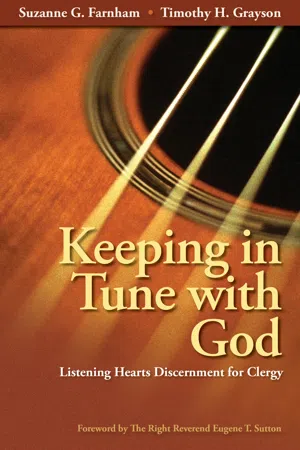
eBook - ePub
Keeping in Tune with God
Listening Hearts Discernment for Clergy
- 120 pages
- English
- ePUB (mobile friendly)
- Available on iOS & Android
eBook - ePub
Keeping in Tune with God
Listening Hearts Discernment for Clergy
About this book
Information
Topic
Theology & ReligionSubtopic
Christian MinistryPRACTICAL
SUGGESTIONS
Introduction
The nine chapters of this book explore basic principles of spiritual discernment, particularly as they apply to ordained ministers. These Appendices of Practical Suggestions lay out step-by-step ways for clergy and church leaders to integrate this practice of discernment into their lives and ministries, making use of two companion books, Listening Hearts: Discerning Call in Community by Farnham, Gill, McLean, and Ward, and Grounded in God: Listening Hearts Discernment for Group Deliberations by Farnham, Hull, and McLean.
Unfortunately, it is all too easy for busy clergy to become isolated from their congregations, as much as they might want to stay in tune with their members and God, for whom they have sacrificed so much to serve. The press of administrative duties, pastoral responsibilities, and the deadline for a Sunday sermon that seems to circle round more quickly each week all contribute to a hive of activity that allows little time for rest and reflection. Little by little, pastors can become consumed by the constant need to “do” rather than “be,” while opportunities to listen deeply to a person in need of counsel or a friendly chat grow increasingly rare.
As time to listen to others decreases, the ability to be present to people dissipates. Meanwhile, an alienation that seemingly comes from nowhere may slowly creep in to edge out what was once a quiet empathy. On a larger scale, an inability to listen to another person may easily be transmitted to the congregation as a whole, with potentially disastrous consequences. The people in the pews may believe their pastor has lost touch with them, and the pastor may feel that the people are shutting him out. In cases like these, and even in congregations where communications are good, it helps to have an instrument that will facilitate listening among all members of a faith community. This can also help them hear God’s call on their lives with more clarity. For this reason, the authors especially hope that Appendix 1, “Developing a Congregation that Listens to God and One Another,” will be a useful resource for pastors, who are directed to Grounded in God for more detailed information.
Each appendix outlines a workable way to move toward a specific goal. This does not mean that there is no other way to approach that objective. The purpose is to provide the reader with field-tested models from which to work. The guidelines can be adapted to accommodate the particular needs of a given person, group, or community.
Those who cultivate discerning communities mysteriously find themselves keeping in tune with God. If you have questions or concerns as you work with the ideas in these appendices, feel free to contact Listening Hearts Ministries at [email protected] or through the website, www.listeninghearts.org.
Appendix 1
Developing a Congregation that
Listens to God and One Another
Developing a Congregation that
Listens to God and One Another
Deep, prayerful listening is the bedrock of spiritual discernment. The Discernment Listening Guidelines, listed below and detailed in Appendix 1 of Grounded in God, can change the culture of an entire congregation or ministry if implemented with careful education and conscientious follow-up procedures:
DISCERNMENT LISTENING GUIDELINES
1. Take time to become settled in God’s presence.
2. Listen to others with your entire self (senses, feelings, intuition, imagination, and rational faculties).
3. Do not interrupt.
4. Pause between speakers to absorb what has been said.
5. Do not formulate what you want to say while someone else is speaking.
6. Speak for yourself only, expressing your own thoughts and feelings, referring to your own experiences. Avoid being hypothetical. Steer away from broad generalizations.
7. Do not challenge what others say.
8. Listen to the group as a whole—to those who have not spoken aloud as well as to those who have.
9. Generally, leave space for anyone who may want to speak a first time before speaking a second time yourself.
10. Hold your desires and opinions—even your convictions—lightly.
To effectively implement the above guidelines:
1. Begin by introducing them to the leadership of the congregation as follows:
• Assemble the group in a circle.
• Distribute copies of the guidelines to each member of the group. Attractive laminated copies can be purchased from Listening Hearts Ministries (www.listeninghearts.org).
• Going around the circle, each person in turn reads one guideline aloud. Pause between readers to give everyone time to assimilate the guideline as well as raise questions or concerns, and offer comments. Emphasize that it is important for people to speak up if they do not understand a guideline or do not agree with it. The objective is to develop a common understanding of the intent and value of each guideline. This usually takes about forty-five minutes, sometimes slightly less, occasionally much longer. It can be scheduled for a single meeting or can be spread over a number of consecutive meetings.
• After all of the guidelines have been processed, ask the group if it is willing to adopt them as group norms. If some members are reluctant, ask if they would be agreeable to using them for a specified period on a trial basis.
2. It is essential that everyone understand that each person has both the privilege and the responsibility of helping the group stay faithful to the guidelines. The convener of the meeting cannot effectively police the listening habits of the group. If everyone shares responsibility for the guidelines, working collaboratively in a way that is gentle, caring, and ever-vigilant, members will mature together as a listening community.
3. Once the group has agreed to use the guidelines at its meetings, it is important that participants read them aloud at the beginning of each meeting (each guideline read by a different person, with a pause between readers). Then, at the end of each meeting, build in a few minutes for members to consider how well they did at abiding by them.
4. Once the guidelines have been introduced to the leadership, introduce them in the same way to all of the groups that are part of the congregation.
5. After all of the groups are acquainted with the guidelines, introduce them to the congregation as a whole at Sunday services, in the church’s newsletter, in other printed materials, and on the church’s website. The senior minister may want to reinforce the importance of the guidelines by discussing them in a letter sent to all members. Posters of the guidelines can be displayed in appropriate places. A supply of laminated copies to use at meetings can be kept in convenient places.
Appendix 2
Ways to Enter the Flow of the Spirit
through Artistic Expression
Ways to Enter the Flow of the Spirit
through Artistic Expression
Through a disciplined prayer life, marked by humility before God and detached from the material, spiritual, and psychological sirens that distract and ensnare, ordained ministers can stay in tune with God. The Holy Spirit moving within them may manifest itself in new and unexpected forms, expressing itself in ways that are both surprising and liberating. Men and women who once felt no personal attraction to the worlds of literature, art, drama, and music may discover an unexpected channel within themselves that can enliven their relationship with God in innovative and dynamic ways.
When artistic expression springs forth from contemplative prayer, it almost always taps into the currents of God’s Holy Spirit. As we meditate on symbols that emerge from our time of prayer, we get in touch with deeper truths and unearth realities hitherto hidden from us. On occasion, profound transformation may occur. Simple procedures can provide a structure that invites the Spirit to flow freely, stimulates artistic expression, and brings forth God’s guidance for our lives.
Well ahead of time, assemble artistic materials that you may need for your time of meditation.
1. Let yourself become still. Try to let your muscles relax. Let your thoughts and feelings come to rest. Let God’s presence seep into your being. If you are unaccustomed to silence, begin by trying it for two minutes. Over time, gradually increase the time to five minutes and eventually to ten minutes.
2. Continue the silence, holding the current state of your life at the center of your being for a few minutes. If any specific issue or relationship is troubling you, let it emerge and come into focus. Carry this with you in your heart as you move into the Scripture.
3. Leaf through a Bible, looking for a passage, theme, image, or character that may speak to your situation. Perhaps read it in context, looking to see what precedes and follows it. Possibly locate parallel readings that tell the same story in different words or that have similar themes. If no Bible is available or if it is difficult to find a suitable passage, select one from the list at the end of these instructions.
4. Once the words permeate you, fall still and let your life situation and the Scripture simply envelop you.
5. Remain still until you feel moved to express yourself.
6. Whatever artistic medium you use, do not concern yourself with artistic merit. The objective is not to produce a product, but to open yourself to God so completely that you are revealing your inmost thoughts and feelings to God, and God has free access to your inmost parts.
7. Alternate between expressing yourself and being still with what you have expressed.
8. When finished, take time to reflect on your experience and ponder its message. If others are doing this meditation at the same time, take time to share the fruits of your meditation with the group, reverently listening to each other without comment.
9. Conclude with a short prayer or possibly with a hymn.
Here are some art forms you may want to try. It can be fruitful to try something you would not normally select. Sometimes God speaks most powerfully through unfamiliar channels.
• Draw. Use coloring pens, with a good selection of colors available. At the very least have red, yellow, blue, green, black, and brown. It is good to have both bold colors and pastels to choose from. Express yourself by the colors you choose and the movement of the pens. What you render may be either abstract or naturalistic.
• Write. You may write a stream of consciousness, a story, a poem, a hymn to a familiar tune, a letter to God, or a conversation between objects or characters in the Scripture. Do not worry about punctuation, spelling, grammar, or sentence structure. Try not to censor what you are writing. Just let the words tumble out.
• Modeling clay. Use real clay that is firm and can hold its shape, not Plasticine. You may pound, rip it open, or break it into small pieces. Or caress it, gently molding it. Consider using something like a chopstick or knitting needle to puncture or etch the surface. Let the clay speak to you by how it responds. For instance, if the clay is cold and hard when you begin and becomes more malleable from the warmth of your hands, that may say something to you. Clay offers a fluid way of meditating that can take you from one place to another, sometimes ending up in new and surprising territory. As you alternate between working with the clay and being still, let God mold you.
• Make a collage. Slowly and contemplatively, go about looking for items that express what you are sensing or feeling. In good weather, things from nature can be especially evocative. When you are finished collecting, meditatively arrange what you have found on construction paper, poster paper, fabric, or a board. As an alternative, you may reflectively look through magazines and picture calendars to find pictures and words that connect with your meditation. Cut them out and develop a collage by mounting images from the printed page on construction paper.
• Make a mobile. Wander about, indoors or out, looking for small objects, manufactured or natural, that speak to you as you hold your life situation and your Scripture text in your heart. As an alternative you may leaf through magazines, cutting out pictures and captions to which you gravitate. Mount the pictures on construction paper and, if you want, put them together to creat...
Table of contents
- Cover Page
- Title Page
- Copyright
- Contents
- About Listening Hearts Ministries
- Acknowledgments
- Foreword by The Rt. Rev. Eugene Taylor Sutton
- Introduction
- One The Demands of Ordained Ministry
- Two Opening Ourselves to God
- Three The Paradox of Humility
- Four The Paradox of Detachment
- Five Engaging the Rational Faculties
- Six Drawing upon Creativity and Imagination
- Seven Coming Together in the Spirit
- Eight Forging Deep Collegiality
- Nine The Springs of Spiritual Refreshment
- Appendices of Practical Suggestions
Trusted by 375,005 students
Access to over 1.5 million titles for a fair monthly price.
Study more efficiently using our study tools.
Frequently asked questions
Yes, you can cancel anytime from the Subscription tab in your account settings on the Perlego website. Your subscription will stay active until the end of your current billing period. Learn how to cancel your subscription
No, books cannot be downloaded as external files, such as PDFs, for use outside of Perlego. However, you can download books within the Perlego app for offline reading on mobile or tablet. Learn how to download books offline
We are an online textbook subscription service, where you can get access to an entire online library for less than the price of a single book per month. With over 1.5 million books across 990+ topics, we’ve got you covered! Learn about our mission
Look out for the read-aloud symbol on your next book to see if you can listen to it. The read-aloud tool reads text aloud for you, highlighting the text as it is being read. You can pause it, speed it up and slow it down. Learn more about Read Aloud
Yes! You can use the Perlego app on both iOS and Android devices to read anytime, anywhere — even offline. Perfect for commutes or when you’re on the go.
Please note we cannot support devices running on iOS 13 and Android 7 or earlier. Learn more about using the app
Please note we cannot support devices running on iOS 13 and Android 7 or earlier. Learn more about using the app
Yes, you can access Keeping in Tune with God by Suzanne G. Farnham,Timothy H. Grayson in PDF and/or ePUB format, as well as other popular books in Theology & Religion & Christian Ministry. We have over 1.5 million books available in our catalogue for you to explore.