eBook - ePub
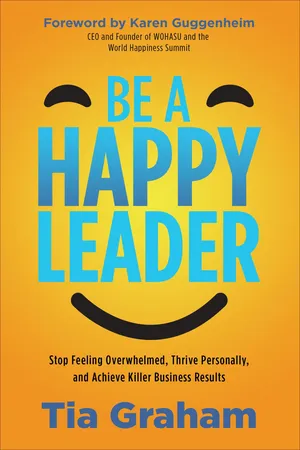
Be a Happy Leader
Stop Feeling Overwhelmed, Thrive Personally, and Achieve Killer Business Results
- English
- ePUB (mobile friendly)
- Available on iOS & Android
eBook - ePub
Be a Happy Leader
Stop Feeling Overwhelmed, Thrive Personally, and Achieve Killer Business Results
About this book
America and the Western world are facing an epidemic of disengaged, unhappy, and burnt-out leaders and in
Be a Happy Leader, Tia Graham utilizes her knowledge of positive psychology and unique 8-step business methodology to help leaders lead positively, put their people first, and create engaged teams leading to higher productivity and profit.
Information
Topic
Personal DevelopmentSubtopic
Management
CHAPTER 1:
The Calling of Leadership
What if you could create sustainable happiness and lifelong contentment? How many lives and careers could you positively impact if you had an exact methodology for success?
Do you wonder if you’re on the right leadership career path? Do you feel overwhelmed, stressed, and unsure if you have what it takes to be an incredible leader who is filled with joy and purpose?
I have been in that very situation several times throughout my 15-year career as a team leader. At a very young age, I was thrown into the water to sink or swim, so to speak, and became a leader. I was promoted by one of my mentors to be a director of sales and marketing at the age of twenty-six after being a manager for only one year. That mentor and others ensured that I did not drown, and I worked my tail off to make sure that I kept swimming. I led my first team to many successes, and I learned a lot of what not to do from that first role as well.
Deep down, I have always known that I wanted to be happy and enjoy life. I have also known that I truly enjoy working with and inspiring people, and that I was born to lead others. You might feel similarly. Just like every other leader, I have experienced the roller coaster of ups and downs throughout life. Along the way, I have learned and discovered incredible insights and strategies, and I am here to share them with you.
Happiness
You can absolutely create sustainable happiness in both your personal and professional life. By happiness, I don’t mean being filled with excitement, love, and joy every second of every day— it isn’t humanly possible. Every single human on this earth feels pain via stress, anger, fear, guilt, and sadness. What I mean by happiness is a commitment to your personal joy, contentment, and purpose while accepting the peaks and valleys of life. Happiness at life is about being resilient and appreciating all the incredible gifts that life has to offer. Happiness at work is knowing that you’re on the right path and working towards purposeful goals. It’s understanding that your work matters and that you make a difference. When you’re happy at work, you use your personal strengths and truly connect with those with whom you work. Again, it isn’t possible to be in a happy state every single day when you’re at work. However, when you are content while working, your good days outnumber the challenging ones, and the pleasant emotions outnumber the unpleasant feelings on average.
Everyone must work with difficult people every day. Currently, you might be dealing with a very distressing boss. Your peers and stakeholders might make you want to scream. Some of your direct reports might irritate you because they are your exact opposite, leaving you feeling that they’re misaligned or not on the same page as you at all. Dealing with such people drains your energy. Office politics exists in every organization. As a result, you must balance your own beliefs and conviction while continuously working on building and maintaining relationships with all those surrounding you.
The Demands of Leadership
As a leader in an organization, you might feel some, or all, of these emotions in your professional life right now: overwhelmed, overworked, unbalanced, uninspired, frustrated, and stressed. Are you unsure if you’re moving in the right direction with your career and your life overall? Have you landed in an industry where you’re unsure if it’s the right one for you? Do you find it challenging to align your team in order to exceed your annual targets? Maybe you wish you were living a healthier life. Are you stressed about your financial situation and wish that you had more money? Do you not get along with one or more colleagues, stakeholders, or maybe even your boss? It’s likely you simply want to be happier at work!
I understand the feeling of spinning your wheels for days, weeks, and months on end, not knowing when you will come up for air. I know how frustrating it is to work long hours and still not achieve the team results that you want and need. When the leadership challenges you face outweigh the number of successes you have, you might feel as if you are running on a hamster wheel—a very tiring and soul-crushing hamster wheel. When you put a tremendous amount of effort into your leadership role and don’t move forward at the speed you want and need, it’s frustrating and energy-depleting. Throughout this book, I will share several personal stories to show that you are not alone, and that you will never be alone.
As a leader striving for excellence and results, you likely feel acute pressure in life. You don’t want to disappoint your boss, the stakeholders, your peers, your team, your family, your friends, and, above all, yourself. The fear that you feel about not being successful in a leadership role can weigh very heavily on you. Throughout my leadership career, I’ve had days when I questioned, “Am I the right person for this job? Am I good enough?” Leaders spend time, effort, and resources studying, training, working, and building relationships so that they can become a team leader with large responsibilities.
As a Type A person with a tendency towards perfectionism, I didn’t want my loving and supportive parents to see me fail. The thought of disappointing my parents, myself, and, later on, my direct bosses kept me working long hours into the night on a weekly basis. As an adult, I chose a leadership career in sales and marketing. The stress of doing well and achieving goals has always been a constant in my adult life.
Being a leader today means juggling expectations, teams, technology, and never-ending demands. The volume of work can be overwhelming, the to-do list is continuously growing, and leaders are expected to always be available due to perpetually evolving technology and the glorification of “busy.” As a leader, you must constantly navigate office bureaucracy, which can slow you down or even bring you to a complete stop. It can be difficult to focus between 9:00 A.M. and 6:00 P.M. due to the overwhelming quantity of meetings, phone calls, and pop-up emergencies. Trying to balance being supportive and available for your team while moving your projects and work forward can be difficult, especially when you’re distracted by news, social media, text messages, email, and phone calls. Toss in dealing with demands from your boss, peers, stakeholders, and team members, and your daily work life can become overwhelming. It is likely rare, indeed, when you can find an hour to focus on a project in peace.
Is it a struggle to motivate, inspire, and retain your star team members? Do you worry that they may leave at some point in the near future? Or perhaps it has already occurred. Has one of your very best employees recently resigned, only to be hired by a competitor? Whenever that happens, physical, emotional, and psychological energy is sucked right out of your body, mind, and spirit. As a passionate and engaged leader, having the right people in the right positions moving forward together fills you with energy for your work. It is detrimental when a valued team member goes to a competitor because it lowers the morale of the team, sets you back in terms of productivity, and is costly to recruit, hire, and train a new team member.
Are several members on your team mediocre? Are they showing up and working but are nowhere near giving it their all? Do they have what it takes to transform into star team members? Some may simply not be the right fit, perhaps inherited from your predecessor’s team, leaving you to wonder how they lasted so long in the organization. You might be unsure how, when, and if you can even manage to remove ineffective people from your team. Perhaps it’s daunting to fathom even recruiting and hiring anyone better.
Your given goals could be unrealistic. So, not only are you thinking, “How am I ever going to achieve them?” but your mind could also be filled with thoughts like “How am I going to convince my team that we can achieve these goals?”
Personal Well-Being
Right now, happiness and purpose in your personal life and work are needed more than ever. Personal well-being is crucial to successful and impactful leadership. Without it, it’s extremely hard for a leader to become the person that they’ve envisioned. Work has always challenged team leaders, but nowadays additional obstacles exist in work and personal life. Leaders are expected to surpass goals, be continuously innovative, and have high employee engagement. Tremendous value is placed on material wealth and status, and everyone must constantly drive to achieve more. We are bombarded with negative news media 24/7 via our smartphones, which creates a lifestyle where we’re always distracted and receiving content whether we like it or not, no matter where we are. As the work volume grows, it becomes even more difficult to focus on what needs to be focused on.
Families are spread out geographically, and time for friendships is reduced. Grocery stores are jam-packed with prepackaged foods that are highly processed, full of sugar, and genetically modified. These foods make us think that we are happy, yet they hurt our physical bodies. The convenience of life makes it challenging to have the desire or need to move. We can receive anything with a few clicks, why we would walk anywhere? The state of the planet is depressing and feels hopeless, along with a huge laundry list of other international issues that exist. While society is more connected than ever before, it is easy and common to feel isolated in today’s world. Anxiety and depression are increasing among both children and adults, yet all everyone wants to feel is happy and successful.
Do you truly want to be a thriving, accomplished leader? Do you want to put in the effort of self-discovery and professional development? Now is the time to prioritize your personal well-being and learn how to become a happy and successful leader! If not now, when?
Be A Happy Leader
I have created the Be a Happy Leader methodology to give you the exact strategies and tools to incorporate into your life to help you not only be happy in your personal life, but also be happy and successful in your career. Using my strategies and tactics, you can learn how to be a positive leader, to impact your direct reports and colleagues, and to achieve wildly successful business results.
My Personal Career History
Everyone must start somewhere. I began my work life as a fast-food worker at Dairy Queen and as a part-time babysitter. I also sold shoes in a department store and collected lift tickets at a ski resort. At the age of 18, I was fired from my job at a pizza restaurant because I was ill-suited for the position at the time and did not take it seriously. It was a great lesson for me. I learned that if you are not serious about a position, there are real consequences, and I felt the embarrassment of not succeeding at a role.
Some of my bosses have been inspirational and strong, while others have been demoralizing and manipulative. My physical work environments have been both extremely ugly and energy-sucking to really beautiful and calming. Some members of my teams have had attitudes, personality conflicts, and have made judgment errors. Some of my team members have been the strongest and most incredible people that I’ve ever met. I’ve been stressed out and anxiety ridden. I’ve fumed at decisions that owners and stakeholders have made. There were many long days and even longer nights. Yet, I’ve always known that I wanted to be a leader and took it very seriously. I believe being a leader doesn’t have to be extremely hard; it can, in fact, be a ton of fun! Know that I am here for you and with you. At times, I have questioned myself as a leader but continued on the path because of the calling to lead and inspire people.
My hope is that you live with contentment, purpose, and joy. My goal is that you are successful in all areas of your life and positively impact every single person that you lead.
Maslow’s Hierarchy of Needs
When people are in a state where they’re trying only to get their needs met, they are not trying to also feel happy every day. If a person doesn’t have shelter or enough food to eat and is worried about personal safety, they’re focused only on making decisions to meet their needs. In order for people to prioritize their personal well-being and focus on being happy, their needs must be met first. Per Abraham Maslow’s “hierarchy of needs,” human beings start thinking about actualizing their potential only once their basic needs are met.
Unfortunately, misconceptions and myths abound as to what makes us happy and content with our lives.
Money and Happiness
A glaring misconception is that most people believe that when they have more money, they will be happier. Since childhood, this message has been continuously reinforced by our parents, other family members, friends, and society. We receive it consistently from the media, especially social media, and via marketing messages. Various studies have been completed on happiness and money. One study showed that experiential purchases (money spent on doing) tend to provide more enduring happiness than material purchases (money spent on having). The researchers demonstrate that waiting for experiences tends to be more positive, pleasurable, and exciting than waiting for possessions.1 Another study demonstrated that experiential purchases enhance social relations more readily and effectively than material goods, form a bigger part of a person’s identity, and are evaluated more on their own terms and evoke fewer social comparisons than material purchases.2 It is also interesting to note that people who spend money on others report greater happiness than if they are spending it on themselves. The benefits of such prosocial spending emerge among adults around the world, and the warm glow of giving can be detected even in toddlers.3 Martin Seligman, PhD, the “father of positive psychology,” teaches about the hedonic treadmill, also known as the hedonic adaptation. A former president of the American Psychological Association, he is called the father of Positive psychology because his primary aim has been the promotion of the field of what makes humans thrive and what makes life worth living. He has spent his life expanding the research to the areas of education, health, and neuroscience.
The hedonic treadmill demonstrates that once people are living in a relatively comfortable financial position, more money does not necessarily equal a large increase in their personal happiness. For example, in the United States, when a single person is making $75,000 annually, any additional income adds only a small incremental increase in happiness. Let’s say said person receives a $15,000 salary increase. What the hedonic treadmill reveals is that he’ll have a spike in his pleasant emotions for three to four months, and then he’ll return to his resting level of happiness—his happiness baseline. This same phenomenon occurs when a person making over the annual amount spends money to buy a new car. She’ll feel her happiness and pleasant emotions increase temporarily, then she’ll return to how she felt prior to the purchase.
This isn’t to say that individuals shouldn’t be ambitious or not want to prosper in their careers. What it does demonstrate is that financial success is not the sole path to happiness. However, young people and adults consistently receive the strong message that “if you become ‘successful,’ you’ll be happy,” which isn’t necessarily the case.
Another misconception is that status, titles, and power are highly correlated with happiness. Studies show that people who are in places of wealth are slightly happier than the less fortunate, but it is marginally incremental. High income buys life satisfaction, the thoughts people have when they think about their life, but not emotional well-being, the emotional quality of an individual’s everyday experience.4 Many extremely wealthy and powerful people are miserable inside. However, if your status, title, and/or power are by-products of a personally meaningful pursuit, your happiness will definitely increase due to your purposeful journey, achieving the meaningful goals along the way, and the impact that you make.
My Happiness Mission
You might be wondering why I ventured into so much investigation about one core question: What makes people happy?
I was blessed with two loving parents and had a loving family. I was a happy-go-lucky child with a natural sunny disposition and always thrived when I was around other people. I grew up at a small local ski area in the Pine Pass in Northern British Columbia, Canada. The closest town was a 45-minute drive away, and the average temperature in the winter was -20°F. We didn’t have a phone or television in our log cabin until I was 5 years old, and I took a school bus through the Rocky Mountains to elementary school. I’ve always felt very grateful for my experiences in life, and part of it might be due to the fact that I grew up in the middle of a forest! My parents separated when I was 10 and then divorced a few years afterward. My entire family moved to Kelowna, British Columbia, Canada, after their separation.
Like most people, I didn’t have a perfect childhood. In addition to the regular challenges faced by any child, I grew up in two households. I didn’t feel extremely happy as a young adult because I felt unconnected ...
Table of contents
- Cover
- Title
- Copyright
- Table of Contents
- Acknowledgments
- Additional Resources
- Note from the Author
- Foreword By Karen Guggenheim
- Chapter 1: The Calling of Leadership
- Chapter 2: Positive Leadership: What’s at Stake?
- Chapter 3: A Desire for More
- Chapter 4: The Possibility
- Chapter 5: Be A Happy Leader Methodology
- Chapter 6: Step One—Start with You
- Chapter 7: Step Two—Zoom Out
- Chapter 8: Step Three—Execute Brilliantly
- Chapter 9: Step Four—Prioritize Relationships Over To-Do Lists
- Chapter 10: Step Five—Your Number One Priority
- Chapter 11: Step Six—Measure to Excel
- Chapter 12: Step Seven—Be the Spark
- Chapter 13: Step Eight—Master Your Mindset
- Chapter 14: The Ripple Effect
- About the Author
- Endnotes
Trusted by 375,005 students
Access to over 1.5 million titles for a fair monthly price.
Study more efficiently using our study tools.
Frequently asked questions
Yes, you can cancel anytime from the Subscription tab in your account settings on the Perlego website. Your subscription will stay active until the end of your current billing period. Learn how to cancel your subscription
No, books cannot be downloaded as external files, such as PDFs, for use outside of Perlego. However, you can download books within the Perlego app for offline reading on mobile or tablet. Learn how to download books offline
Perlego offers two plans: Essential and Complete
- Essential is ideal for learners and professionals who enjoy exploring a wide range of subjects. Access the Essential Library with 800,000+ trusted titles and best-sellers across business, personal growth, and the humanities. Includes unlimited reading time and Standard Read Aloud voice.
- Complete: Perfect for advanced learners and researchers needing full, unrestricted access. Unlock 1.5M+ books across hundreds of subjects, including academic and specialized titles. The Complete Plan also includes advanced features like Premium Read Aloud and Research Assistant.
We are an online textbook subscription service, where you can get access to an entire online library for less than the price of a single book per month. With over 1.5 million books across 990+ topics, we’ve got you covered! Learn about our mission
Look out for the read-aloud symbol on your next book to see if you can listen to it. The read-aloud tool reads text aloud for you, highlighting the text as it is being read. You can pause it, speed it up and slow it down. Learn more about Read Aloud
Yes! You can use the Perlego app on both iOS and Android devices to read anytime, anywhere — even offline. Perfect for commutes or when you’re on the go.
Please note we cannot support devices running on iOS 13 and Android 7 or earlier. Learn more about using the app
Please note we cannot support devices running on iOS 13 and Android 7 or earlier. Learn more about using the app
Yes, you can access Be a Happy Leader by Tia Graham in PDF and/or ePUB format, as well as other popular books in Personal Development & Management. We have over 1.5 million books available in our catalogue for you to explore.