Deep Learning Approaches to Cloud Security
  1. English
  2. ePUB (mobile friendly)
  3. Available on iOS & Android
eBook - ePub

About this book

DEEP LEARNING APPROACHES TO CLOUD SECURITY

Covering one of the most important subjects to our society today, cloud security, this editorial team delves into solutions taken from evolving deep learning approaches, solutions allowing computers to learn from experience and understand the world in terms of a hierarchy of concepts, with each concept defined through its relation to simpler concepts.

Deep learning is the fastest growing field in computer science. Deep learning algorithms and techniques are found to be useful in different areas like automatic machine translation, automatic handwriting generation, visual recognition, fraud detection, and detecting developmental delay in children. However, applying deep learning techniques or algorithms successfully in these areas needs a concerted effort, fostering integrative research between experts ranging from diverse disciplines from data science to visualization. This book provides state of the art approaches of deep learning in these areas, including areas of detection and prediction, as well as future framework development, building service systems and analytical aspects. In all these topics, deep learning approaches, such as artificial neural networks, fuzzy logic, genetic algorithms, and hybrid mechanisms are used. This book is intended for dealing with modeling and performance prediction of the efficient cloud security systems, thereby bringing a newer dimension to this rapidly evolving field.

This groundbreaking new volume presents these topics and trends of deep learning, bridging the research gap, and presenting solutions to the challenges facing the engineer or scientist every day in this area. Whether for the veteran engineer or the student, this is a must-have for any library.

Deep Learning Approaches to Cloud Security:

  • Is the first volume of its kind to go in-depth on the newest trends and innovations in cloud security through the use of deep learning approaches
  • Covers these important new innovations, such as AI, data mining, and other evolving computing technologies in relation to cloud security
  • Is a useful reference for the veteran computer scientist or engineer working in this area or an engineer new to the area, or a student in this area
  • Discusses not just the practical applications of these technologies, but also the broader concepts and theory behind how these deep learning tools are vital not just to cloud security, but society as a whole

Audience: Computer scientists, scientists and engineers working with information technology, design, network security, and manufacturing, researchers in computers, electronics, and electrical and network security, integrated domain, and data analytics, and students in these areas
Tools to learn more effectively

Saving Books

Saving Books

Keyword Search

Keyword Search

Annotating Text

Annotating Text

Listen to it instead

Listen to it instead

1
Biometric Identification Using Deep Learning for Advance Cloud Security

Navani Siroya1* and Manju Mandot2
1 MDS University Ajmer, India
2 Computer Science, JRN Rajasthan Vidyapeeth University, Udaipur, India
* Corresponding author: [email protected]
Abstract
A few decades ago, biometric identification was a staple technology of highly advanced security systems in movies, but today, it exists all around us. Biometric technologies have the potential to revolutionize approaches to identity verification worldwide.
This chapter discusses the prevailing Biometric modalities, their classification, and their working. It goes on to discuss the various approaches used for Facial Biometric Identification such as feature selection, extraction, face marking, and the Nearest Neighbor Approach.
Here, we propose a system that compares an input image with that of the database in order to detect the presence of any similarities. Moreover, we use fiducially point analysis to extract facial landmarks and compare them with the database using data mining and use the Nearest Neighbor Approach for identifying similar images.
The chapter ends with deliberations on the future extent of Biometric technologies and the need to put in ample safeguards for data protection and privacy.
Keywords: Biometric, feature extraction, facial recognition, nearest neighbor approach

1.1 Introduction

Biometric authentication is a security process that relies on the unique biological characteristics of a person in order to affirm their identity. Biometric verification frameworks compare biometric data with existing original datasets that are stored. Examples of biometric characteristics include iris, palm print, retina, fingerprint, face, and voice signature. In recent years, deep learning-based models have helped accomplish best in class results in machine vision, audio recognition, and natural language processing tasks. These models appear to be a characteristic fit for dealing with the everexpanding size of biometric acknowledgment issues, from phone verification to air terminal security frameworks. Thus, application of machine learning techniques to biometric security arrangements has become a trend [1].
Classification of Biometric Data:
  • • Behavioral Biometrics: gestures, vocal recognition, handwritten texts, walking patterns, etc.
  • • Physical Biometrics: fingerprints, iris, vein, facial recognition, DNA, etc.
Data science consultants can use machine learning’s capacity to mine, look, and examine huge datasets for improving the execution of security frameworks and their reliability.
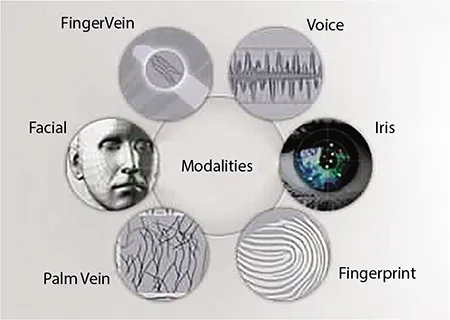
In light of its exceptional capacity to recognize people, biometric innovation has quickly become a way to help forestall shams and discovered its place in today’s standard advancements. Consequently, it turns out to be more reliable than the customary validation frameworks that utilize passwords and documents for verification shown in Figure 1.1.
Schematic illustration of biometric modalities.
Figure 1.1 Biometric modalities [2].
Physical modalities like fingerprints, voice, faces, veins, iris, hand geometry, and tongue print are unique and provide robust advancements in the field of cyber security [2]. They are useful compared to names, ID numbers, passwords, etc. because they are extraordinary, hard to reproduce, and are more significantly and genuinely bound to the individual.
A computing model which gives on-demand services like information stockpiling, computer power, and infrastructure to associations in the IT industry is termed to be ā€œcloud computingā€ [3]. Despite the fact that cloud offers a ton of advantages, it slacks in giving security which is an issue for most clients. Cloud clients are hesitant to put classified information up because of looming threats to security.

1.2 Techniques of Biometric Identification

1.2.1 Fingerprint Identification

An automated technique for recognizing or affirming the identity of an individual dependent on the examination of two fingerprints is termed as Fingerprint Recognition. Human fingerprints are not easy to manipulate and are nearly unique and durable over a person’s lifetime. They are unique, permanent, easy to acquire, and are a universally acceptable mode of identification [4].
Human fingerprints are difficult to control but remain sturdy over the life of an individual, making them suitable as long stretch markers of human character.
WORKING OF DIFFERENT TYPES OF FINGERPRINT READERS
  1. 1. Optical Readers’ sensors work using a 2D image of the fingerprint. Algorithms can be utilized to discover novel patterns of lines and edges spread across lighter and hazier zones of the picture
  2. 2. Capacitive Readers use electrical signals to form the image of fingerprints. As the charges differ in the air gap between the ridges and lines in the finger set over the capacitive plate, it causes a difference in the fingerprint patterns.
  3. 3. Ultrasound Readers use high frequency sound waves to infiltrate the external layer of the skin which is used to capture a 3D depiction of the fingerprint. It involves the use of ultrasonic pulses using ultrasonic transmitters and receivers.
  4. 4. Thermal Readers sense the temperature difference between fingerprint valleys and ridges on making a contact. Higher power consumption and a performance reliant on the surrounding temperature are impediments for these readers.

1.2.2 Iris Recognition

The iris is a shaded, flimsy, roundabout structure of the eye which controls light entering the retina by regulating the diameter and size of the pupil. It doesn’t change its appearance over a range of an individual’s lifetime except if harmed by external components [5]. Hereditarily indistinguishable twins also have distinctive iris designs. The irises of two eyes of an individual are also unique. Iris recognition is an automated method of identifying unique intricate patterns of an individual’s iris using mathematical pattern-recognition techniques.
WORKING OF IRIS READERS
  1. 1. Scan an individual’s eyes with subtle infrared illumination to obtain detailed patterns of iris.
  2. 2. Isolate iris pattern from the rest of the picture, analyze, and put in a system of coordinates.
  3. 3. Coordinates are removed using computerized data and in this way an iris mark is produced.
Even on disclosure, one cannot restore or reproduce such encrypted iris signatures. Now the user just needs to look at the infrared camera for verification. Iris acknowledgment results in faster coordination and is extremely resistant to false matches.

1.2.3 Facial Recognition

A non-intrusive technique to capture physical traits without contact and cooperation from people discovers its application in the acknowledgment framework. Every face can be illustrated as a linear combination of singular vectors of sets of faces. Thus, Principal Component Analysis (PCA) can be used for its implementation. The Eigen Face Approach in PCA can be utilized as it limits the dimensionality of a data set, consequently upgrading computational productivity [6].
WORKING OF FACIAL RECOGNITION TECHNIQUE:
Facial recognition technology identifies up to 80 factors on a human face to identify unique features. These factors are endpoints that can measure variables of a person’s face, such as the length or width of the nose, the distance between the eyes, the depth of the eye sockets and the shape and size of the mouth. In order to measure such detailed factors, complexities such as aging faces arise. To solve this, computers have learned to look closely at the features that remain relatively unchanged no matter how old we get. The framework works by capturing information ...

Table of contents

  1. Cover
  2. Table of Contents
  3. Title Page
  4. Copyright
  5. Foreword
  6. Preface
  7. 1 Biometric Identification Using Deep Learning for Advance Cloud Security
  8. 2 Privacy in Multi-Tenancy Cloud Using Deep Learning
  9. 3 Emotional Classification Using EEG Signals and Facial Expression: A Survey
  10. 4 Effective and Efficient Wind Power Generation Using Bifarious Solar PV System
  11. 5 Background Mosaicing Model for Wide Area Surveillance System
  12. 6 Prediction of CKD Stage 1 Using Three Different Classifiers
  13. 7 Classification of MRI Images to Aid in Diagnosis of Neurological Disorder Using SVM
  14. 8 Convolutional Networks
  15. 9 Categorization of Cloud Computing & Deep Learning
  16. 10 Smart Load Balancing in Cloud Using Deep Learning
  17. 11 Biometric Identification for Advanced Cloud Security
  18. 12 Application of Deep Learning in Cloud Security
  19. 13 Real Time Cloud Based Intrusion Detection
  20. 14 Applications of Deep Learning in Cloud Security
  21. About the Editors
  22. Index
  23. End User License Agreement

Frequently asked questions

Yes, you can cancel anytime from the Subscription tab in your account settings on the Perlego website. Your subscription will stay active until the end of your current billing period. Learn how to cancel your subscription
No, books cannot be downloaded as external files, such as PDFs, for use outside of Perlego. However, you can download books within the Perlego app for offline reading on mobile or tablet. Learn how to download books offline
Perlego offers two plans: Essential and Complete
  • Essential is ideal for learners and professionals who enjoy exploring a wide range of subjects. Access the Essential Library with 800,000+ trusted titles and best-sellers across business, personal growth, and the humanities. Includes unlimited reading time and Standard Read Aloud voice.
  • Complete: Perfect for advanced learners and researchers needing full, unrestricted access. Unlock 1.4M+ books across hundreds of subjects, including academic and specialized titles. The Complete Plan also includes advanced features like Premium Read Aloud and Research Assistant.
Both plans are available with monthly, semester, or annual billing cycles.
We are an online textbook subscription service, where you can get access to an entire online library for less than the price of a single book per month. With over 1 million books across 990+ topics, we’ve got you covered! Learn about our mission
Look out for the read-aloud symbol on your next book to see if you can listen to it. The read-aloud tool reads text aloud for you, highlighting the text as it is being read. You can pause it, speed it up and slow it down. Learn more about Read Aloud
Yes! You can use the Perlego app on both iOS and Android devices to read anytime, anywhere — even offline. Perfect for commutes or when you’re on the go.
Please note we cannot support devices running on iOS 13 and Android 7 or earlier. Learn more about using the app
Yes, you can access Deep Learning Approaches to Cloud Security by Pramod Singh Rathore, Vishal Dutt, Rashmi Agrawal, Satya Murthy Sasubilli, Srinivasa Rao Swarna, Pramod Singh Rathore,Vishal Dutt,Rashmi Agrawal,Satya Murthy Sasubilli,Srinivasa Rao Swarna in PDF and/or ePUB format, as well as other popular books in Technology & Engineering & Electrical Engineering & Telecommunications. We have over one million books available in our catalogue for you to explore.