Starting With Shares
eBook - ePub

Starting With Shares

A Beginner's Guide to Sharemarket Success

  1. English
  2. ePUB (mobile friendly)
  3. Available on iOS & Android
eBook - ePub

Starting With Shares

A Beginner's Guide to Sharemarket Success

About this book

Your no-nonsense guide to trading shares and succeeding on the share market 

Starting your share investing journey is easier than you might think. You don't need a heap of capital, just a few basic rules and strategies. 

In Starting With Shares you'll take your first steps toward building a profitable, sustainable portfolio. Written for beginners and packed with informative illustrations, straightforward tips and proven techniques, this essential guide will help you to become an effective and financially successful share investor.  

From Roger Kinsky, Australia's foremost share-investing educator and the best-selling author of Teach Yourself About Shares and Online Investing on the Australian Sharemarket, this guidebook will show you the simplest ways to make money from shares and protect your hard-earned dollars in the process! 

Unlike most sharemarket guides, this book explains in simple language all the stock market terms and definitions you need to know, with uncomplicated tips and straightforward strategies for earning returns. Learn how to get started and get ahead, buy and sell shares, build a portfolio, manage risk, deal with dividends and choose the best shares. 

Intimidated by jargon and unsure about where to start? Starting With Shares is a unique book that is shorter, simpler and more visual than other trading and investing resources, making it an excellent choice for you if you have little or no prior sharemarket knowledge.  

  • Learn to buy and sell shares from the best-selling author of Teach Yourself About Shares 
  • Start investing right away, even if you are an absolute novice with no knowledge of the markets 
  • Appreciate the simple, accessible explanations and informative illustrations of share investing basics 
  • Discover uncomplicated strategies that you can use for long-term investing success 

In Starting With Shares, you'll not only learn how to start your share investing journey, but you'll discover how to maximise your profitability into the future. 

Trusted by 375,005 students

Access to over 1.5 million titles for a fair monthly price.

Study more efficiently using our study tools.

Information

Publisher
Wiley
Year
2021
Print ISBN
9780730395164
eBook ISBN
9780730395188

Chapter 1
What you need to know

In this chapter, I outline what you really need to know about investing in shares so you can get started, covering market unpredictability, the relationship between risk and reward, and what you're actually investing in when you buy shares. I also highlight some of the stuff you don't really need. Are you surprised at that? You might think that the more you know about shares, the greater the profit you'll make when you invest in them. Actually, no evidence indicates that ‘more’ information is necessarily better; in fact, ‘more’ can be worse because you can get bogged down in detail and miss the important stuff. And, as I explain, some great share investing strategies are based on very simple ideas that anyone can apply.
Before I go too much further, however, I'd like you to meet someone who you'll see a lot of through this book.

Meet Michelle

In most cases, when financial decisions are involved a bias exists toward the male gender. Company directors and top executives are still predominantly male. And most finance books still seem to assume that the reader is male. In this book, I try to avoid gender discrimination and, because of the current bias toward males, I have deliberately used a female named Michelle in my illustrations. She appears in most of the illustrations in this book, guiding you through your introduction to share investing.
image
‘Hi! I'm Michelle. I'll be accompanying you on your journey.’
Sorry fellas, I have nothing against the male gender but women are fast becoming a force in the financial arena. By the way, studies have shown that when it comes to share investing, women are more successful than men. I explain why in chapter 5.

Trust yourself

When it comes to share investing, I want you to trust yourself and not think you need to rely on others such as share investment advisors. Many people feel like ‘dunces’ when it comes to share investing — even those with a good education. This means people often rely on investment advisors or share advisors who they believe are experts in the field — and who usually charge a hefty fee for service.
However, from my own personal experience, acquired over 50‐odd years of share investing, I have found that the results don't always justify the cost. In fact, my most disastrous share investments occurred as a result of following recommendations. Now I no longer act on advice without first putting it through the ‘grist of the mill of my own mind’ and coming to my own conclusions.
I wrote this book so I could explain the basic principles of share investing in a way you can understand so you won't need to seek ‘expert’ advice. Believe me, most ordinary people have the necessary nous to be successful share investors once they grasp the basic principles. If you ignore the hype and jargon, ‘it really ain't that hard’. You won't always be right and not all your share investments will be profitable, but you can take heart in the fact that no person and no computer program can make profitable predictions about shares that are always right.

Knowledge level you'll need

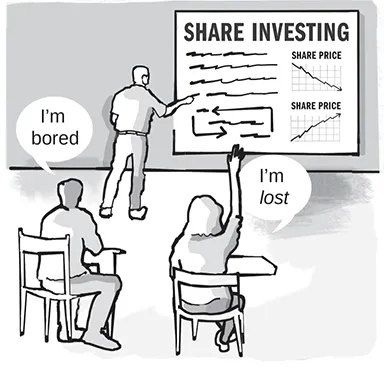
I have written many non‐fiction books over the past 50 years, and taught many classes on subjects ranging from engineering theory to shares. When I start teaching a new class or writing a new book, I face the difficulty of determining the knowledge level of the students or readers who want to learn. If I pitch the starting point too high, those who don't have the pre‐requisite knowledge get lost at the start and have to try to catch up. But starting from behind isn't a good idea when learning a new skill or acquiring new knowledge because you have to learn the old stuff at the same time as you are trying to absorb the new.
image
‘How am I going to catch up?’
On the other hand, if I pitch the beginning point too low, those who already know a fair bit get bored and can easily lose interest. After all, if someone is going to learn something new they need to be interested.
My publishers and I decided to pitch this book about shares at the beginner level — which explains the title ‘Starting with Shares’. I've been faithful to the title and assumed you know very little about shares, and have made that my starting point. You can find plenty of books about shares and lots of info is available on the internet, but the problem with most of these sources is that they usually assume the reader already knows a fair bit about shares — certainly enough to understand the terminology. In this book, I explain everything in a way that you can understand even if you know virtually nothing about shares. As far as possible, I avoid the use of jargon — although I do have to use some of the terms commonly used with shares because you need to understand them to find your way. But before I use a term that might be unfamiliar to you, I explain it first in everyday, straightforward language.
image
If you already know a fair bit about shares, you may want to skim over some of the content in the early chapters. But there's an inherent danger in this that I now discuss.

Types of knowledge

Knowledge comes in several types. One type is the knowledge you know you don't know. For example, you may be aware that you don't know much about servicing or repairing a car. So when your car needs servicing or has some problem, you take it to a mechanic who has the required knowledge and can service or repair your car. But there may also be a whole mountain of knowledge out there that you don't know you don't know. This is called blissful ignorance, because you don't worry about things you don't know about. For example, your car could have a fault that you're not aware of and so you keep driving the car until the fault gets worse. One day you notice the problem and take your car to your mechanic. The mechanic may say something like, ‘Well, if you had brought the car in to me earlier I could have fixed the problem easily and cheaply, but now it's a big and expensive fix’. The reason you didn't bring the car in earlier was because you weren't aware of the problem.
When it comes to shares, you may be aware of your lack of knowledge in certain areas but you might also have a lack of knowledge in areas you're not even aware of and that might cause problems.
Finally, there is knowledge you think you know but really don't — and this can be very dangerous. For example, when I first bought a yacht and started cruising, the yacht once ran aground during the night. I'd thought I knew how to anchor a yacht safely but, in fact, I wasn't following the best procedure at all and when the wind changed unexpectedly while I was asleep I ended up in trouble.
That's why I suggest you don't fast‐forward through the early chapters without at least skim reading first to ensure you aren't skipping over something you really don't understand.

How long is the journey?

You're probably wondering how far we're going to go and what y...

Table of contents

  1. Cover
  2. Table of Contents
  3. Title page
  4. Copyright
  5. Introduction
  6. Chapter 1: What you need to know
  7. Chapter 2: Getting into shares
  8. Chapter 3: Profiting from shares
  9. Chapter 4: Is share investing gambling?
  10. Chapter 5: Benefits and pitfalls of share investing
  11. Chapter 6: Sectors and shares for your portfolio
  12. Chapter 7: Setting up to trade
  13. Chapter 8: Getting to know your shares
  14. Chapter 9: Getting your timing right
  15. Chapter 10: Buying and selling shares
  16. Chapter 11: Managing your shares
  17. Chapter 12: Turbocharging your share investment
  18. Chapter 13: Let's recap
  19. Go for it!
  20. Appendix: Details of my portfolio spreadsheet
  21. Index
  22. End User License Agreement

Frequently asked questions

Yes, you can cancel anytime from the Subscription tab in your account settings on the Perlego website. Your subscription will stay active until the end of your current billing period. Learn how to cancel your subscription
No, books cannot be downloaded as external files, such as PDFs, for use outside of Perlego. However, you can download books within the Perlego app for offline reading on mobile or tablet. Learn how to download books offline
We are an online textbook subscription service, where you can get access to an entire online library for less than the price of a single book per month. With over 1.5 million books across 990+ topics, we’ve got you covered! Learn about our mission
Look out for the read-aloud symbol on your next book to see if you can listen to it. The read-aloud tool reads text aloud for you, highlighting the text as it is being read. You can pause it, speed it up and slow it down. Learn more about Read Aloud
Yes! You can use the Perlego app on both iOS and Android devices to read anytime, anywhere — even offline. Perfect for commutes or when you’re on the go.
Please note we cannot support devices running on iOS 13 and Android 7 or earlier. Learn more about using the app
Yes, you can access Starting With Shares by Roger Kinsky in PDF and/or ePUB format, as well as other popular books in Personal Development & Personal Finance. We have over 1.5 million books available in our catalogue for you to explore.