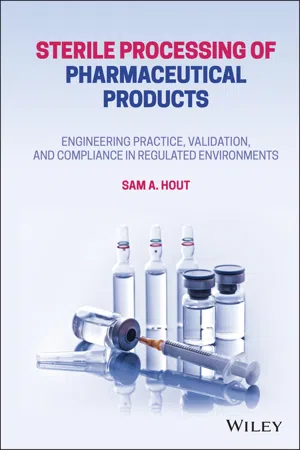
Sterile Processing of Pharmaceutical Products
eBook - ePub

Sterile Processing of Pharmaceutical Products

Engineering Practice, Validation, and Compliance in Regulated Environments

  1. English
  2. ePUB (mobile friendly)
  3. Available on iOS & Android
eBook - ePub

Sterile Processing of Pharmaceutical Products

Engineering Practice, Validation, and Compliance in Regulated Environments

About this book

Describes the methodologies and best practices of the sterile manufacture of drug products

Thoroughly trained personnel and carefully designed, operated, and maintained facilities and equipment are vital for the sterile manufacture of medicinal products using aseptic processing. Professionals in pharmaceutical and biopharmaceutical manufacturing facilities must have a clear understanding of current good manufacturing practice (cGMP) and preapproval inspection (PAI) requirements.

Sterile Processing of Pharmaceutical Products: Engineering Practice, Validation, and Compliance in Regulated Environments provides up-to-date coverage of aseptic processing techniques and sterilization methods. Written by a recognized expert with more than 20 years of industry experience in aseptic manufacturing, this practical resource illustrates a comprehensive approach to sterile manufacturing engineering that can achieve drug manufacturing objectives and goals. Topics include sanitary piping and equipment, cleaning and manufacturing process validation, computerized automated systems, personal protective equipment (PPE), clean-in-place (CIP) systems, barriers and isolators, and guidelines for statistical procedure. Offering authoritative guidance on the key aspects of sterile manufacturing engineering, this volume:

  • Covers fundamentals of aseptic techniques, quality by design, risk assessment and management, and operational requirements
  • Addresses various regulations and guidelines instituted by the FDA, ISPE, EMA, MHRA, and ICH
  • Provides techniques for systematic process optimization and good manufacturing practice
  • Emphasizes the importance of attention to detail in process development and validation
  • Features real-world examples highlighting different aspects of drug manufacturing

Sterile Processing of Pharmaceutical Products: Engineering Practice, Validation, and Compliance in Regulated Environments is an indispensable reference and guide for all chemists, chemical engineers, pharmaceutical professionals and engineers, and other professionals working in pharmaceutical sciences and manufacturing.

Frequently asked questions

Yes, you can cancel anytime from the Subscription tab in your account settings on the Perlego website. Your subscription will stay active until the end of your current billing period. Learn how to cancel your subscription.
No, books cannot be downloaded as external files, such as PDFs, for use outside of Perlego. However, you can download books within the Perlego app for offline reading on mobile or tablet. Learn more here.
Perlego offers two plans: Essential and Complete
  • Essential is ideal for learners and professionals who enjoy exploring a wide range of subjects. Access the Essential Library with 800,000+ trusted titles and best-sellers across business, personal growth, and the humanities. Includes unlimited reading time and Standard Read Aloud voice.
  • Complete: Perfect for advanced learners and researchers needing full, unrestricted access. Unlock 1.4M+ books across hundreds of subjects, including academic and specialized titles. The Complete Plan also includes advanced features like Premium Read Aloud and Research Assistant.
Both plans are available with monthly, semester, or annual billing cycles.
We are an online textbook subscription service, where you can get access to an entire online library for less than the price of a single book per month. With over 1 million books across 1000+ topics, we’ve got you covered! Learn more here.
Look out for the read-aloud symbol on your next book to see if you can listen to it. The read-aloud tool reads text aloud for you, highlighting the text as it is being read. You can pause it, speed it up and slow it down. Learn more here.
Yes! You can use the Perlego app on both iOS or Android devices to read anytime, anywhere — even offline. Perfect for commutes or when you’re on the go.
Please note we cannot support devices running on iOS 13 and Android 7 or earlier. Learn more about using the app.
Yes, you can access Sterile Processing of Pharmaceutical Products by Sam A. Hout in PDF and/or ePUB format, as well as other popular books in Technologie et ingénierie & Chimie industrielle et technique. We have over one million books available in our catalogue for you to explore.

Information

1
Introduction

This book is engineering driven to highlight basis of design, design criteria, and assumptions to coach and guide professionals involved in learning more about sterile manufacturing engineering and in pharmaceutical and biopharmaceutical manufacturing facilities, including operational requirements. The intent of this book is to present a simplified treatise with some very specific description of aseptic processing techniques and sterilization methods.
Sterile manufacturing engineering and process validation guides (US FDA, Guidance for Industry – Process Validation) are intended to manage risk, introduce Quality by Design (QbD), and ensure continued process reliability, consistency, and repeatability.
Sterile manufacturing guidelines are based on specific elements in the construction and installation of classified clean rooms, critical utility systems such as water for injection (WFI), solution transfer systems, powder transfer systems, and monitoring and controls, including automation of processes. Specialized technologies [1] in design of fill/finish lines of vials, cartridges, bottles for ophthalmic or otic purposes, prefilled syringes (PFSs), or ampoules, which might be filled and sealed aseptically or IV bags that are mostly terminally sterilized. In addition, considerations for personnel and material flow to prevent cross contamination are usually very well defined to separate in and out movements of sterile suites and cascading clean rooms through separate paths, including the use of path‐through transfer systems for material flow.
Overall, paying attention to the design, construction, and installation should focus on process flow and employ standardization of equipment and methodologies as much as possible. Building sustainable premises, equipment qualifications, cleaning validation, and sanitization requirements should be all in consideration as part of the design of pharma/biopharma processing. Similarly, process validation and periodic revalidation of manufacturing systems are all important stages and steps that need to be on well‐defined schedules to ensure reliability of drug production [2].
The main emphasis of clean room classifications is to quantify particle limits when rooms are in operation (dynamic conditions) for nonviable particles. In addition, microbiological limits are emphasized when classified rooms are in operation for viable particles. Media fills are conducted to certify rooms for aseptic conditions of drug products. EN ISO 14644 Methodology
Class ISO 146144‐1 (Federal Standard 209E) Average airflow velocity, m/s (ft/min) Air changes per hour Ceiling coverage (%)
ISO 8 (Class 100,000) 0.005–0.041 (1–8) 5–48 5–15
ISO 7 (Class 10,000) 0.051–0.076 (10–15) 60–90 15–20
ISO 6 (Class 1,000) 0.127–0.203 (25–40) 150–240 25–40
ISO 5 (Class 100) 0.203–0.406 (40–80) 240–480 35–70
ISO 4 (Class 10) 0.254–0.457 (50–90) 300–540 50–90
ISO 3 (Class 1) 0.305–0.457 (60–90) 360–540 60–100
ISO 1–2 0.305–0.508 (60–100) 360–600 80–100
Microbiological Limits
Recommended limits for microbial contamination
Grade Air sample, cfu/m3 Settle plate, Ø 90 mm, cfu/4 h Contact plates, Ø 55 mm, cfu/plate Glove print, 5 fingers, cfu/glove
A <1 <1 <1 <1
B 10 5 5 5
C 100 50 25
D 200 100 50
Monitoring of classified areas is continuous whether the room is in operation or not. Particles are measured through a continuous particle monitoring computerized system under measured conditions of temperature, pressure, and relative humidity. In addition, Environmental Monitoring Systems (EMS) with automated features are fitted with alarms to control alert and action levels in classified rooms limit of operation and regulatory requirements. Microbial counts are sampled and read using settling plates both at the aseptic core and equipment surroundings inside the classified clean room. Locations of these plates and frequency of sampling are based on formal risk analysis, sampling requirements, and validation protocols.
Various technologies are employed in sterile manufacturing such as Isolator technologies, Blow/Fill/Seal, aseptic customized tubing set as needed for product specifications, and ter...

Table of contents

  1. Cover
  2. Table of Contents
  3. Title Page
  4. Copyright
  5. Preface
  6. Acknowledgments
  7. 1 Introduction
  8. 2 Sterilization
  9. 3 Sterile Manufacturing Facilities
  10. 4 Sanitary Process Piping and Equipment
  11. 5 Passivation
  12. 6 Chilled Water System
  13. 7 Clean‐In‐Place (CIP) Systems
  14. 8 Computerized Automated Systems
  15. 9 Personal Protective Equipment (PPE) and Process Flow
  16. 10 Sterile Aseptic Processing
  17. 11 Integrated Facility Design
  18. 12 Barriers and Isolators
  19. 13 Guidelines for Statistical Procedure
  20. 14 Calibration
  21. 15 Cleaning Validation
  22. 16 Validation of Filling Equipment
  23. 17 Manufacturing Process Validation
  24. Appendix A: Installation Test Plans
  25. Appendix B: Operational Tests Plans
  26. Appendix C: WFI Turbulence Flow Requirements
  27. Appendix D: Water For Injection (WFI) – Design Requirements
  28. Appendix E: Solution Transfer System (STS) – Design Requirements
  29. Glossary
  30. Nomenclature
  31. References
  32. Further Reading
  33. Index
  34. Back Cover
  35. End User License Agreement