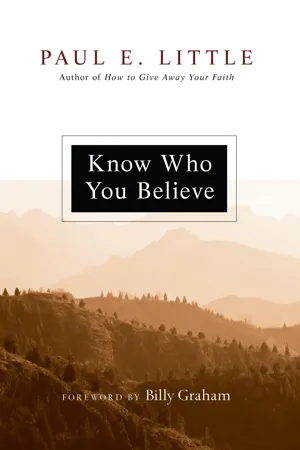
In writings lovingly collected and edited by his wife Marie after his death, Paul E. Little explores the central question of Christianity: can we know God? By looking at the identity of Jesus Christ, his claims regarding his identity and his promises to his followers and inquirers, we arrive at the wonderful conclusion of the Christian faith: through Jesus Christ we may know God personally.
- 142 pages
- English
- ePUB (mobile friendly)
- Available on iOS & Android
eBook - ePub
Know Who You Believe
About this book
Information
Topic
Theology & ReligionSubtopic
Christian Theology1
Inner Direction Needed
DOES A CAR NEED A DRIVER?
Without a clear description,
God would be little more to us than our
own construction or imagination.
Ask any ten people what makes a person a Christian and you’ll get ten different answers.” These words came out of my mouth unexpectedly at a dinner table where a group of friends, old and new, were relaxing over a third cup of coffee. The air was filled with lively conversation on an array of subjects. My wife and I knew the hosts well, but the others were new to us. Unexpectedly, one of the guests turned to me and asked what I was writing on. At that moment all I could think of to describe the ideas for this book was the above statement.
My new friend nodded his head with genuine sincerity, saying, “I’d be interested in having it boiled down for my thinking, too.” As we talked, he soberly posed some stimulating questions about God and faith and how we acquire these ideas. We met again later and it was evident he was starting on a quest to sort out the true from the false.
Without overdoing it, here is a sampling of definitions I’ve heard in fraternities, university halls and other places as I’ve traveled with InterVarsity Christian Fellowship. Some ideas may have a grain of truth; others give a far-from-accurate picture. I’ve heard a Christian is
- a Gentile: anyone not Jewish or an adherent of one of the world’s major religions
- someone who was born and raised in a Christian home or country, or who inherited their faith
- a person who goes to church
- someone who practices rituals such as baptism, Communion or Bible reading
- one who follows the Golden Rule and leads a moral life
- a person who abstains from specific external, so-called worldly practices
- someone who gives casual intellectual assent to a certain list of beliefs
Would an atheist like Richard Dawkins want to be called a Christian? Can faith be passed on through childbirth? Does going into a garage make you a car? Activities such as baptism, Communion and Bible reading may have value, but is the allwise, personal God in the picture? Does merely following the teachings of Jesus give us a one-on-one connection with him? And how does an emphasis on negatives fit in with Jesus Christ’s message: “I have come that they may have life, and have it to the full” (John 10:10)? Similarly, a person might say “Oh yes, I believe all that I heard in church,” but is belief nothing more than a tentative list of ideas without a personal interchange or connection between the individual and God?
Other ideas may come to our minds, but they further emphasize the importance of providing a clear answer to our beginning question:What makes a person a Christian? Some time ago I gave a talk at Queens University in Kingston, Ontario, on the reasonableness of Christianity. At the end, I opened the floor for discussion. A heavily bearded graduate student stood up, took his pipe out of his mouth, and asked, “Why do you Christians bother?” I was riveted by the young man’s honesty, and his underlying complaint of irrelevance went far beyond his words.
Christians “bother” because truth is at stake. None of the definitions above gives the full picture of the Christian message. Our understanding of the truth determines what we believe and trust. Coming to know the truth could be like the difference between being in a dark room and suddenly finding a light. It does matter what we think of God and Jesus Christ.
To illumine our thinking, these pages will lay out the bottom-line truths on which the Christian faith rests. The focus will be on the basics. What defines an authentic, inside Christian—not a superficial, casual type? We’ll avoid discussing liturgical differences or minor doctrinal spin-offs and concentrate instead on the essentials, using the Bible as our truth source. We will find that the Bible spells out the extraordinary impact of Jesus’ life, teaching and identity. Who he was will naturally be the hub of this “Christian story.”
INNER DIRECTION NEEDED
Our first bottom-line truth is that we need direction. Jesus himself advanced this idea to a group of highly religious people of his day. He saw the lives of some well-meaning people entirely absorbed with ceremonial rules and practices. They had strict procedures for washing their hands, the proper utensils to use, the kind of food to eat and other endless rituals. Jesus told them: “Can’t you see that the food you put into your body cannot defile you? Food doesn’t go into your heart, but only passes through the stomach and then goes into the sewer” (Mark 7:18-19 NLT). He went on to say it’s what comes out of our hearts that matters. Who we are on the inside was of utmost importance to him. I think you would agree it is to us, also.
It’s interesting to note that Jesus discussed thoughts and actions in almost the same breath. He spoke of hatred and murder as equally culpable and told people that questions are posed by the inner heart that senses a need for help. Poet John Donne echoed that thought:
How little of a man is his heart
Yet it is all by which man is.1
Who of us hasn’t had inner churning, wishing someone would listen to us, or even wondered if friends or family or anyone around us is trustworthy? What do God and Jesus Christ have to do with my everyday life? Does it matter what choices I make, what friends I hang out with, what career I follow? Can I really, personally connect with God and Jesus Christ for certain in my inner self? In his song “Is Anybody There?” singer John Hiatt strikes a chord of truth:
Well, I’m out here on my own
Followin’ a star
Asking on my knees, for some direction, please
And, God, You know that’s hard.2
Such petitions germinate from the inner soul. St. Augustine called it a “God-shaped vacuum that only God can fill.” In his heart Hiatt knew he needed help. Life was not going the way he felt it should, and something inside drove him to turn to God for an answer. If God doesn’t care, who does? Hiatt got down on his knees and poured out his heart to God through Jesus Christ.
Asking questions defines us as humans; it’s the natural thing to do. We feel we need help from someone outside of ourselves. Some of us may have gone to a church or looked at the Bible hoping for answers, but too often, seeking God and praying become our last and feeblest resort.
Let me assure you, there is hope. From the beginning pages of the Bible, God reached out to the people he created. He desired a “family” relationship. Throughout the Bible we see God directing, guiding, encouraging people to be in close relationship with him. At one point, God calls out to the first couple, “Where are you?” (Genesis 3:9). God didn’t want to be separated. Likewise, he calls to every one of us whom he created. “Come to me . . . and I will give you rest” (Matthew 11:28).
DOES A CAR NEED A DRIVER?
Imagine for a moment you are going into a car dealership and checking out a new car. The technical brilliance and the shining exterior of a new car are hard to resist. The latest model blows your mind with all the add-ons. But this enticing new machine has one unalterable deficiency. It will function only if it has an intelligent driver behind the wheel. Without a driver, an automobile is a mere museum piece. If you shoved one of these cars down a steep hill without a driver, it would careen and reel downward, wreaking damage along the way, and finally crash.
Similarly, we human beings function best when we get our cues from God. We were made to be directed and led in life’s path in close connection with our Maker. Unfortunately, each of us has individually shoved God out of the driver’s seat of our lives.
From early childhood, the knee-jerk reaction we follow is “I’ll do it myself.” We live our lives with this same kind of independence. “Don’t drive me, God, I’ll drive myself.” We continue to ratify this decision and handle our lives without reference to God. Trying to live life without God, our incredibly wise Creator, is really as silly as holding our breath because we’re upset that we need air to breathe! Cutting ourselves off from the one available Source of divine, nurturing power is like a tree cutting off its roots. A car needs a driver; a tree needs roots; we need air!
Author Martyn Lloyd-Jones quotes the European psychiatrist Carl Gustav Jung unexpectedly agreeing that we all need God:
Those psychiatrists who are not superficial have come to the conclusion that the vast neurotic misery of the world could be termed a neurosis of emptiness. Men cut themselves from the root of their being, from God, and then life turns empty, inane, meaningless, without purpose, so when God goes, goal goes, when goal goes, meaning goes, when meaning goes, value goes, and life turns dead in our hands.3
When God, “the root of our being,” takes the wheel of our car, starts the engine, revs the motor, steers it in the right direction, and feeds us the right amount of...
Table of contents
- Cover
- Title Page
- Contents
- Foreword by James Nyquist
- Foreword by Billy Graham
- Preface
- 1 Inner Direction Needed
- 2 Jesus Christ, the Centerpiece
- 3 Alone on the Stage of History
- 4 Love and Justice Meet
- 5 He’s Alive
- 6 Jesus Christ, a Valid Object
- 7 Making the Magnificent Connection
- 8 God Uses Words
- 9 Biblically Correct Angels
- 10 “That’s Your Truth, Not Mine”
- 11 It’s Hard to Be an Atheist
- 12 Staying Power for the Journey
- Appendix
- Notes
- Praise for Know Who You Believe
- About the Author
- More Titles from InterVarsity Press
- Copyright
Trusted by 375,005 students
Access to over 1.5 million titles for a fair monthly price.
Study more efficiently using our study tools.
Frequently asked questions
Yes, you can cancel anytime from the Subscription tab in your account settings on the Perlego website. Your subscription will stay active until the end of your current billing period. Learn how to cancel your subscription
No, books cannot be downloaded as external files, such as PDFs, for use outside of Perlego. However, you can download books within the Perlego app for offline reading on mobile or tablet. Learn how to download books offline
Perlego offers two plans: Essential and Complete
- Essential is ideal for learners and professionals who enjoy exploring a wide range of subjects. Access the Essential Library with 800,000+ trusted titles and best-sellers across business, personal growth, and the humanities. Includes unlimited reading time and Standard Read Aloud voice.
- Complete: Perfect for advanced learners and researchers needing full, unrestricted access. Unlock 1.5M+ books across hundreds of subjects, including academic and specialized titles. The Complete Plan also includes advanced features like Premium Read Aloud and Research Assistant.
We are an online textbook subscription service, where you can get access to an entire online library for less than the price of a single book per month. With over 1.5 million books across 990+ topics, we’ve got you covered! Learn about our mission
Look out for the read-aloud symbol on your next book to see if you can listen to it. The read-aloud tool reads text aloud for you, highlighting the text as it is being read. You can pause it, speed it up and slow it down. Learn more about Read Aloud
Yes! You can use the Perlego app on both iOS and Android devices to read anytime, anywhere — even offline. Perfect for commutes or when you’re on the go.
Please note we cannot support devices running on iOS 13 and Android 7 or earlier. Learn more about using the app
Please note we cannot support devices running on iOS 13 and Android 7 or earlier. Learn more about using the app
Yes, you can access Know Who You Believe by Paul E. Little in PDF and/or ePUB format, as well as other popular books in Theology & Religion & Christian Theology. We have over 1.5 million books available in our catalogue for you to explore.