![]()
1
I must have slept weird, folks. My backstory is killing me.
When the house burns down, so to speak, there’s no guarantee that anybody will stick around to help sweep up. This is not the dominant narrative I’d been raised to believe in. Sure, Lucy and Ricky could end up divorced—the twin beds were a clue, in hindsight, and he was such a fascist about kicking her out of his stupid nightclub act—but you figure Lucy would always have Ethel Mertz. In my moment of sudden destruction, I learned the very hard way that reinforcements would not be coming. When I lost everything—my Ricky, my Fred and Ethel, the nightclub and band, even the gig on the chocolate-factory assembly line—I found out the sheltering trees above me were gone, and I was on my own.
It’s Opening Day in Crooked Path! Looks like another beautiful season of head games, everybody.
I almost drove the car off the road when I saw the caller’s name appear on my phone: Frank Delaney. I’d met the Irish writer maybe a year or two earlier, through work, and we’d hit it off, but I never would have expected him to call me up again out of the blue. Frank was a novelist and BBC journalist, and smooth—indeed, he’d been called “the most eloquent man in the world” by NPR—but I was struck again by how kind he was, how genuine, how compassionate. After we’d met just that one time, he’d sent along a gift for my little boy: a copy of Kaufman’s Field Guide to Butterflies of North America.
Frank had a sharp eye and a storyteller’s ear. He had interviewed thousands of people in his decades in broadcasting, everyone from Prince Charles to Alan Greenspan, and that expertise revealed itself: somehow in our short time together, over a day or two, he’d gotten my whole story out of me. I still don’t know how he did it, how he ever perceived so much, so fast.
“How are you?” he asked me. “Are you all right? I hope by now you’ve stopped pushing people away.”
I pulled the car off the road into an empty church parking lot. “I’m trying, Frank,” I said. “Thanks for asking.”
“What days are the hardest for you?” he asked.
“Sundays.”
“So I’ll tell you what you do on Sundays: French lessons. Dance lessons. Piano lessons. Immerse yourself in the deep pleasures of Latin and Greek. Sign yourself up for something every hour. Fill your days.”
“Okay,” I said. “Thank you.”
“It will get easier with time,” Frank said.
“All right.”
“How’s your son now?” he asked.
“You’re so kind to ask. He’s eight already, if you can believe it.” I could hear my voice was shaky. “We’re trying. We’ll be okay.”
“When you have no one to put their arms around you, you must put your arms around yourself,” Frank Delaney said. “Will you do that?”
“I’ll try, Frank,” I said.
But I didn’t know how.
I’m looking for something shiny to show you in this garbage pile, loons. Maybe a bit of sea glass. I’m trying.
I can remember one day, during this period, hanging around at my job with nothing in particular to do. I worked as a writer and editor for a publishing house that had been started decades earlier by academics, and our beloved locally owned firm had recently been bought by a foreign company to be stripped down for parts. Four hundred or so of my colleagues had been let go. The handful of us who were allowed to stay on a little longer had a few projects to finish up here and there, if we cared to, and we did. We wanted to at least complete the work we’d started. Our lease wasn’t quite up yet, so we stuck around, a few loose marbles rattling in an otherwise empty building. Desks and chairs were stacked floor to ceiling, and boxes of unwanted papers had been dumped in darkened conference rooms.
I went wandering the halls looking for coffee in the break room one day and ran into one of the guys from the new parent company. We both stood there silently waiting for the coffee to finish brewing until, finally, he cleared his throat.
“You know, usually when we go into an organization like this to clean it out, we start looking into the business and find out the place was a disaster, bleeding money,” he said. “Mismanaged, driven into the ground. But this place”—he shook his head—“this was an American tragedy. It was a beautiful organization. Very, very well run. Solid margins. People cared. I mean, they really cared.” He sounded surprised. I didn’t give him the satisfaction of telling him he was right. It had been a beautiful organization. Of course we had cared. I held his gaze in silence until he turned and left the room.
The few of us who’d been lucky enough to have been kept around for a bit knew it wouldn’t last. We all had to find new jobs. Most of our clients had split as soon as they saw the ship taking on water, and the little bit of work that was left for us didn’t fill the whole day. In the meantime, we kept turning up every morning, mostly to have someplace to go.
“Show me how to set up an account on social media,” I said to my work pal Naomi one day, in boredom. I was lying down on the desk in her office, staring at the ceiling. “I’ve never been on there. I feel like I’m missing out.”
“You’re not missing anything,” she said. “It’s all the people you haven’t seen since high school posting pictures of their kids. Lot of libertarians with government jobs complaining about paying their taxes, for some reason.”
“I wouldn’t mind seeing what people are up to,” I said. “As long as they can’t see me.”
“If you’re out there, they can see you,” she said. “It’s reciprocal. That’s the whole point. It’s why they call it social media.”
“And yet somehow I’m feeling like this is not the time for me to establish a public presence out amongst the people,” I said, waving my hand in the direction of the hallway, by which I meant the street outside, our town, the world. She nodded.
Naomi knew enough of the salient details of my story that she supported my intuition not to start posting anything personal online at that very moment. She and I had both learned the hard way that family court judges and divorce attorneys are not typically the first to leap forth in an embrace of harmless good fun.
“Could you set up an account for me so I’m anonymous?” I asked.
“Anonymous?” she said. “You mean fake?”
“No. I can’t lie. I certainly don’t want to trick anybody,” I said. “I’m thinking it could be obviously fictional. I’ll use a pseudonym. I won’t even post. I’ll just listen in on what everyone else is saying.”
“What’s your pen name?” she said.
I thought about it. “You know that classic parlor game that lets you figure out your drag queen name? You take the name of the first pet you ever had as your first name and your mother’s maiden name as your last name.”
“I thought it was your first gym teacher’s name and the name of the street you grew up on.”
“That’s a perversion of the form in my opinion, but yes. That’s pretty much it.”
“You can’t use your own mother’s maiden name,” she said. “People who know you might recognize it.”
“Good point. I won’t use my own. What’s your mother’s maiden name?”
“Didion.”
“Derivative,” I snorted.
“Too bad. I’m not letting you use my mother’s real maiden name. Keep looking.”
“Fine. I’ll tell you the funniest one I ever heard,” I said. “A dear old friend of mine: his first dog was a black Lab named Duchess, and his mother’s maiden name was Goldblatt.”
“Duchess Goldblatt.”
“I’ve always loved it. It’s so fun to say. And it sounds made-up, so I think people would take the hint right away that this is not a real person.”
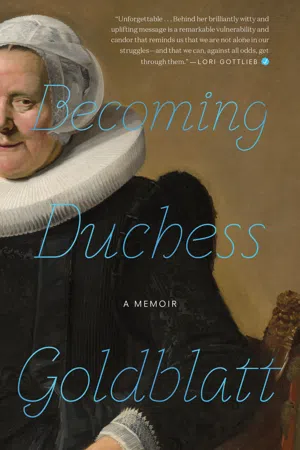
“All right, so then you’ll need a picture to go with the name.”
I liked the idea of a person who was real but not real, so I searched on the term “funny elderly lady.”
“These are all the wrong vibe. They’re so corny,” I said. “I want people to get a visual cue right away that this is a fictional character.”
I changed the search terms to “elderly lady.”
One of the first images to come up then was an oil painting from the Dutch Golden Age. The notes that accompanied the image told me it was a 1633 painting by Frans Hals, titled Portrait of an Elderly Lady, and was included in the collection of the National Gallery in Washington.
The subject is shown in formal seventeenth-century dress: a black gown, a stiff wire-backed ruff at her neck, a modest white cap covering wispy hair, and her hand clutching a book, suggesting she had some education. Her mouth is closed, but she’s smiling gently. You can see there’s a twinkle in her eye, a slight sauciness in her gaze, that shows she had a sly wit. She would have been a woman of some means. At first glance I thought she looked about eighty years old, with her wrinkles and her matronly form, all buttoned-up seventeenth-century business, but the notes told me that the woman had been approximately sixty when she sat for the painting. Her real name has been lost to history, but her portrait is believed to have been a companion to a second portrait, most likely that of her husband.
I fell in love with her.
“She’s perfect. That’s her,” I said. “Look at her cute little face. She looks like she has a sense of humor. That’s Duchess Goldblatt.”
“She’s great,” Naomi said. “But once you start making connections, people will see who you’re friends with and figure out it’s you in five minutes. Is it critical that you stay anonymous?”
I considered this. I’d recently borrowed thousands of dollars for a divorce attorney. She liked to cup her hands into a pretend megaphone to help her scream at me louder. (“Wake up and smell the coffee!” she’d shout at me. “Stop being an idiot!”) I’d sold my jewelry. I’d taken in a boarder.
Strangers were scrutinizing and questioning my bank account statements, credit card statements, tax returns, receipts, decisions, choices, motives, integrity, and heart. I’d lost my family, my dear ones, my livelihood, and was about to lose my home.
Friends, even friends I’d had since childhood, had turned tail and disappeared. My husband’s friends and relations slipped away from me during the split, even the ones I’d thought were genuinely attached to me, but so, too, did many of my own circle: my friends, my dear ones, the people my grandmother would have called my girlfriends. Some of my friends hadn’t been wild about my choice of husband to begin with, but now they were furious at me for letting my life fall into such a shambles. How could I have been so careless? Men can be careless, not women. Women have to hold the world steady, or the whole operation will spin right off its axis.
(“Are you sure you want to do this?” one of them asked me on my wedding day.
“Yes, of course I want to get married,” I’d said.
She rolled her eyes and snorted. “You’re not getting married, though, right, as much as you’re becoming the single mother of a seven-year-old boy.” She thought I was signing up for a lifelong burden instead of a partner. I laughed. I repeated that story for years afterwards. I thought she was joking. It’s possible, in hindsight, that I’ve never understood anything.)
I’d had very small hopes for my life. I hoped to be married and I hoped to have a child, just one child—to be an only child was my own lifelong dream; I’d always thought siblings were about the worst thing you could ever do to a kid. Being married meant everything. It meant I would have safely navigated childhood and set down an anchor in a safe harbor: a family, a home, another person who was willingly tethered to me.
I tried to express this in a letter of gratitude and joy I wrote to all the friends who came to a big milestone birthday party for me. So what if I’d thrown the party for myself? I didn’t mind. I’d never had one before. I’d thrown a baby shower for myself when I was pregnant, too, when it became clear no one else was going to do it for me. And it’s still a party if you throw it for yourself, isn’t it? Nobody gets everything they want in life. Lucy never got to be in the nightclub act. Ethel deserved better than Fred. Sure, Lucy and Ethel got fired from the candy factory, but it was a terrible job anyway.
Did we have a happy marriage? I thought so. My ex-husband says we didn’t. I guess that difference in perspective tells you all you need to know. I do remember being floored when he told me he wanted a divorce. We had moved into a huge new house only a few weeks before. The boxes weren’t even unpacked. All I could say was “Why?” The rug had been pulled out from under me, and beneath that the floorboards, and beneath that the foundation, and the ground, the earth itself, even the 5,000-degree ball of iron and nickel at its core was a little shaky.
The reason he gave me was that I’d spent too much money on a new couch.
“Can’t you return the couch?” my mother-in-law said to me on the phone, sobbing.
“I could return it,” I said. “But I don’t think it’s the couch.”
“He told us you went ahead and bought a couch he didn’t want,” she said.
“He was with me. We bought it together.”
“Just return the couch. He doesn’t like it,” she said.
“Okay, I’m hearing you say that,” I said. “I’m thinking it’s something else besides the couch.”
People tried really hard to stay neutral and remain friendly with both of us, but that wasn’t going to be allowed. My husband wanted a clean break: nothing to do with me or with anyone who continued to be friendly with me. Everyone had to choose. People started to peel away from this whole sorry mess one by one, two by two. (It can’t be about the couch! Who gets divorced over a couch? And they just bought the new house! He was always devoted to her. She must have done something but he’s not saying what.)
“You’re overhoused,” my attorney said. “Sell the house.”
“I understand, but we just moved in,” I said. “I can’t uproot my son again, move him again.”
“Sure you can. What did you need such a big house for, anyway?”
“My husband has a huge family,” I said. “We thought we’d have big Thanksgiving dinners and Christmas parties, lots of people over all the time. Last Christmas there were s...